Railroad Track Maintenance: The Complete Guide to Track Maintenance of Way in 2026
A track does not become unsafe in one step. It drifts, and the drift is measurable long before it becomes visible. The job of maintenance of way is to decide what condition the track is supposed to be in, measure how far it has drifted from that condition, and intervene before the drift turns into a failure.
Direct answer
Track maintenance of way — the permanent way — is the discipline of holding a railway in a defined, measured condition. It covers five layers from subgrade to rail head, and every interval is set by whichever clock runs faster: the tonnage clock or the calendar clock.
That framing sounds abstract until you compare it with how maintenance is often actually run. In many organisations the work is triggered by what someone noticed, funded by whatever budget survived the last round of cuts, and scheduled into whatever possession happened to be available. The parts all move, the gangs are busy, and the track still gets worse. Nothing in that cycle is a measurement decision, so nothing in it can be planned.
This guide sets out how maintenance of way is structured when it is run as a measurement discipline: what it covers and what it does not, the two clocks that set every interval, the four defect families and the intervention each one actually needs, the measurement chain that has to stay unbroken, why the possession rather than the budget is the real constraint, and how a railway moves from a reactive programme to a planned one without pretending it already has the baseline that a planned programme requires.
What Railroad Track Maintenance Covers — and What It Does Not
Maintenance of way is the permanent way: everything that carries the wheel and holds the two rails the right distance apart. Concretely, five layers.
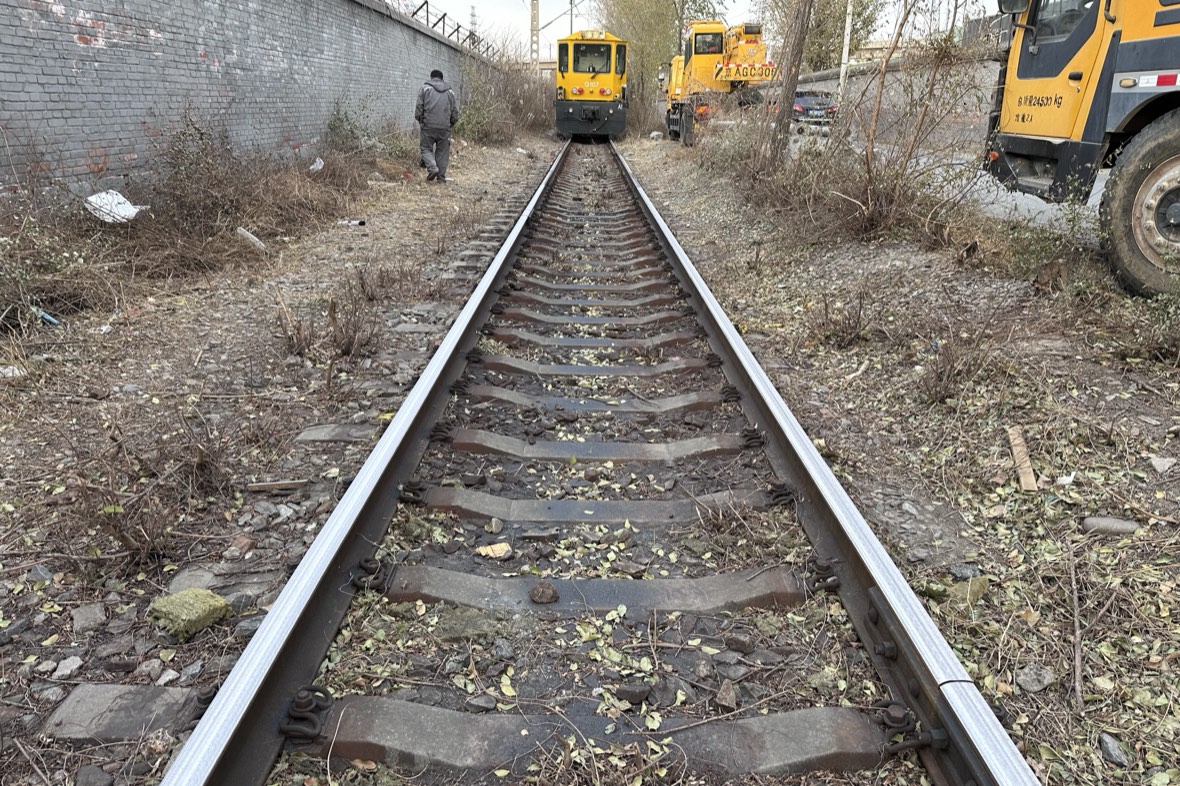
The rail itself — the running surface and the section beneath it. Rail sections in mainline use run from 60 kg/m upward, with 75 kg/m on heavy-haul lines; the steel grade matters as much as the section, since a standard carbon-manganese grade and a chromium-vanadium wear-resistant grade behave differently under the same grinding pass. Why the section has become more standardised over time is its own story, and the reason 50 kg/m is being retired from new work is instructive: wheel treads have adapted to the 60N profile, so a lighter rail head wears into a lip rather than a profile. That is a maintenance consequence of a procurement decision made decades earlier.
The ties, which hold gauge and transmit load into the ballast; the fastenings, which hold the rail to the tie and fail in two characteristic ways — corrosion and bolt loosening; the ballast, which provides drainage, load distribution and the ability to be re-tamped back into geometry; and the subgrade and drainage, which decide whether the ballast can do its job at all.
Add the special trackwork — turnouts, crossings, expansion joints — and you have the full scope. What is not in scope is equally important: signalling and train control, structures such as bridges and tunnels, overhead line equipment, and rolling stock. This boundary is not pedantry. It is where accountability lives. A geometry problem that originates in a failing bridge deck is a structures problem that tamping will chase forever; a wheel-rail contact problem that originates in a badly profiled wheel is a fleet problem that grinding cannot fix. Knowing which layer owns a symptom is the first skill in maintenance of way, and the most common source of wasted possessions is a gang working confidently on the wrong layer.
The full anatomy of what sits between the rails and beneath them is covered in our guide to what railroad tracks are made of, and the reason ballast is shaped and sized the way it is gets its own treatment in why there are crushed stones beneath conventional track.
The Two Clocks That Set Every Maintenance Interval
Almost every argument about how often to maintain a track reduces to a disagreement about which clock to read. There are two, and they do not run at the same rate.
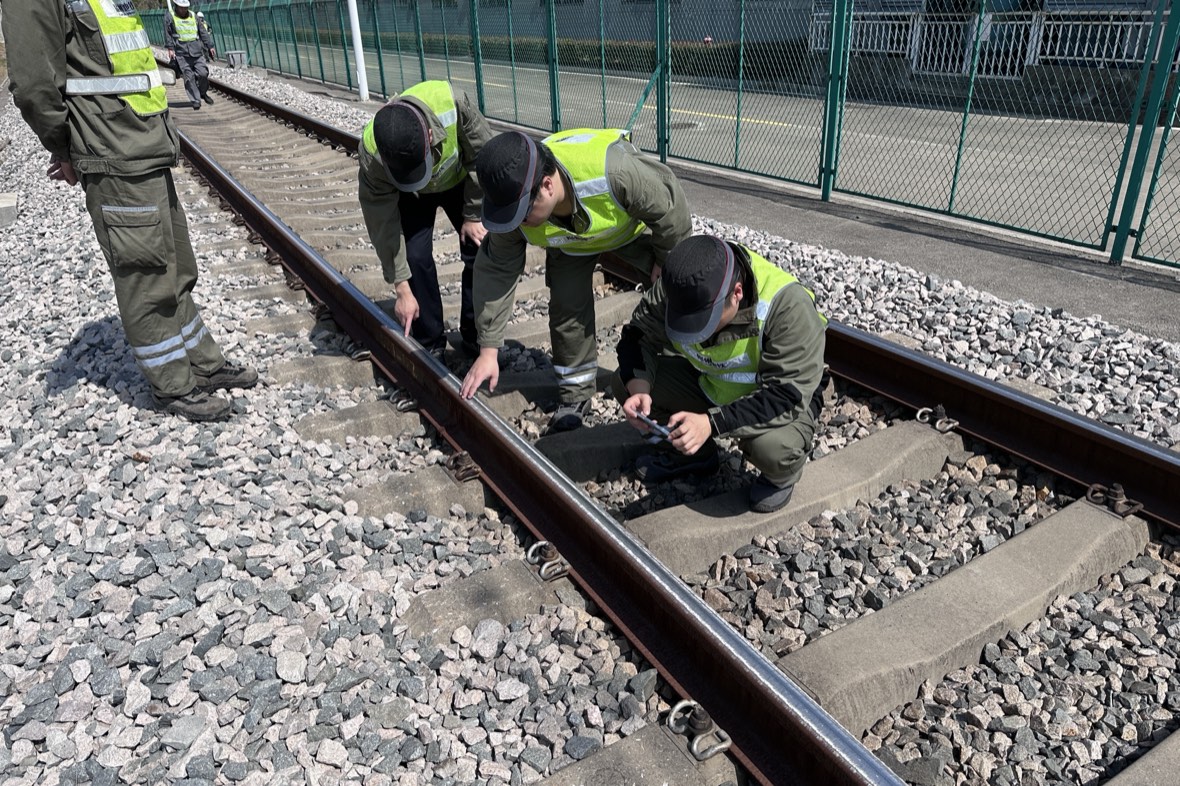
The tonnage clock is driven by traffic. Load passes over a defect and makes it worse; the more load, the faster. This clock accelerates with traffic and is measured in millions of gross tonnes. It dominates on heavy-haul lines, where the axle loads are high and the tonnage accumulates quickly, and it is why a mining railway and a commuter line of the same length need completely different intervals.
The calendar clock is driven by environment. Freeze-thaw cycles open and close the subgrade; drainage that works in summer fails in a wet winter; vegetation and ballast fouling accumulate whether or not a single train passes. This clock is measured in seasons and is almost entirely independent of traffic. It dominates on low-density lines, where tonnage is trivial but the ground still moves.
| Clock | What drives it | Measured in | Dominates on | What it forces into the plan |
|---|---|---|---|---|
| Tonnage | Load passing over the defect | Millions of gross tonnes | Heavy-haul and busy mainline | Interval written in tonnes; curves and gradients shorten it |
| Calendar | Environment — freeze-thaw, drainage, ballast fouling | Seasons | Low-density lines | Interval written in months; tonnage barely moves it |
Here is the practical consequence, and it is the single most useful idea in this guide: the interval for a given section should be set by whichever clock runs faster at that location. A programme that applies one corporate interval across a network is therefore wrong by construction — it will over-maintain the sections where the calendar clock is slow and under-maintain the sections where the tonnage clock is fast. The error is not random. It is systematically biased toward the average, which means it is systematically biased against the extreme sections, and the extreme sections are exactly the ones that fail.
There is a third effect that catches people out. The two clocks do not merely add. Tonnage that arrives on a track whose ballast is already fouled produces deterioration faster than the same tonnage on a clean track, because the load path has lost its ability to distribute. The clocks interact, which is why condition data beats both of them — and why a purely tonnage-based interval, popular as it is, is only an approximation of the truth.
How tonnage interacts with maintenance on the most demanding networks is set out in our guide to mining and heavy-haul rail grinding, where the tonnage clock dominates to the near-exclusion of everything else.
The Four Defect Families and the Intervention Each One Needs
Defect lists in textbooks run to dozens of entries. For maintenance planning, four families are enough — because within a family, the same measurement detects the problem and the same intervention removes it. Across families, neither is true. Mixing them is how a possession gets spent twice on the same section.
| Family | What it is | Measured by | Removed by | Cannot be fixed by |
|---|---|---|---|---|
| Track geometry | Gauge, cross-level, twist, alignment and longitudinal level drifting out of tolerance | Track geometry recording, or manual measurement of gauge and level | Tamping, lining, tie replacement | Grinding, welding |
| Rail cross-section and surface | Corrugation, profile deviation, side wear, flow and lip, surface damage | Corrugation depth and wavelength, profile traces against the design profile | Profile and corrective grinding | Tamping, ballast work |
| Rail internal integrity | Transverse and longitudinal flaws, bolt-hole cracks, weld defects | Ultrasonic inspection | Replacement, weld repair | Grinding, tamping |
| Ballast and subgrade | Fouling, poor drainage, pumping, loss of support | Ballast condition, drainage survey, and the rate at which geometry returns after tamping | Ballast cleaning, drainage works, renewal | Grinding, and tamping beyond a point |
Two entries in that table deserve emphasis because they are where most money is wasted.
Grinding cannot fix support. A track that cannot hold its geometry will return to the same bad geometry within weeks of being tamped, and grinding the rail will make the surface look better without changing the mechanism. The tell is the pattern: if the defect repeats at tie spacing, the problem is below the rail, and adding grinding passes is treating a symptom. This is the most expensive mistake in the whole discipline, because it consumes both the grinding budget and the rail section while the cause survives.
Tamping cannot fix a profile. A correct geometry with a wrong rail cross-section still produces bad dynamic behaviour, because the wheel does not run where the designer intended. The surface symptom is often reported as "rough riding" and the automatic response is to tamp; the actual fix is to restore the profile.
The rail surface family deserves a specific note on acceptance, because it is the only family where the result is invisible from the operator's seat. Acceptance is not a visual judgement. It is a set of measurements: profile held inside tolerance, surface finish within the specified roughness, no continuous blueing from heat damage, and total depth into the parent metal inside the permitted limit. The full acceptance apparatus, including how to verify a grinding result, is in our guide to grinding acceptance standards.
The Measurement Chain: Six Links, and the Cost of a Missing One
Maintenance of way runs on a chain of six links. Every functioning programme has all six; every struggling programme is missing at least one, and the missing link is usually not the one being discussed.
Inspect → measure → plan → execute → accept → record.
| Missing link | What it looks like in practice | What it costs |
|---|---|---|
| Inspect | Work is triggered by complaints, ride quality reports or visible damage | The programme addresses the loudest section rather than the worst one |
| Measure | The intervention is judged by eye and by the operator's feel | Depth and profile become a matter of opinion, so results cannot be compared |
| Plan | The possession is filled with whatever work is nearby and urgent | Machine and crew time is spent on low-value work while high-value work waits |
| Execute | — (this link is rarely the weak one) | — |
| Accept | The section is handed back without a measurement record | Rework is discovered months later, in service, and paid for twice |
| Record | No consistent archive of pre- and post-work condition | The next plan starts from zero, so the programme never learns |
The last link is the one that separates a mature programme from a busy one, and it is the cheapest to fix. Recording is not administration; it is the only mechanism by which a railway discovers its own defect growth rates. Without it, every interval must be imported from someone else's network, and someone else's network has different traffic, different drainage and different steel.
There is a second-order cost to a broken chain that rarely appears in any budget: the possession itself. A grinding job that cannot be accepted on the night has to be re-entered, and the second entry costs a whole window for work that was nearly finished. Measuring before handing back is far cheaper than measuring in service.
Why the Possession Is the Real Currency of Track Maintenance
Ask a maintenance manager what constrains the programme and the answer is usually money. It is almost never money. Budgets can be reallocated, argued upward, or moved between years. Track time cannot be created. The number of hours in which a section can be closed is fixed by the traffic timetable, and on a busy line it is the scarcest resource in the entire operation.
Once possession is understood as the currency, several familiar problems resolve into one.
Fragmenting work raises its unit cost. Every entry carries a fixed overhead: travelling to site, setting up protection, commissioning plant, standing the crew down, handing back. A single long window amortises that overhead across hours of work; six short windows pay it six times for the same output. Networks that schedule many small interventions often believe they are being responsive. They are paying a fragmentation premium and calling it flexibility.
The cheapest quote per kilometre may be the most expensive contract. A price per kilometre says nothing about how much track time the contractor needs to deliver it. Two suppliers quoting the same rate, one needing twice the windows, are not offering the same product. The contract that looks cheaper per unit of work can be significantly dearer per hour of possession — and possession is the thing that is actually in short supply. This is why any serious comparison has to put possession hours next to price, and why our guide to rail grinding cost per kilometre treats window utilisation as a first-order cost driver rather than a footnote.
The value of a machine is measured in possession efficiency, not in headline capability. A higher-capability unit that needs longer to mobilise or cannot work within the available window delivers less than a simpler unit that fits the window exactly. This is the argument behind choosing a rail grinder for your track: the machine has to match the possession, not the brochure.
Three Ways to Buy Maintenance, and What Each One Costs
Maintenance work can be bought three ways, and they differ in what triggers the work and therefore in what the buyer can control.
| Reactive (corrective) | Cyclic (planned) | Condition-based | |
|---|---|---|---|
| Triggered by | A defect that has already reached a limit | The calendar or a tonnage count | A measurement that predicts a limit being reached |
| Data needed | Almost none | A traffic or calendar record | A baseline and repeatable measurement |
| Strength | Costs nothing until something breaks | Predictable budget and resource profile | Spends work where it is needed and nowhere else |
| Weakness | Each event is a surprise, and each surprise is bought at the worst price | Blind to actual condition, so it over-works some sections and under-works others | Requires discipline that most organisations underestimate |
| Failure mode | Chronic under-maintenance disguised as cost control | Complacency: the interval is met, so nobody asks whether it was right | Abandoned after year one because the baseline was never properly built |
The progression in the table is not a maturity ladder to be climbed for its own sake. A network with almost no traffic may rationally run a reactive programme for some asset families; a heavy-haul line may rationally run a fixed tonnage interval because its clock is so dominant that condition measurement adds little. The point is to choose deliberately rather than to drift into whichever mode the organisation's habits produce.
What is not defensible is a programme that believes it is planned while actually being reactive. The signature is a budget line that gets consumed by unplanned events before the planned work is reached — so the planned work is deferred, which generates more unplanned events next year. Many railways are in this loop and describe it as "firefighting", which is accurate but treats it as a personality trait rather than a structural problem.
Why Deferred Work Costs More Than the Work Itself
The intuitive case for preventive work is that catching a defect early is cheaper. The real case is stronger and less intuitive: deferred work does not merely cost more later, it changes the kind of work required.
A surface defect that is caught while shallow can be removed by a light grinding pass that removes a fraction of a millimetre and leaves the rail's section almost untouched. The same defect, left for a year, has to be chased down to its root — which means a deeper cut, more passes, more wheel consumption and, critically, a permanent reduction in the rail's remaining section. The rail is now a smaller rail for the rest of its life. Every subsequent grinding decision has less room to move.
The same logic applies in the other families with different currencies. Geometry deferred converts a tamping job into a ballast job. Ballast deferred converts a cleaning job into a renewal. Internal flaws deferred convert a planned replacement into an emergency one, bought at emergency prices inside a disrupted timetable. In each case the deferred option is not the same work performed later at higher cost; it is a different, larger class of work.
There is a second, subtler penalty. Deferred work compresses into the same possession calendar as the planned work, so the programme's own downstream years become unachievable. A railway that defers a year of grinding has not saved a year of grinding; it has created a year in which twice the grinding is needed and only the original time is available. This is why deferral tends to be followed not by recovery but by a permanent lowering of the standard the track is held to.
Moving From Reactive to Planned: the Baseline Problem
Every organisation that decides to become planned runs into the same wall, and it is not a resource wall. It is the absence of a baseline.
You cannot write an interval against a condition you have never measured. You cannot tell whether last year's programme worked if you have no comparable record of what the track looked like before it. So the first year of a planned programme is not a year of planning; it is a year of establishing measurement, and organisations that skip this step spend the following years arguing about whether their intervals are right, with no data capable of settling the argument.
The sequence that works has four steps, in order.
Fix the measurement method and the measurement locations. Same instrument, same positions along the track, same conditions of measurement, recorded the same way. It matters less which method is chosen than that it is chosen once and repeated. A rough measurement applied consistently every quarter beats a precise measurement applied differently each time.
Measure repeatedly before planning anything. The value is in the rate of change, not in the absolute value. A section at a moderate defect level that is deteriorating fast needs attention before a section at a worse level that is stable.
Set the interval against the faster clock, using the observed rate rather than an imported standard. The observed rate is specific to your traffic, your drainage, your steel and your climate, and it is not transferable.
Then change the contract language. This is the step that decides whether the programme survives. If the procurement still measures success in kilometres treated, the programme will revert to producing kilometres treated. The contract has to be written against condition and against possession efficiency, or the old incentives win.
For grinding specifically, the transition depends on teams being able to read the measurements they are now taking, which is a training question as much as a technical one — the tiering logic is set out in our guide to railway maintenance training.
How the Asset Layers Fail in Sequence
The five layers described at the start fail in a characteristic order, and the order explains a great deal of apparently inexplicable maintenance spend.
Water enters a failing subgrade or blocked drainage. The ballast becomes fouled and loses its ability to distribute load. Load concentrations reach the ties, which degrade — rot in timber, cracking in concrete — and lose their ability to hold gauge and offer. The fastenings then work loose or corrode as the tie no longer holds them properly. Finally the rail, now sitting on an uneven and poorly supported bed, develops surface and profile defects at an accelerated rate.
Read backwards, this chain is why grinding a track with bad support is futile, and why tamping a track with fouled ballast gives geometry that lasts weeks. Each intervention in the chain only holds if the layer beneath it is sound. The correct diagnostic question is therefore not "what is the defect?" but "how far down the chain does this defect originate?"
The chain also explains why some programmes appear to work and then stop working. Early grinding on a track with reasonable support produces visible improvement and lasts. The same programme on a track whose support has since deteriorated produces the same visible improvement and it disappears within a season. Nothing about the grinding changed; the layer beneath it did. Detecting that shift early requires the record discussed above — the same work producing a worse result is a signal about the asset, not about the work.
Measurement That Does Not Lie: Choosing Maintenance KPIs
Maintenance KPIs fail in a consistent way: they measure activity and call it outcome. Kilometres ground, tonnes of ballast placed, defects closed, possessions used — all of these are inputs, and all of them can be maximised while the track deteriorates.
Four measures resist that failure because each one has a denominator tied to the asset.
Defect recurrence rate — how often the same defect returns to the same location within a defined period. This is the single most informative number in maintenance, because it distinguishes a repair from a postponement. A grinding programme with a high recurrence rate is not fixing profiles; it is refreshing surfaces.
Possession utilisation — productive hours as a share of window hours. It exposes the fragmentation premium and makes the cost of many small interventions visible.
Cost per unit of life extension — spend divided by the service life actually gained, rather than spend divided by work done. It is harder to compute and far harder to game.
Unplanned intervention share — the proportion of the programme consumed by events that were not planned. This is the clearest available measure of whether a programme is actually planned. A railway claiming to run preventive maintenance while most of its possession hours are consumed by unplanned work is running reactive maintenance with a preventive budget.
The acceptance apparatus for rail surface work fits into the same logic, since an acceptance criterion that is not measured is not a criterion. What an acceptance check should contain is set out in the standards context of rail grinding services, contracts and acceptance.
How to Build a Railroad Track Maintenance Plan for Your Territory
The plan itself is less complicated than the politics around it. Six steps, in order.
1. Segment the territory by degradation driver. Not by administrative boundary and not by length. Group sections by which clock dominates and by what they are built from: heavy-haul tonnage sections, mixed-traffic mainline, low-density lines where the calendar governs, and special trackwork, which behaves unlike plain line and needs its own treatment.
2. Fix the measurement for each family and start taking it. One method per family, repeated on a defined cycle, at fixed locations, recorded in a form that allows comparison. Resist the temptation to improve the method in year one; consistency is worth more than precision.
3. Establish the current state as a baseline, and accept that it will be worse than expected. Almost every first baseline finds defects that were not in anyone's plan. This is normal and it is not a failure of the exercise; it is the reason the exercise is necessary.
4. Rank by rate of change and by consequence, not by severity alone. A moderate defect deteriorating quickly on a high-traffic section outranks a severe defect on a quiet siding. The ranking should be explicit and written down, because it will be challenged.
5. Write the intervals against the observed rates, and budget the possessions before the money. The possession calendar is decided first and the work fitted into it, not the reverse. A plan that cannot be delivered within the available track time is not a plan.
6. Attach a measurement to every work item before it is executed. Decide in advance how the result will be judged, and record it when the work is handed back. This is what converts a year of work into a baseline for the next year.
Two practical notes. First, the first plan should be deliberately smaller than the ambition — a plan that is met builds the credibility to expand, while a plan that is missed by half builds nothing. Second, special trackwork should not be folded into plain-line intervals. Turnouts and crossings concentrate load, contain components with different failure modes, and need their own measurement and their own windows; treating them as short pieces of plain line is a reliable way to under-maintain the most maintenance-hungry asset on the network.
The Discipline Is Measurement, Not Effort
Maintenance of way is unusual among engineering disciplines in that the effort is largely visible and the result largely is not. A gang that works a full possession looks, from every angle available on the night, exactly like a gang that worked a full possession well. The difference appears months later, in a measurement.
That is why the discipline is built the way it is. The two clocks tell you when. The four families tell you which intervention and which owner. The measurement chain tells you whether the programme is actually closed, or merely busy. The possession tells you what the real constraint is, and the KPIs tell you whether you are buying life or buying activity.
None of it requires more effort than an unplanned programme — it requires the effort to be aimed. A railway that measures first and works second spends the same possession hours as one that works first and measures never, and ends the year with a track that is measurably better rather than a track that has been touched a great deal.
If you are building or reviewing a maintenance plan and want the intervention side to be measurable, start with the part that decides whether a depth was achieved: the wheel on the machine. Our rail grinding solution sets out how wheels, machines and acceptance fit together, the rail maintenance solution covers the wider maintenance scope, and the rail inspection solution covers the measurement that makes any of it verifiable.
Where RailwayCare Fits
Our position in this discipline is specific, and it is worth stating plainly. We make the consumables, the machines and the measurement tools that maintenance of way runs on, and we train teams to use them — we are not a track maintenance contractor and we do not take on a network's maintenance programme.
Concretely: rail grinding wheels for grinding trains, turnout and portable machines, including light customization for non-standard heads; rail grinders and turnout grinders; rail inspection and measurement tools; track maintenance tools; and a tiered training programme for the people who run them. The programme structure is at grinding training, the machines at rail grinder, the wheels at rail grinding wheel, and the measurement side at rail inspection tools.
What we can contribute to a maintenance plan is the part most plans are weakest on: making the intervention measurable. A grinding programme whose wheel choice, machine match and acceptance criteria are consistent produces data; one where each is decided separately produces activity. The wheel is the variable that sets how much metal leaves the rail per pass, so it is also the variable that decides whether a planned depth was achieved or merely attempted — and that is why we quote a grade against a stated duty rather than as a standalone number.
If the constraint you recognise in that list is possession rather than budget, the conversation worth having is about making the intervention measurable. Send your line conditions, annual tonnage and target class to our engineering team and we will set out what the work would take — including, where it is the honest answer, that you should contract it rather than buy for it.
Frequently Asked Questions
What is the difference between track maintenance and track construction?
Construction changes the form of the asset; maintenance holds its condition. That difference drives everything else — how the work is priced, how it is procured, and how it is accepted. Construction is bought against a drawing and a bill of quantities, paid by quantity of work, and accepted by comparison with the design. Maintenance is bought against an observed condition and an interval, paid on a work basis, and accepted by measuring the resulting state. Applying a construction method to a maintenance scope, or the reverse, produces the mismatch that shows up as either unmeasurable maintenance or over-specified construction. The distinction is set out in more detail in our guide to railroad construction company scope and selection.
How often should track maintenance of way be carried out?
There is no defensible single answer, and a plan that offers one should be treated with suspicion. The interval is set by whichever of two clocks runs faster at that location: tonnage, which accelerates with traffic and dominates heavy-haul and busy mainline; or the calendar, which is driven by freeze-thaw, drainage and ballast fouling and dominates low-density lines. Within those two, the actual rate is specific to your steel, your support conditions and your climate, which is why the interval has to be derived from your own repeat measurements rather than imported from another network. The first year of a planned programme should be spent establishing those rates, not applying someone else's.
What are the best practices for railroad track maintenance?
The practices that consistently separate well-run programmes are unglamorous. Measure the same way at the same locations on the same cycle, so that the rate of change is visible. Match the intervention to the defect family rather than to the available machine — grinding does not fix support and tamping does not fix a profile. Budget the possession before the money, because track time is the binding constraint. Accept every job by measurement and record it. And rank work by rate of change and consequence rather than by severity alone, since the loudest defect is rarely the most urgent one.
Which defects can grinding fix, and which can it not?
Grinding removes material from the rail head, so it can fix anything that is defined by the shape and condition of that surface: corrugation, profile deviation, side wear, flow and lip, and shallow surface-initiated cracks. It cannot fix anything whose cause lies elsewhere. It cannot restore support, so a defect that repeats at tie spacing will come back. It cannot repair an internal flaw, which needs detection and replacement. It cannot correct gauge. And it cannot fix a profile problem that originates in the wheel rather than the rail — a fleet with badly profiled wheels will keep reproducing the defect that grinding removes. Knowing the boundary of the intervention is more valuable than knowing its capability.
How much track time does a maintenance programme need?
The honest answer is that the requirement should be derived from the work, not assumed — and that most programmes are constrained by possession long before they are constrained by money. Two calculations make the requirement visible. First, the productive hours a given scope needs, which depends on work rate per pass and the number of passes the defects require. Second, the overhead each entry carries, which does not shrink with shorter windows. Because that overhead is fixed per entry, consolidating work into fewer and longer windows usually releases capacity that was previously being spent on mobilisation. A programme that cannot fit its scope into the available calendar is not under-budgeted; it is under-windowed, and that is a different problem with a different solution.
Should maintenance be contracted out or done in-house?
The deciding factors are annual volume, capital tied up in plant, the depth of technical skill you can keep on staff, and how well the machine would be utilised if you owned it. Networks large enough to keep a grinding unit busy across most of the year can justify ownership; small networks usually cannot, because the specialist skills atrophy between campaigns and the capital sits idle. There is also a middle model worth considering: ownership of the machines with contracted specialist operation, which keeps the asset on your books while buying the expertise when it is needed. Whatever the model, the contract has to specify possession efficiency and acceptance measurement, or the incentives will favour activity over outcome.