How to Achieve Seamless Track Replacement Within a Blockade Window Using a Lithium Rail Saw and Thermite Welding?
Introduction
On heavy‑haul and high‑speed lines, continuous welded rail eliminates most joints but increases the complexity of removing local defects. The work must be completed within scheduled blockade windows, placing demands on equipment reliability and process precision. This paper examines how specific tooling – a battery‑powered rail saw and a thermite welding system – supports efficient rail replacement.
Demolition: Precision Rail Cutting
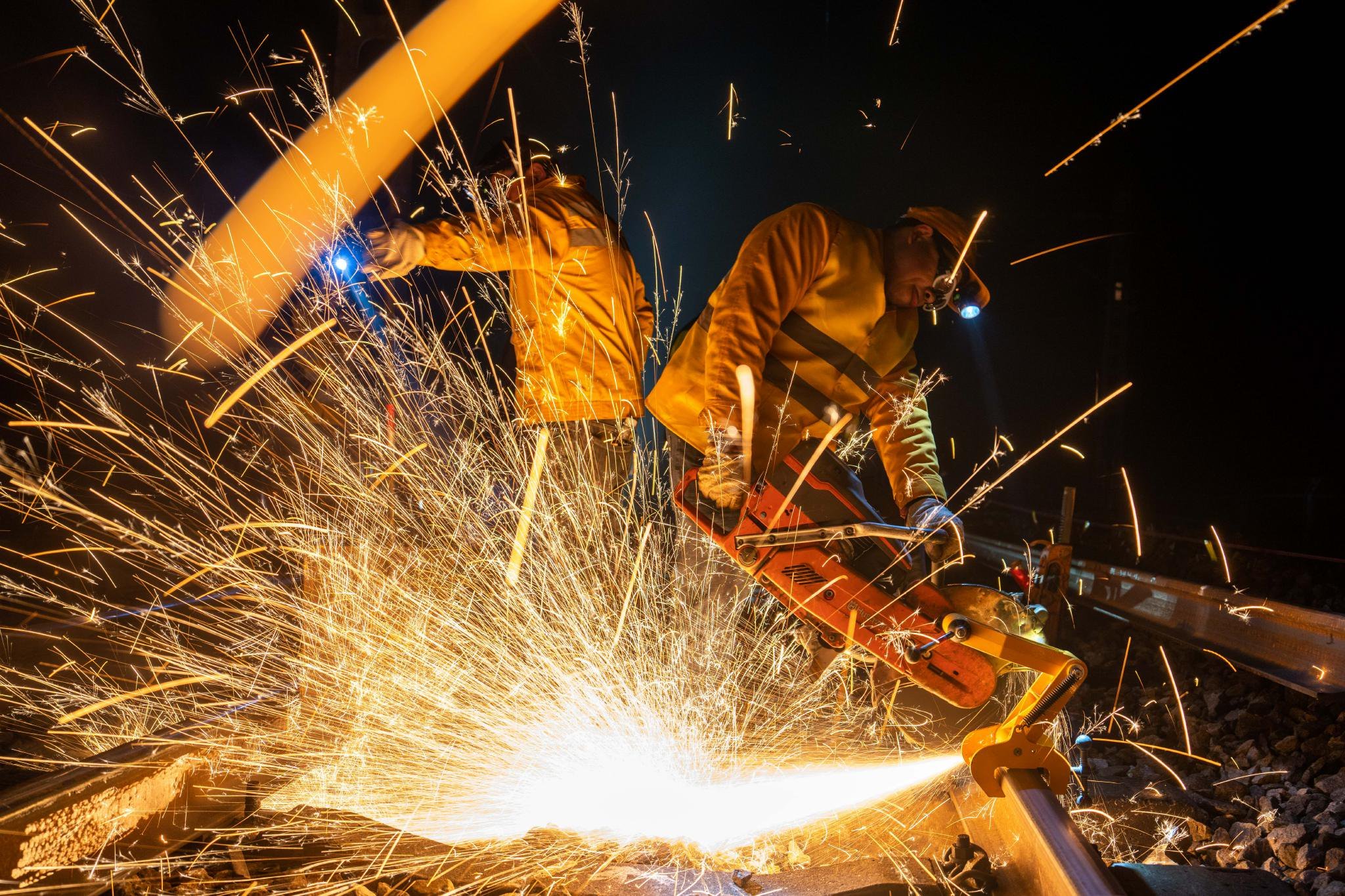
The first step is accurate removal of the defective rail section section. Traditional internal combustion rail saws have limitations: difficult starting, exhaust emissions in tunnels, and cable constraints.
The RailwayCare RCS‑L50 lithium rail saw operates on a 72 V Li‑ion battery pack and a 5.0 kW brushless motor. Cutting power is comparable to internal combustion units. For 60 kg/m rail, cutting time stays within 120 s, with stable speed and no power attenuation. The IP45 protection rating and industrial‑grade cells allow operation in rain or freezing conditions. The all‑steel construction absorbs vibration and helps maintain cut‑face perpendicularity. The emission‑free design eliminates exhaust gases – an advantage for tunnel work.
Rail Welding: Metallurgical joining
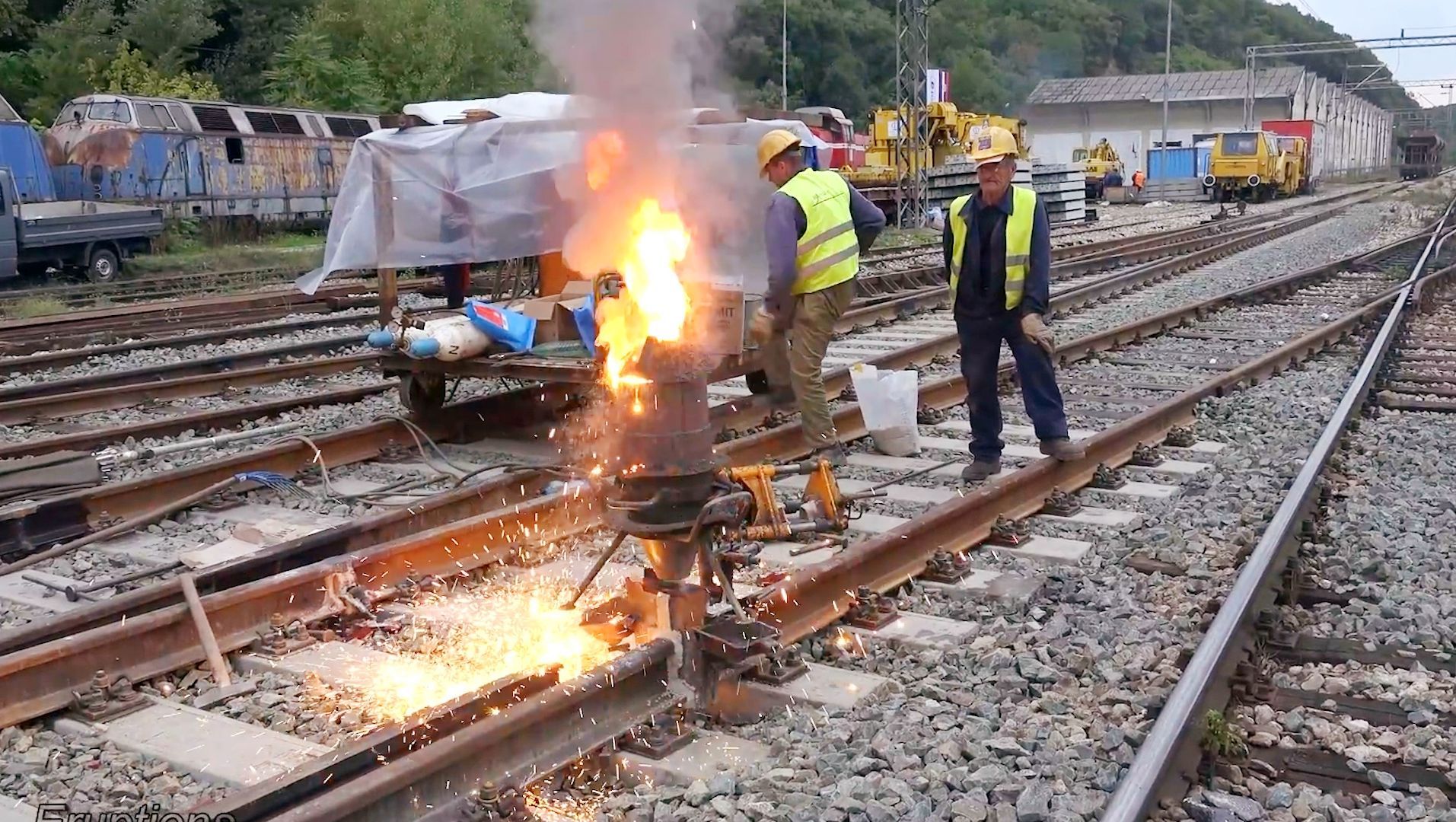
After the defective rail is removed, the new and existing rail ends must be connected. Thermite welding uses an exothermic reaction to inject molten steel into the rail gap, creating a metallurgical bond. Unlike mechanical joints, this eliminates the mechanical step and restores rail continuity.
The RCS TWS system includes high‑activity flux and an adaptive pouring mould to resist wind and rain interference. With precise pre‑heating, the weld achieves base‑metal strength under different ambient temperatures. The side and base moulds produce a full‑profile grinding the weld head. After grinding, the weld head reaches zero or minimal protrusion, meeting requirements for high‑speed operation.
Process integration
The RCS‑L50 and TWS systems form a sequential workflow. First, the lithium saw cuts the defective section cleanly, leaving a square end face. Next, rail end preparation and alignment are done with professional clamps to adjust the gap and straightness. Then, the TWS thermite process injects molten steel above 1350 °C for atomic‑level bonding. Finally, post‑weld normalising and grinding produce a smooth, continuous rail surface.
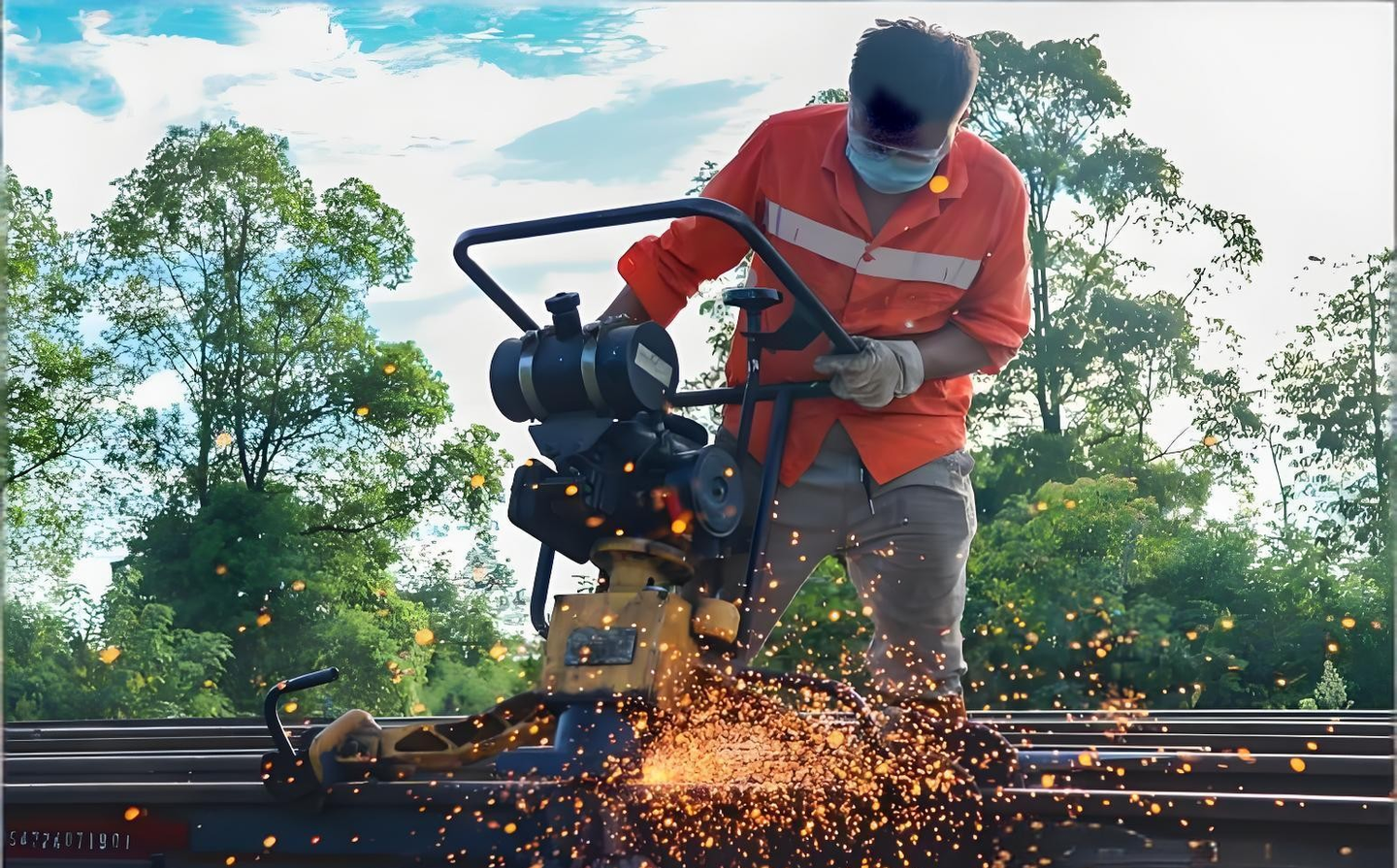
RailwayCare Maintenance Solution
RailwayCare provides the RCS‑L50 rail saw and TWS welding system as part of a rapid‑response solution for defective rail replacement. The focus is on reliable cutting and welding processes that minimise stress concentrations on the track. For detailed technical documentation, please contact RailwayCare.
Get in Touch
Request the RCS‑L50 and TWS technical manual
FAQ
Why use a battery rail saw instead of a petrol saw?
Starting reliability, emissions and cable constraints. A lithium rail saw removes the difficult starting of a small combustion engine, produces no exhaust gas — which matters in tunnels where ventilation is limited — and needs no trailing power cable inside a possession. It also keeps cutting performance comparable to internal combustion units.
What cutting performance is achieved on 60 kg/m rail?
Cutting time stays within 120 seconds, with stable speed and no power attenuation through the cut. The saw runs on a 72 V lithium-ion pack with a 5.0 kW brushless motor, carries an IP45 protection rating for work in rain or freezing conditions, and uses an all-steel construction that absorbs vibration and helps hold the cut face perpendicular.
How does thermite welding compare with a mechanical joint?
Thermite welding pours molten steel into the gap so the two rail ends are joined metallurgically, which restores rail continuity. A mechanical joint leaves a physical step between the rail ends — a permanent irregularity that the wheels strike on every passage. Eliminating that step is the reason thermite welding is used on continuous welded rail.
What happens after the weld is poured?
The weld head is normalised and then ground until protrusion is zero or minimal, which is the step that makes the joint suitable for high-speed operation. The grinding sequence and the geometry checks it has to satisfy are covered in our guide to rail welding and grinding workflows.
What preparation is needed before the cut?
The defective section has to be located and marked precisely, the rail ends protected against movement while the cut is open, and the replacement length measured so the new piece needs no further trimming. Clamps are set up in advance of the pour, because gap and straightness have to be held from the moment the rail ends are prepared until the weld has cooled.
What is the full sequence inside a blockade window?
Cut the defective section with the lithium saw leaving a square end face, prepare and align the rail ends with clamps to set gap and straightness, pour the thermite charge above 1350 °C for atomic-level bonding, then normalise and grind the weld head back to a smooth continuous surface. Each step depends on the previous one holding tolerance.
Talk to RailwayCare
Need a grinding wheel specification for your fleet, or a second opinion on a rail maintenance programme? Our engineers work directly with track operators, contractors and distributors worldwide, and answer technical questions in English and Chinese.
WhatsApp: +86 15072332788
Email: simon.wang@railwaycare.com
Web: www.railwaycare.com