How to order custom rail grinding wheels for non-standard grinders?
How to order custom rail grinding wheels for non-standard grinders?
You order a custom wheel by describing the head, not the rail. Send six things: the machine make and model with a drawing or photo of the grinding head; the wheel you run today, as a drawing or the worn wheel itself; the bore or thread pattern and how the wheel is held on; the spindle speed at that head; the rail section and steel grade; and the duty with the quantity you need. We then check whether that head matches a body shape already defined in JB/T 11431, and where it does not, we draw a new one. Nothing enters batch production before a sample lot has run on your track.
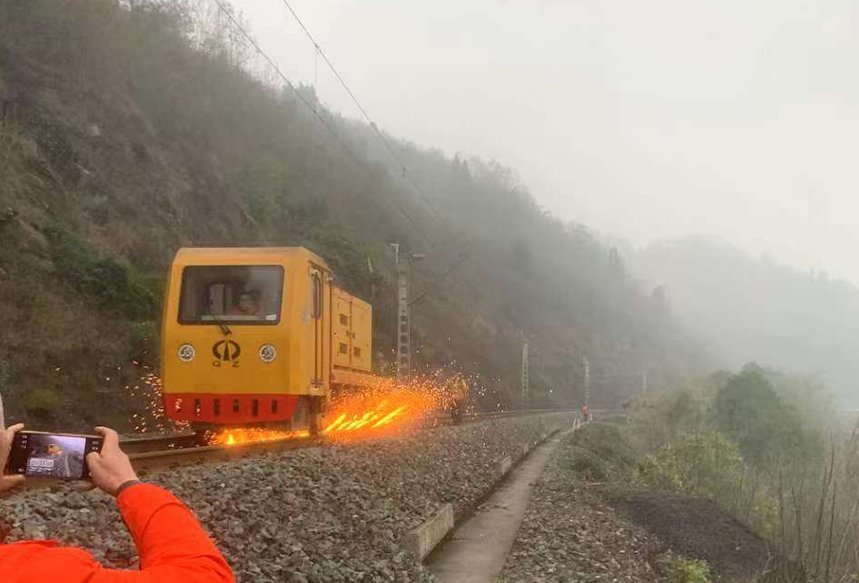
The six-point custom wheel brief
| What we need | What to send | Why it decides the wheel |
|---|---|---|
| Machine and head | Make, model, and a drawing or photo of the grinding head including the clearance around it | Sets the largest diameter and thickness the head can physically carry, and the access angle at the rail |
| The wheel you run today | A drawing, or the worn wheel itself with measured outside diameter, bore, thickness and thread | We measure rather than guess — a worn wheel also shows the mounting depth and where the wear-limit marker sits |
| How it is fixed | Bore diameter, thread form or bolt pattern: M10 clamping bolts on train wheels, M20 / 5/8 inch / M8 on portable machines, dual-step or bolt-on patterns | This is what holds the wheel on the spindle; get it wrong and nothing else on the drawing matters |
| Spindle speed | rpm at that head, and direction of rotation | Sets the surface speed you must declare on the wheel, and the largest diameter that stays inside 50 m/s |
| Rail and duty | Rail section (43-75 kg/m, UIC60, 60N), steel grade (U71Mn, U75V, U78CrV), and whether the head does metal removal, finishing or weld dressing | Decides abrasive, grit (16 / 20 / 30) and grade — hard rail and hard wheels both grind less metal per pass |
| Quantity and horizon | First lot size, expected annual volume, and delivery port | Decides the fixture and whether a dedicated tooling set is justified for the pattern |
If you would rather start from the machine family than from a drawing, the compatibility check is set out in can one wheel fit different grinding machines, and the reading of an existing size is in what a specification like 260x90x154 mm means.
What can be changed, and what cannot
| Open to customization | Fixed by standard and physics |
|---|---|
| Outside diameter, bore and thickness, within the tolerance classes of JB/T 7992 | The rated surface speed has to be marked on the wheel (JB/T 11431 marking) and must not be exceeded on the machine |
| Thread form and mounting pattern — M10, M20, 5/8 inch, M8, dual-step bores, bolt-on fixing | Rotation strength: 1.5× rated speed for 30 s without bursting at 50 m/s or below, 1.6× above 50 m/s (Q/CR 1-2014, table 1) |
| Abrasive — zirconia alumina (ZA), brown alumina, or a composite mix | Static balance: coefficient K = 0.4, unbalance not greater than 0.4 × √M, where M is wheel mass |
| Grit — 16 for train wheels, 20 for portable and turnout wheels, 30 for cutting wheels | Piece-by-piece release inspection — appearance, mated surfaces and dimensions, static balance, rotation strength. A small custom lot is not sampled instead |
| Grade and bond formulation, including the resin system, moving the balance between wear resistance and cutting ability | Glass-fibre winding for burst protection, uniform, tight and colour-consistent; the metal body must not break or separate from the grinding body |
| Body material — aluminium or steel, with pre-formed mounting holes | Thread engagement of at least 17 mm on the M10 mounting bolts used on train wheels |
| Geometry and balance class, marking and wear-limit marker position, packaging to your requirement | The wear-limit marker has to be permanent and still readable when the wheel is at its limit |
The left column is what a drawing lets us change. The right column is what we will not trade away on a custom order, because those items are the difference between a wheel that performs and a wheel that fails on a possession. We build custom and near-catalogue patterns through light customization solutions, with worked examples in the customization case file.
The speed limit that caps every custom wheel
A non-standard grinder does not exempt you from arithmetic. Surface speed and diameter are locked together by n = 954,930 ÷ D, so at a rated 50 m/s the largest wheel a head can carry falls as the head spins faster:
| Wheel outside diameter | Maximum spindle speed at 50 m/s |
|---|---|
| 350 mm | 2,728 rpm |
| 280 mm | 3,411 rpm |
| 260 mm | 3,673 rpm |
| 230 mm | 4,152 rpm |
| 180 mm | 5,305 rpm |
| 150 mm | 6,366 rpm |
| 125 mm | 7,639 rpm |
Work it backwards from your machine. If the head runs at 6,000 rpm, the largest wheel that stays inside 50 m/s is about 159 mm (954,930 ÷ 6,000). A wheel cannot be re-rated simply because the machine spins faster — the rating belongs to the wheel and is proven on the wheel, not on the machine. So a fast non-standard head gets either a smaller diameter, or a wheel built and tested for the higher speed as its own type. The general rule is set out in what the maximum operating speed means.
How the order runs, step by step
- Technical review. Head geometry, clearance, spindle speed and duty, with your current wheel measured rather than assumed.
- Drawing and proposal. Where the head matches a body shape and size already defined in JB/T 11431 — the standard sets out G1, G2, G3, G4, G5, G6 and G7 bodies with their mounting patterns — we quote against it. The standard also states that wheel types are not limited to those listed, so where nothing fits we draw a new pattern. Two such patterns are already catalogued: 180×80×M20 and 230×60×25 for custom systems.
- Sample lot. The first delivery is deliberately small. On the Shuohuang heavy-haul programme the first stage was 4 wheels of four different formulations on one side of a car against 4 original wheels on the other side — only then 48, then 96, then 100, then 600.
- On-track validation. Pass-kilometres per millimetre of wheel thickness, rail roughness Ra, blueing, profile and how far each wheel travels before its wear limit.
- Type test and batch. A pattern that is a new type, or whose structure, material or process changed materially, goes through a full type test before batch supply.
- Serial supply with traceability. Each batch carries a number — recent programmes ran WHFL230829, CYF230930, CYF240130, SH240412 and SH240708 — so a wheel on your track can be traced back to its pressing record.
If your concern is the size of the first order rather than the design work, that is answered separately in what MOQ to expect; the buying sequence itself is covered in how to get a rail grinding quote.
What a non-standard wheel still has to pass
- Type testing is mandatory before a new wheel type is finalised, when structure, material or process change materially, after production has stopped for more than 6 months, when production moves to a new site, and every two years of continuous production (Q/CR 1-2014, §6.4.2).
- The grinding performance test uses a 45 steel cylinder 1,585 mm in diameter and 10 mm thick at 150-180 HB, with line wheels tested at 10.8 km/h and turnout wheels at 5.4 km/h. The test is stopped if the wheel bursts, the grinding sound becomes abnormal, contact pressure exceeds 10,000 N, or instantaneous power exceeds the setpoint by 50% (Annex C).
- Dimensional work is gauged, not judged by eye. The mounting bore is checked with a plug gauge — the go gauge must enter the bore by 15 mm and the no-go gauge must not — and threaded bores are checked with a thread plug gauge (JB/T 11431).
- A non-catalogue sample measured clean. A G6a 150×65×20-40×20 wheel submitted for testing to JB/T 11431-2020 and GB 2494-2014 returned 15 g unbalance against a 21 g limit, 0.8 mm outside-diameter deviation against ±1.0 mm, 0.7 mm thickness deviation against ±1.5 mm, 0.1 mm parallelism against ≤0.4 mm and 0.3 mm concentricity against ≤0.5 mm, surviving 8,276 rpm for 30 s with burst speed at 11,014 rpm.
- Building one is not the constraint. The plant runs six hot presses (over 300 wheels per shift), four curing ovens (over 600 per shift) and two glass-fibre winding machines (over 200 per shift), with two static balancing testers, a dynamic balancing machine and two rotation testers — which is what makes a piece-by-piece release possible even on a short run.
What a custom order buys is the same inspection regime, not a lighter one — the same conclusion as for small quantities generally.
What this looks like in practice
- A first contact that grew into a supply relationship. An agent in South Africa placed a sample order, validated it against their own machines, and the partnership followed — see the sample validation case. A localised OEM supply-chain model with a Chinese railway bureau followed the same pattern, in the Xi’an case.
- Samples that earned their batch. The 4 sample wheels on Shuohuang averaged 5.96 pass-km per millimetre of wear against 4.99 for the wheels already on the car, 19.4% better, with the best single wheel reaching 332.3 pass-km — which is what justified the 48, 96 and 600 wheel follow-ups.
- Freight for a trial shipment is easy to estimate: 9 kg for a 260×90×154, 7.48 kg for a 250×75×150 and 6.2 kg for a 180×105×90.
- Scale behind the drawing office. More than 230,000 wheels shipped in 2025, on an annual capacity of roughly 500,000, and a standard we co-drafted — JB/T 11431 — which is also the reason we can tell you when a custom wheel is the wrong answer.
If you are still deciding between a wheel for a portable machine and one for a train, the boundary is physical rather than commercial, and it is set out in are portable and train wheels interchangeable. The wider Molaton range is listed in the Molaton wheel range and on the railway grinding wheel product page.
Related questions you may also ask
What MOQ should I expect when buying rail grinding wheels? Can one rail grinding wheel fit different grinding machines? What is the RailwayCare (Molaton) rail grinding wheel range? How to choose a reliable rail grinding wheel supplier? More answers on rail grinder wheelsSend us the head, not the catalogue number
Photograph or dimension the grinding head, tell us the wheels you run on it today and the rail you work on. We will confirm whether a catalogue Molaton wheel fits, and if it does not, quote a custom drawing and a sample lot you can validate on track before you commit to volume.
Request a Custom Wheel Quote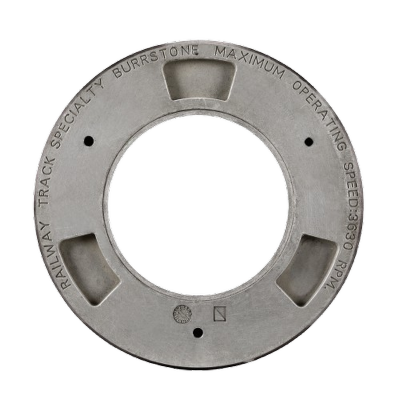
Are you looking for a reliable manufacturer of railway grinding and track maintenance equipment?
We can quickly provide customers with market analysis, technical support and customized services.
Safe Tracks Proven by China
- Name
- Phone
- *Title
- *Content