Which grinding wheel removes small radius curve corrugation best?
Which grinding wheel removes small radius curve corrugation best?
Use a coarse zirconia-alumina wheel — F16 to F20, resin bond with glass-fibre reinforcement, rated 50 m/s — sized to your machine, and pair it with a gauge-corner profile correction in the same campaign. A finer or harder wheel will make the rail look smooth while leaving the wave pattern behind, and the corrugation returns within one grinding cycle. On small-radius curves the wheel is half the answer: removal happens only if the pass actually cuts to depth and the contact geometry is corrected at the same time. For the wheel choice itself, work in this order: pick the size the machine takes, pick the coarsest grade that still meets the finish limit, then set the pass plan so the wave is removed in one visit rather than in a series of shallow ones.
Why curve corrugation is a different problem from tangent-track corrugation
- The damage comes as a package. Where the curve radius is tight, the dominant defects are not a single wave pattern: side wear and corrugation appear together, along with fatigue cracking at the gauge corner. The damage mix is radius-driven — on urban and metro lines with radius below about 1,000 m, side wear and corrugation lead; on heavy-haul lines, crushing and flange flow lead; on high-speed lines, contact fatigue leads. A wheel chosen from the defect name alone will miss the two defects travelling with it.
- The surface is the symptom, not the cause. Once the rail head profile has moved away from the design shape, contact concentrates on the gauge corner. That raises the local slip and the local stress, and the corrugation regenerates from the same mechanism that created it. This is why a wheel that removes the wave without restoring the profile changes the calendar, not the outcome.
- The crack window is narrow. Rolling-contact fatigue builds through ratcheting of the surface layer: micro-cracks nucleate, then initiate, then propagate, and the first two stages take up the great majority of the fatigue life. When crack depth is still within about 0.2 mm, a normal grinding pass removes the cracked layer completely. Past that depth the surface can be cleaned while the crack root survives — and it will come back. This is the technical reason for grinding curves on a short cycle rather than on condition.
- Heat is harder to shed. Curve passes often run at lower speed and higher unit pressure, which is exactly the combination that produces burning and white layer. Ground-surface finishing temperature has to stay below 150 °C, and the white layer generated at the surface is roughly 870 HV0.3 against about 340 HV0.3 for the parent metal. That brittle layer fragments under traffic and feeds new cracking, so a wheel that burns to gain cutting depth is a false economy.
What the wheel has to deliver on a curve
| Property | Requirement for curve corrugation | Why |
|---|---|---|
| Abrasive | Zirconia alumina (ZA); F16 grain measures 308.0 MPa compressive strength and a grinding ratio of 41.0, against 124.0 MPa and 22.4 for calcined brown alumina | The wave has to be removed by cutting, and the wheel has to keep cutting through a mixed defect package |
| Grit | 16 for production-size wheels and heavy removal; 20 for portable and confined work | Coarse grain cuts faster per pass; fine grain polishes the wave and masks it |
| Bond | Resin bond with glass-fibre reinforcement — the bond used across every rail grinding machine in service, active and high-speed passive alike | Survives intermittent and impact loading on curve joints without fracturing |
| Speed rating | 50 m/s minimum, marked on the wheel and higher than the head it is fitted to | Curve passes often run below rated speed; the marking is what protects you |
| Balance | Batch-balanced, with the full inspection regime behind it: appearance, dimensions, static balance and rotation strength checked wheel by wheel under Q/CR 1-2014 §6.2.2 | Imbalance becomes chatter and burning, and burning on a curve is where the white layer is created |
| Self-sharpening behaviour | Grain must re-expose as it dulls | If the wheel glazes, friction coefficient and cutting both collapse and the pass turns into polishing |
| Size and mount | Must match the machine, not the rail | See the table below |
One caution on hardness, because it is the most common selection error. A harder wheel is not a more durable cutting tool on a curve. In our own series tests, increasing the bond content raised compressive strength but reduced the amount of material removed — the range tested from GS-10 to GS-15 fell from 1.0 g to 0.2 g of stock removed while the grinding ratio rose from 12.8 to 24.1. Higher strength means the grain stays covered and slides instead of cutting. The middle of the range is the optimum, and an over-hard wheel on a curve produces exactly the glazed, burnished surface that operators mistake for a good result.
Selection by machine
| Machine doing the curve pass | Wheel class | Example catalogue size and compatible systems |
|---|---|---|
| Production grinding train, main and curve replacement | Heavy-duty zirconia alumina, 16 grit, resin bond, glass-fibre reinforced, 50 m/s | 260×90×154 mm for Harsco PGM48/96C, CRRC Baoji GMC-48 and Jinying GMC-96 class machines; 250×75×150 mm for Speno GMC-48 and GMC-96 and CRRC Taiyuan |
| Light or portable machine on the gauge corner | Zirconia alumina, 20 grit, resin bond, 50 m/s | 150×65×M20, 150×70×M20, 150×75×32 mm for Geismar and Robel 150 class and Harsco RGH20C machines |
| High-speed passive grinding (no possession) | Small passive wheels, zirconia alumina, resin bond | Small-diameter passive wheels in the 119-122.5 mm class, up to 40 m/s, used for light preventive passes only |
| Turnout approaches on the curve | Turnout switch-unit wheel | 180×105×90 mm for Speno GMC16A switch units — see the turnout wheel answer for the confined-zone logic |
Whichever machine you use, the same pass-depth arithmetic applies. Main-line contract limits cap base-material removal at 0.5 mm per pass, and the typical active-grinding removal per pass is about 0.2 mm. That is the budget you are working with: the wave has to be removed inside a small number of passes, which is why a coarse, sharp wheel and a properly corrected profile matter more on a tight curve than on plain line.
The grinding cycle is part of the wheel specification
Wheel grade and cycle length are one decision, not two. Chinese network practice sets preventive cycles by radius and by traffic:
| Track condition | Preventive grinding interval |
|---|---|
| Small-radius curves (radius below about 1,200 m) | Every 30-50 million tonnes of traffic |
| Tangential track and large-radius curves (above about 1,200 m) | Every 100 million tonnes |
| High-speed lines | Every 30-50 million tonnes, and not more than 2 years apart |
Two consequences follow for the wheel you buy. First, a curve wheel runs more pass-kilometres per year than a tangent wheel, so its cost per pass-kilometre dominates the curve budget — which is why wear rate, not unit price, is the number to compare. Second, a short cycle only works if each pass cuts shallowly and consistently; a wheel that forces you to take deep, damaging passes to compensate destroys the very profile you are trying to restore.
What our own curve and heavy-haul data shows
Wear figures are duty-dependent, so compare them only against lines with similar conditions. Ours, on measured programmes:
- Liuzhou, GMC-96X, 2022 — 18.72 pass-km completed inside a single 2-hour night possession, with wheel wear of 20-30 mm for the composite design against 43.5-59 mm for the imported reference wheel under the same conditions.
- Yiyang line — 5.7 pass-km per mm of wheel wear, averaging 228 pass-km per wheel.
- Shuohuang heavy-haul — 4.98 pass-km per mm, averaging 199 pass-km per wheel; a single-trolley comparison in 2023 recorded 5.96 against 4.99 for the wheel in use, an improvement of about 19.4%, with a best single wheel reaching 332.3 pass-km.
- Hewu high-speed line, PGM-96C, 2020 — 4.28 pass-km per mm against 3.27 for the wheel then in use, or about 1.31 times, with an average of 214.22 pass-km per wheel and no continuous burning.
- Bench comparison at 7 km/h and 8 kW — composite wheels reached 100-150 pass-km against 50-60 pass-km for ordinary and imported reference wheels, and cleared defects in 2-3 passes against 4-6. The pass-count difference is the one that matters on a curve, because it is what lets you finish inside a short possession.
None of those numbers replaces a trial on your own track. Run a small set against your incumbent wheel on the same machine, in the same windows, and measure wear in pass-kilometres rather than in calendar time.
How to tell the corrugation is actually gone
Verification is where curve jobs most often get signed off too early. Check the wave as well as the finish:
- Wave removal — measure the longitudinal profile before and after; a smoother surface with the wave periodicity intact is a failed pass, not a partial success.
- Profile conformance — GQI of 85 or better is the good band, with zone tolerances of rail-head centre +0.2 / −0.4 mm and ±0.2 mm across zones 2, 3 and 4.
- Finish and heat damage — Ra of 10 µm or better, no continuous blue band, and a straightness reading within 0.3 mm under a 1 m straightedge with a ramp-off steeper than 1‰.
- The next cycle — the real verdict arrives one cycle later. If the corrugation reappears early, the profile correction was incomplete, not the wheel.
For the measurement side, rail wear measurement sets out how to record it; for the acceptance framework, see grinding acceptance standards. The corrugation mechanism itself is covered in this analysis of causes and grinding solutions and in how to remove corrugation and verify the result. If your corrugation is on tangent track rather than tight curves, the selection logic and the wheel recommendations are different — see how to choose a wheel to remove rail corrugation. Curve side wear and the accompanying profile work are covered in managing side wear on curved track, and for the machine side of the purchase, how to choose a rail grinding company sets out the evaluation criteria.
Related questions you may also ask
How do I choose a wheel to remove rail corrugation? How does rail grinding prevent rolling contact fatigue? What wheel types does Molaton offer for different railways? Why is my rail grinding wheel glazing and not cutting? Managing side wear on curved track More answers on rail grinder wheelsGet the curve wheel and the pass plan together
Send Molaton your curve radius, your defect mix, the machine and the possession length. We will come back with the Molaton wheel size and grade for that duty, and the pass plan that removes the wave without leaving a burn behind.
Request a Curve Grinding Recommendation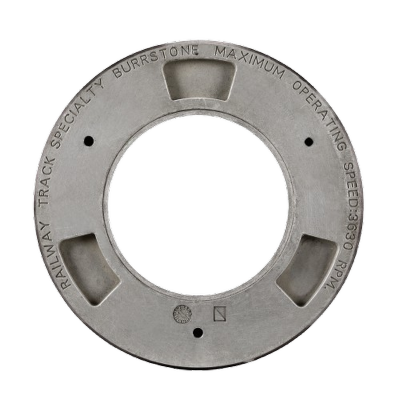
Are you looking for a reliable manufacturer of railway grinding and track maintenance equipment?
We can quickly provide customers with market analysis, technical support and customized services.
Safe Tracks Proven by China
- Name
- Phone
- *Title
- *Content