How does rail grinding prevent rolling contact fatigue?
How does rail grinding prevent rolling contact fatigue?
Rail grinding prevents rolling contact fatigue (RCF) by cutting the crack-bearing surface layer away while the cracks are still shallow — roughly 0.2 mm or less. At that depth one normal grinding pass removes the whole crack array. Once the cracks have propagated deeper, the same pass removes the surface and leaves the crack root in the rail head, where it keeps growing. So prevention is a matter of timing and depth control, not of grinding harder.
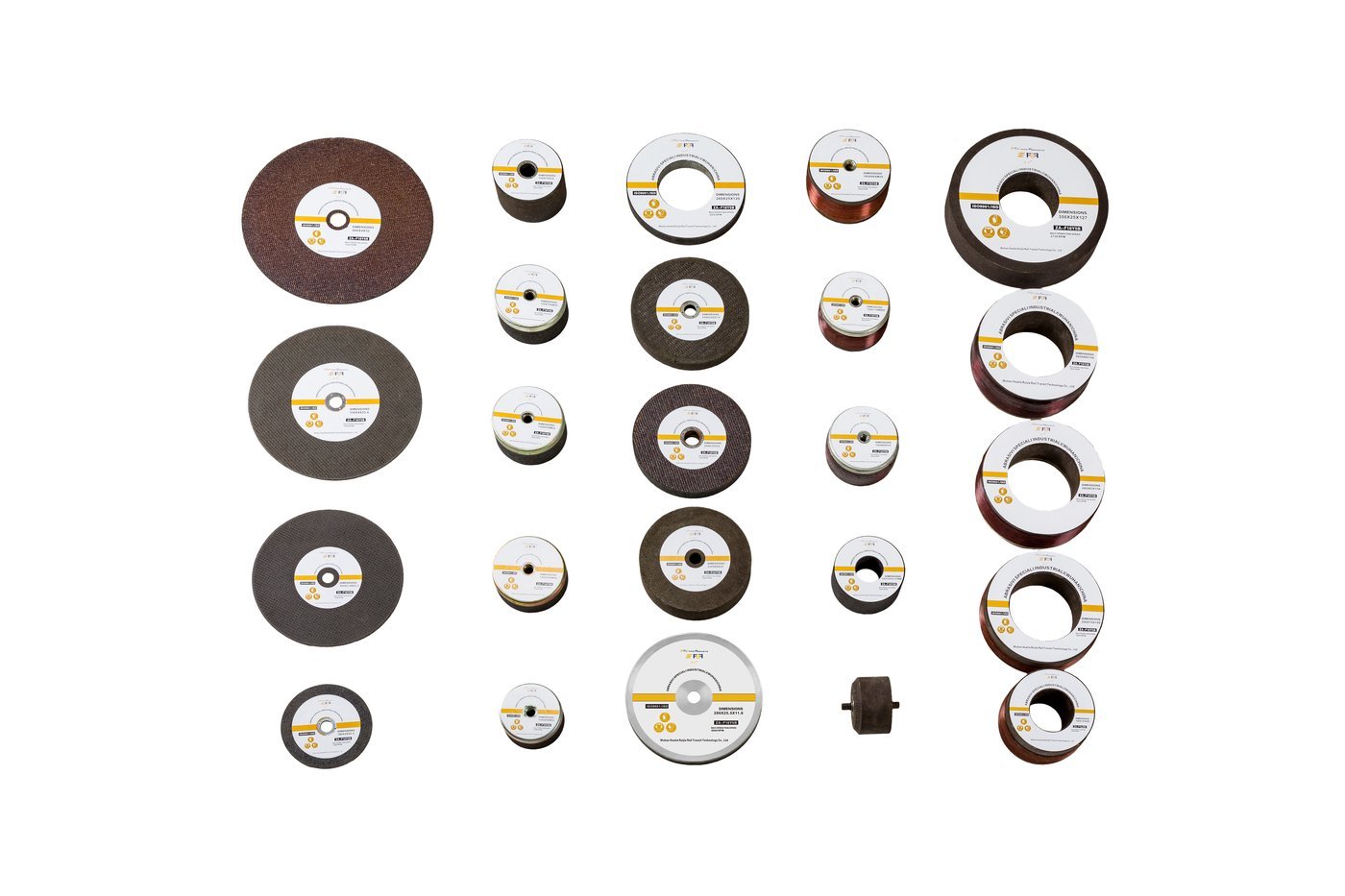
Why RCF forms a layer you can grind off
Rolling contact fatigue is not a single defect. It is the end of a process that starts below the running surface. Repeated wheel loads build up a ratchet effect: plastic strain accumulates in the rail head, the material in that layer becomes measurably harder and more brittle, dislocation density rises, and microcracks nucleate. Those microcracks then grow — transverse and longitudinal — and eventually surface as head checks, spalling and shelling, and in the worst case as a transverse fracture.
The crack development cycle runs through three stages: nucleation → initiation → propagation. The first two stages consume by far the largest share of the component's life. That is precisely the window in which grinding has leverage, because in those stages the damage is still confined to a thin surface layer that a grinding pass can remove completely.
The depth rule that decides the outcome
| Crack propagation depth | What a normal grinding pass achieves | Result |
|---|---|---|
| ≤ 0.2 mm (still in nucleation / initiation) | Removes the full crack-bearing layer in one pass | RCF reset — the rail head returns to sound material |
| Deeper than ~0.2 mm | Removes the surface, leaves the crack root | Crack continues to grow under traffic; deeper corrective cuts or rail replacement follow |
| Corrugation and surface-initiated damage left in place | Nothing is removed | Dynamic wheel loads rise, which accelerates the very ratchet effect that initiates new cracks |
This is the mechanism behind the shift the industry has made from corrective grinding after defects appear to preventive grinding on a tonnage-based cycle. The maintenance requirement in Chinese practice is one grinding pass per 30–50 million tonnes of accumulated traffic on high-speed line, and no more than two years apart; on conventional line every 100 million tonnes on straight and large-radius track, tightening to 30–50 million tonnes below 1,200 m radius. Preventive cuts are shallower by design, which is exactly why they keep the crack depth inside the window where grinding still wins, and why they cost less over the rail's life than repeated corrective work.
Grinding parameters decide whether you prevent RCF or feed it
A grinding pass that runs too hot does not prevent RCF — it seeds it. The evidence is measurable. Increasing wheel speed from 1,000 to 3,000 rpm drives surface roughness from 6.6 to 8.4 μm and white-layer thickness from about 45 μm to 320 μm; at 3,000 rpm the white layer shows spalling pits and the removal mechanism shifts from single-cut to a cutting-and-spalling mix. That white layer is hard and brittle — about 870 HV0.3 against roughly 340 HV0.3 for the parent metal, a 155% increase — and research by Michael et al. and by Steenbergen found that it fractures early in service and is pressed into the substrate by the wheel, which initiates and drives new cracks.
So the aim is a cool, controlled cut held to the acceptance numbers: surface roughness Ra ≤ 10 μm, flatness within 0.3 mm under a 1 m straightedge, no continuous blue burning, grinding depth ≤ 0.5 mm on the parent metal and blending out better than 1‰. A pass that meets those numbers has removed the fatigue layer and left a surface that will not itself become the next crack origin.
Case and data — from crack removal to verified durability
The result is documented on track. On the Hewu high-speed line the verified comparison was 4.28 versus 3.27 pass-kilometres per millimetre of wheel wear, with a best single wheel of 214.22 pass-kilometres and no continuous blue burning — the surface condition that would otherwise feed RCF. A Liuzhou GMC-96X removed 18.72 pass-kilometres in a two-hour possession with 20–30 mm of wheel consumption against 43.5–59 mm for the imported reference. Independent testing at the China Academy of Railway Sciences measured wheel wear 1.4–2.6× better than specification, and a G1b 260×90×153 mm 50 m/s wheel survived 4,775 rpm for 30 s without rupture at 21 g unbalance. Most recently, a Loram DM01 trial achieved Ra 1.05–9.0 μm, mostly 2–4 μm with no blue burning. RailwayCare has built these wheels since 2004 — the first dedicated rail grinding wheel producer in China — drafted the standard JB/T 11431 they are made to, and holds ISO 9001, ISO 45001 and CRCC certification; the Molaton range covers grinding trains and hand-held machines alike, so the same controlled cut is available from a 96-stone train or a single turnout grinder.
Related questions you may also ask
What tools detect rail defects and rolling contact fatigue? How does a grinding train remove rail defects? What is rail infrastructure maintenance inspection? Rail grinding on African railways — RCF and defect controlSet a grinding programme that resets RCF instead of chasing it
Tell us your traffic tonnage, curve radii, existing defect types and the last measured crack depth. We will specify the Molaton wheel, the cut depth per pass and the cycle interval to keep the crack layer inside the window grinding can still remove.
Get a Grinding RecommendationThe preventive grinding approach is set out in more detail under the rail grinding solution, the wheels themselves are listed under railway grinding wheels, and the measured cost of a programme at different intervals is compared in our article on rail grinding cost per kilometre.

Are you looking for a reliable manufacturer of railway grinding and track maintenance equipment?
We can quickly provide customers with market analysis, technical support and customized services.
Safe Tracks Proven by China
- Name
- Phone
- *Title
- *Content