How does a grinding train remove rail defects?
How does a grinding train remove rail defects?
A grinding train removes rail defects by cutting a very thin layer of steel from the rail head with rotating abrasive stones, pass by pass, at a controlled angle and depth. Each stone is set to its own tilt angle so the sequence of cuts reproduces the design rail profile instead of simply smoothing the surface. Because the trains that cause the defects — corrugation, fatigue cracks, shelling, gauge-corner lipping, crushing — sit within the top fraction of a millimetre of metal, a correctly sequenced grinding programme removes them at the root and leaves a rail that stays smooth far longer than one that has merely been polished.
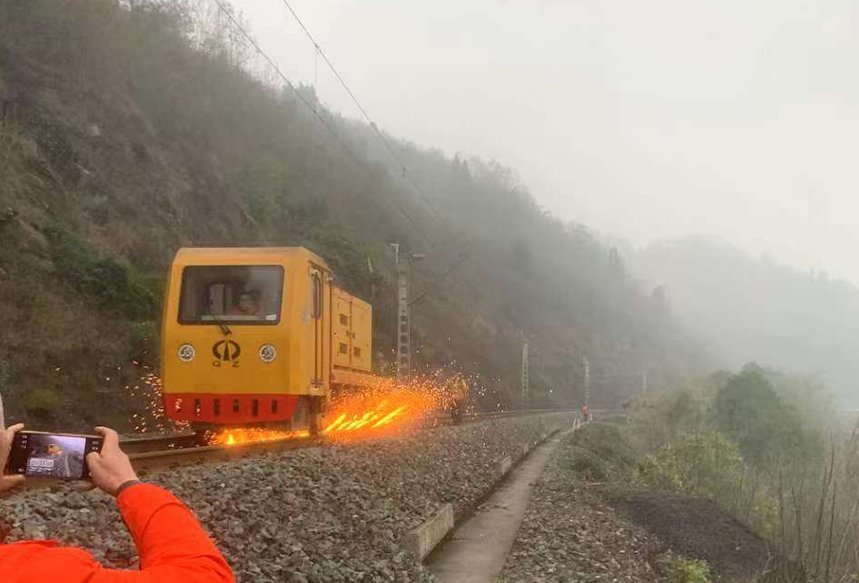
What a grinding train can actually remove
Roughly 80% of all rail damage falls into the defect families below. They have different causes, so they are removed by different parts of the grinding programme — not by a single heavy cut.
| Defect | Where it dominates | How grinding removes it |
|---|---|---|
| Corrugation (wave wear) | Metro and light-rail curves below R1000 m, main lines | Light passes at closely controlled depth flatten the wave; the goal is to cut the wave crests down to the trough level without loading the surface |
| Contact fatigue cracks (head checks) | High-speed rail, where it is the leading damage mode | The cracked layer is cut back to sound metal; angle control lets the gauge corner be relieved without removing the whole rail head |
| Shelling and spalling | Heavy haul, high axle loads | Graded cuts remove the cracked and delaminated layer progressively so that no buried crack tip is left behind |
| Gauge-corner lipping (metal flow) | Heavy haul, sharp curves | Targeted high-angle stones on the gauge corner re-form the corner radius rather than shaving it flat |
| Crushing and rail-head batter | Heavy haul, turnouts | The work-hardened crust is removed in sequence so that the new surface is uniform, not a mix of hard and soft spots |
| Scuffing, indentation and spot damage | All networks | Deeper local cuts, but still inside the permitted material-removal envelope for the rail section |
Two acceptance limits govern the whole job: the finished surface must sit within 0.3 mm of a 1 m straightedge with roughness Ra ≤ 10 μm, and the total depth taken from the parent rail must not exceed 0.5 mm. Defect removal is therefore a geometry exercise as much as a cutting one.
The removal mechanism, in parameters
| Parameter | Typical value | What it protects |
|---|---|---|
| Depth per pass | 0.2-0.3 mm on a 12-head unit; max roughly 0.2 mm per single cut | Keeps the cut below the thermally damaged zone instead of smearing it deeper into the rail |
| Stone tilt range | -72° to +20° across the head | Lets the sequence reach the gauge corner and the field side without over-cutting the crown |
| Stone speed and power | Up to 50 m/s; motors around 12 kW at 4000-6500 rpm | Maintains a cutting action rather than a rubbing one, which is what produces heat |
| Working rate | Around 300 m/h on a 12-head unit; grinding speed commonly 7-12 km/h | Trade-off between output inside the possession and surface quality |
| Surface temperature | Must stay below 130 °C within 30 s | Prevents the hard, brittle white layer that pre-fatigues the rail |
| Wheel life | Not less than 50 km per stone under Q/CR 1-2014 | Stops the programme being limited by stone changes mid-possession |
The white layer is the reason the depth limit exists. In laboratory sectioning, a rail ground at a high surface speed showed a white layer of about 870 HV0.3 sitting on a parent structure of roughly 340 HV0.3. That boundary is brittle, it cracks early under wheel load, and it seeds the next generation of defects. Grinding that removes a defect by burning the surface has not solved the problem — it has moved it a few tenths of a millimetre deeper and delayed the failure.
What the on-track data shows
A GMC-96X class grinding train at Liuzhou in November 2022 cut 18.72 pass-km in a single two-hour night window on the Hengyang-Liuzhou line, working with Molaton grinding stones. The stones consumed 20-30 mm of thickness where the imported reference stones used on the same programme consumed 43.5-59 mm — about twice the wear resistance for the same pass-kilometres. Consistency of the cut matters as much as the amount removed: a stone that stops cutting mid-pass leaves the profile half-finished.
On the Hefei-Wuhan high-speed line the same system averaged 214.22 pass-km per wheel at 4.28 pass-km/mm against 3.27 for the reference product, with no continuous blueing on the finished surface — the visual signature of a rail that has been ground rather than burnt. Batches of 600 stones have passed heavy-haul qualification, and the 2026 Loram DM01 trial produced a finish of Ra 1.05-9.0 μm, most results between 2 and 4 μm, comfortably inside the Ra ≤ 10 μm limit. RailwayCare has made these stones since 2004 and drafted the industry standard JB/T 11431; the products are listed under railway grinding wheels, and the machine side of the process is covered in rail grinding machines.
One warning from the field: if a defect is removed by simply driving the depth up, the surface blues, a white layer forms, and the rail fails earlier than before it was ground. Burn control is discussed in rail burning prevention.
Related questions you may also ask
What is a rail grinder train and how does it work? What are the types of track grinding machines? What is a rail grinding machine and how does it work? Rail grinding solutions for main line, heavy haul and metroTargeting a specific rail defect?
Tell us your train type, the defects you are seeing and the rail section you are working on. RailwayCare will match the Molaton stone specification and angle sequence to remove them within the permitted depth envelope.
Get a Grinding Train Wheel Quote
Are you looking for a reliable manufacturer of railway grinding and track maintenance equipment?
We can quickly provide customers with market analysis, technical support and customized services.
Safe Tracks Proven by China
- Name
- Phone
- *Title
- *Content