Why is my rail grinding wheel glazing and not cutting?
Why is my rail grinding wheel glazing and not cutting?
Glazing is a self-sharpening failure, not a hardness failure. A rail grinding wheel stays sharp by wearing its bond back just fast enough to expose the next layer of grain. When the bond wears back too slowly — because the wheel grade is too hard for the job, the grit is too fine, the wheel speed is too high, or the contact pressure and depth of cut per pass are too light — the exposed grain rounds off, stops penetrating, and the wheel starts rubbing the rail instead of cutting it. The face then polishes to a shiny, glazed surface and removal rate collapses. The cure is to restore the grain/bond wear balance: re-match grade, grit and speed, not to push harder on the machine.
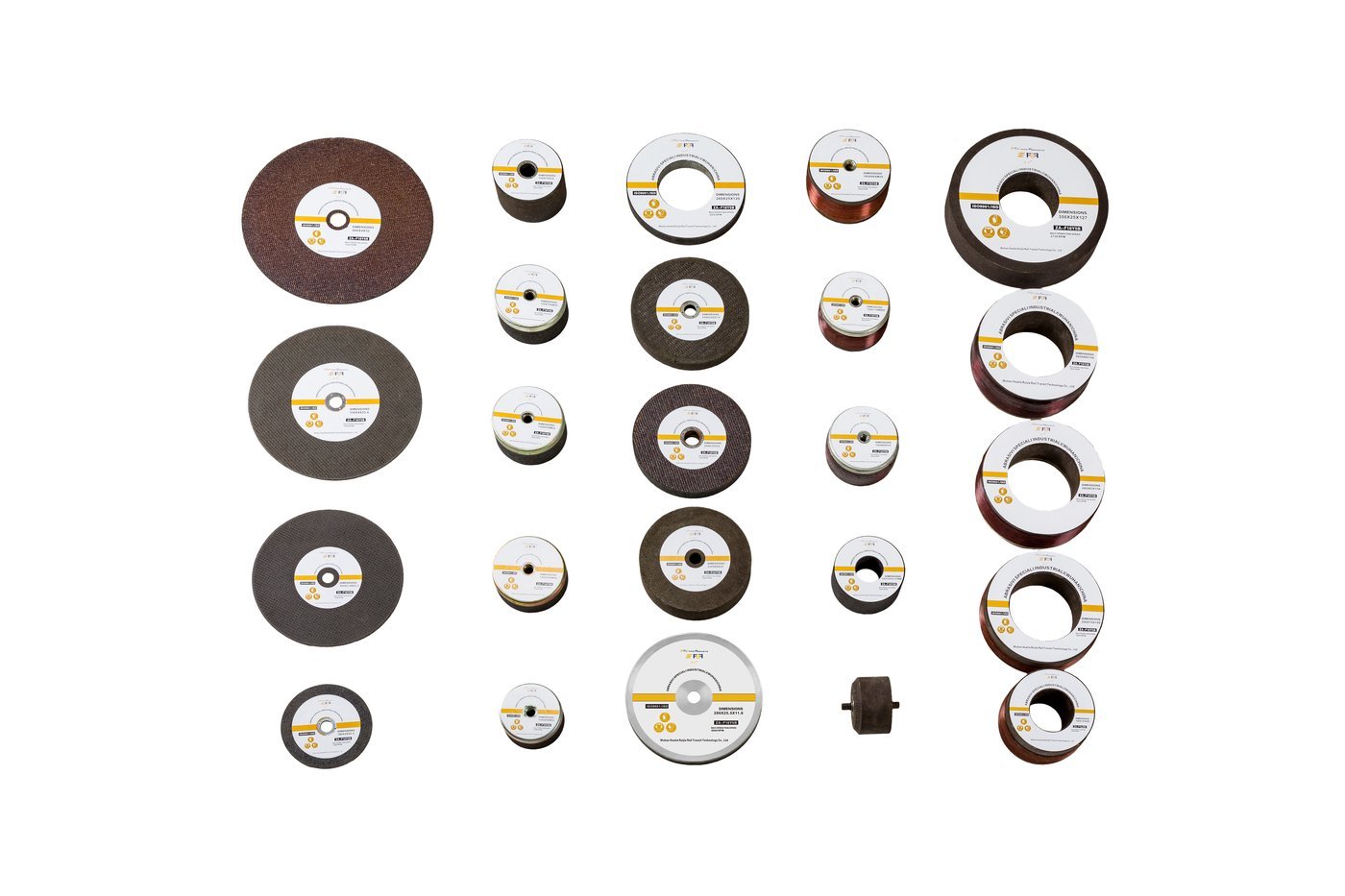
What is actually happening at the contact face
Instrumented grinding tests on rail steel show the friction coefficient at the wheel/rail interface passing through three stages:
| Stage | What happens | Interface friction | Spark pattern |
|---|---|---|---|
| I — engagement | Grain cuts deeper into the rail head; more grain comes into contact | Rises | Heavy |
| II — dulling | Grain wears flat and the wheel loses cutting ability; partial grain fracture and local bond shedding briefly restore sharpness | Falls, with fluctuation | Reduces |
| III — steady state | Bond wear exposing the next grain layer balances grain dulling | Stable | Stable |
Glazing is Stage II that never recovers into Stage III. If the bond cannot wear back, no fresh grain ever appears, and the wheel settles into a polished, non-cutting face. In our own test series the reference rail wheel ran at 0.79 g of rail removal, an interface friction coefficient of 0.46 and a grinding ratio of 35.1 — that is what a healthy, self-sharpening wheel looks like.
The measured evidence: what a glazed face looks like under the microscope
Three test wheels made with progressively more bond filling the grain structure were ground against rail steel under identical conditions, then examined:
| Wheel | Structure before grinding | Condition after grinding |
|---|---|---|
| GS-1 | Grain forms a three-dimensional skeleton, evenly coated by bond; grain protrusion is good | Bond sheds partially, grain protrudes further to form cutting edges, and some grain fractures to expose fresh sharp edges — cutting ability actually improves |
| GS-2 | Grain skeleton is filled further by bond; protrusion is poor | Bond sheds only partially; the number of exposed cutting edges falls |
| GS-3 | Grain is almost completely covered by bond and cannot protrude | Very little bond sheds, so only a few minute grain tips do any cutting, and repeated sliding contact leaves scratches on the wheel face — the classic glazed wheel |
The same effect shows up in numbers. Three wheels of increasing strength, GS-10, GS-12.5 and GS-15, removed 1.0 g, 0.7 g and 0.2 g of rail respectively — GS-15 fell about 71% below GS-12.5 — while their grinding ratios rose from 12.8 to 16.0 to 24.1. Read that pair together: the strongest wheel was the most wear-resistant and the worst at cutting. Wear resistance alone is not a selling point; it is exactly the mechanism behind glazing. The same lesson comes from bond content alone: wheels pressed at low, medium and high bond content measured compressive strengths of 68.9, 95.2 and 122.7 MPa, and the strongest cut worst, because a bond-rich structure is so dense that grain cannot protrude.
Metal-bonded wheels make the point at the extreme: an iron-bond wheel measured a grinding ratio of 686, roughly 15 times a resin-bonded rail wheel, but the bond is so strong that it never wears back, the grain never re-exposes, and the wheel glazes. It also needs dressing, which a grinding train cannot do — which is why every rail grinding wheel in line service is resin bonded.
Five checks to run before you blame the wheel
- Grade and grit against the duty. Harder grade and finer grit hold the grain longer. If the machine has plenty of power and the removal target is light, the wheel rubs instead of cutting.
- Wheel speed against the rating. Excess speed with light contact pressure is the shortest route to a polished face. Check the wheel's rated speed (rpm at 50 m/s) against the actual spindle speed of the machine.
- Depth of cut and machine power setting. Too light a pass does not develop enough force to fracture or release grain. Rail wheels are rated in passes per kilometre for a reason — the removal target has to match the wheel and the power.
- Contact geometry. Check that the head is not riding the gauge corner or the field side, that the unit's angle is set for the target profile, and that nothing is bottoming out on the flange. A wheel that touches only on a narrow band reaches neither the pressure nor the removal it was specified for.
- Mounting and run-out. A wheel not seated flat on a dirty or burred flange runs out of true: it touches intermittently, removes less, and heats the face unevenly. Re-seat it and re-check.
One thing to be clear about: on a grinding train there is no dressing station. Once a rail grinding wheel has glazed in service, it will not recover its cutting ability on that machine. It either has to come off, or the job conditions have to change.
Case data: what the matched wheel delivers
Where the wheel is matched to the machine and the duty, the numbers are unambiguous. On a GMC-96X grinding train at Liuzhou, one 2-hour possession produced 18.72 passes per kilometre, and the wheels ran 20–30 mm of wear against 43.5–59 mm for the imported wheel on the same duty — about two times the wear life. A half-car comparison on the same railway measured 1.5× the life of the imported wheel. On the Yi-Yang line the wheel delivered 5.7 passes per kilometre per millimetre of wear; on the Shuo-Huang heavy-haul line, 4.98. On the He-Wu high-speed line in 2020 the figures were 4.28 against 3.27 passes per kilometre per millimetre for the import, with a single wheel reaching 214.22 passes per kilometre and no continuous blueing. Wheels are accepted to Q/CR 1-2014, with a design life of not less than 100 passes per kilometre, and the standard RailwayCare helped draft, JB/T 11431, defines the dimensional and grading framework these wheels are built to. Molaton rail grinding wheels are specified grade by grade against the machine and the defect being chased, and every batch is traceable to its own test record.
Related questions you may also ask
What grit size and abrasive should I use for rail grinding? Ceramic vs zirconia alumina: which abrasive is better? Resin bond vs vitrified bond rail grinding wheels Domestic vs import rail grinding wheels: five key indicators compared What actually drives the cost of a rail grinding wheelCutting, not polishing
Send the machine model, the rail type and what your wheel is currently doing on track. Molaton will re-match grade, grit and bond to the duty, and back the recommendation with test data.
Ask for a Wheel Specification

Are you looking for a reliable manufacturer of railway grinding and track maintenance equipment?
We can quickly provide customers with market analysis, technical support and customized services.
Safe Tracks Proven by China
- Name
- Phone
- *Title
- *Content