Ceramic vs zirconia alumina: which rail grinding wheel abrasive is better?
Ceramic vs zirconia alumina: which rail grinding wheel abrasive is better?
On a rail grinding wheel, zirconia alumina wins — and it is what every rail grinding train in service actually runs. F16 zirconia-alumina (ZA) grain measures 308.0 MPa in compressive strength and a 41.0 grinding ratio, against 124.0 MPa / 22.4 for calcined brown alumina and 103.2 MPa / 11.9 for white alumina. Ceramic alumina has its own advantages, but they pay off in coated abrasives and precision grinding, not in dry, coarse-grit, 50 m/s rail work under a heavy head load. There is also a naming trap: in rail grinding, "ceramic" is far more often the bond than the grain — and a ceramic-bonded wheel is not specified for rail grinding at all.
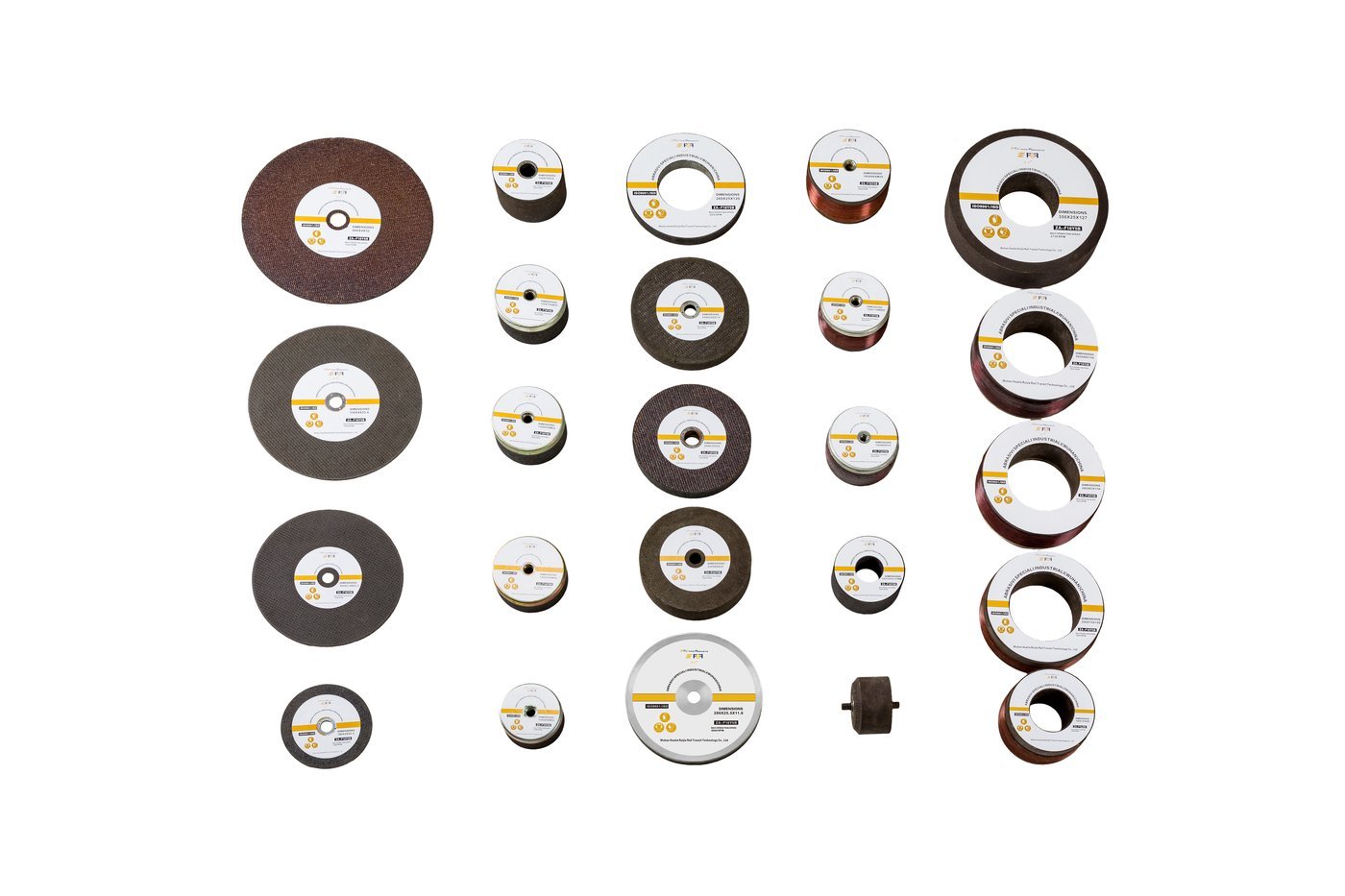
First, separate the two things called "ceramic"
| Term | What it actually is | Where it is used | Position in rail grinding |
|---|---|---|---|
| Ceramic abrasive grain | Microcrystalline / sol-gel engineered alumina that renews itself by controlled micro-fracture, exposing many small sharp points | Coated abrasives, precision and creep-feed grinding, stainless and high-tensile alloys where cycle time dominates cost | Not specified for rail grinding wheels — the grain renews by micro-fracture, which is the wrong mechanism for a coarse F14-F24 grain under extreme contact pressure |
| Ceramic / vitrified bond | Glass- or clay-based bond fired at high temperature; hard, rigid, chemically stable, but brittle with poor thermal conductivity | Precision and form grinding where dimensional stability matters more than shock resistance | Mismatched with rail grinding's high speed, high load, high temperature and strong vibration — no ceramic-bonded rail grinding wheel is reported in service |
If a supplier quotes "ceramic" for a rail wheel, ask which of the two it means. The answer changes the whole conversation: one is a grain proposal, the other is a bond proposal that rail grinding practice does not support.
What the measured data says about rail wheel grain
All three candidate grains were tested on the same instrument, at the same particle size (F16), with the finished wheels run under identical conditions:
| Grain | Composition | Compressive strength (F16) | Grinding ratio | Role on a rail wheel |
|---|---|---|---|---|
| Zirconia alumina (ZA) | Eutectic of Al2O3 and ZrO2, dense structure, high strength and toughness | 308.0 MPa | 41.0 | Base grain of the rail wheel range; built for high-speed, heavy-load, dry grinding |
| Calcined brown alumina (A) | Fused bauxite, calcined (which lifts fracture strength by about 15.6%) | 124.0 MPa | 22.4 | Blend partner: adds filler strength and self-sharpening behaviour |
| White alumina (WA) | Al2O3 content above 97%, harder but more brittle | 103.2 MPa | 11.9 | Fine and precision work — not heavy rail grinding |
Two other minerals are often proposed and both fall down for the same reason. Diamond has a strong affinity for iron, so at grinding temperature its surface graphitises and it loses cutting ability on steel. CBN is tough, thermally stable and hard, but its grain size (maximum under 500 µm) and price make it uneconomic in the coarse, heavy-load rail duty. That is why rail wheel manufacture settles on the corundum family, and on ZA in particular.
Grain size is part of the same decision. Rail wheels are made in the F14-F24 band, most commonly F16 and F20, and blending is how the balance between cutting and wear resistance is tuned: a low-ratio F16 + F30 ZA blend reached 4.0 g of rail removed at a 46.2 grinding ratio; an F16 ZA + brown alumina blend reached 8.1 g at 37.8; and adding a composite superhard grain to F16/F20 ZA + A reached 12.2 g at 43.1 — about three times the reference removal target. Cutting geometry matters too: finite-element modelling shows a grain with a 15° rake angle forms a continuous ribbon chip with lower force and temperature, while blunt, high negative-rake grains produce small chips, high stress and a poorer rail surface.
Evidence: what the grain choice delivers on track
The comparison is not theoretical. On the Liu Zhou GMC-96X in 2022, our composite-grain wheel wore 20-30 mm against 43.5-59 mm for the imported wheel over the same track, while a two-hour possession delivered 18.72 pass-kilometres. In the Liu Zhou development programme, the composite-grain wheel reached 100-150 pass-kilometres per wheel against 50-60 for imported or ordinary wheels, and removed common rail defects in 2-3 passes instead of 4-6. On the Hewu high-speed line in 2020 the same range measured 4.28 against 3.27 pass-kilometres per millimetre of wheel wear, at 214.22 pass-kilometres per wheel, with no continuous burning.
The thermal side is measured too. In rig testing at 3,600 rpm, our wheel face ran at 124 °C maximum and 55 °C minimum against 143 °C and 68 °C for the imported wheel — better heat transfer from the contact zone, which is what keeps a rail surface free of blueing. Rig service life measured about 60% longer than an ordinary wheel of the same format. Grain selection, in other words, shows up as wheel life, pass count and rail surface quality, not as a catalogue claim. Compare the full Molaton wheel range by railway type.
Related questions you may also ask
What grit size and abrasive should I use for rail grinding? What does a 260×90×154 mm wheel specification mean? What types of railway grinding wheels are available for different railways? Domestic vs imported rail wheels: five performance indicators compared Railway grinding wheel product rangeTell us the track, we will tell you the grain
High-speed, heavy-haul, metro or turnout — each duty has a different balance of cutting rate and wheel life. Molaton will recommend the grain, grit and blend for your machine and confirm it against test data from lines like yours.
Request a Grain Recommendation

Are you looking for a reliable manufacturer of railway grinding and track maintenance equipment?
We can quickly provide customers with market analysis, technical support and customized services.
Safe Tracks Proven by China
- Name
- Phone
- *Title
- *Content