Rail Corrugation Grinding: How to Remove Corrugation and Verify the Result
Corrugation is the rail defect that keeps coming back. A line is ground, the ride improves, noise drops - and two years later the same wavelength pattern is back on the same curve. The reasons usually have less to do with the cause of the corrugation than with how the grinding was done: too shallow a cut, a transition that leaves a step, or a grinding process that quietly writes a new periodic pattern of its own. This guide is about the execution side of rail corrugation grinding - how to measure corrugation properly, remove it at the right depth, avoid creating new irregularities, and verify the result against numerical acceptance criteria.
Why Corrugation Returns After Grinding
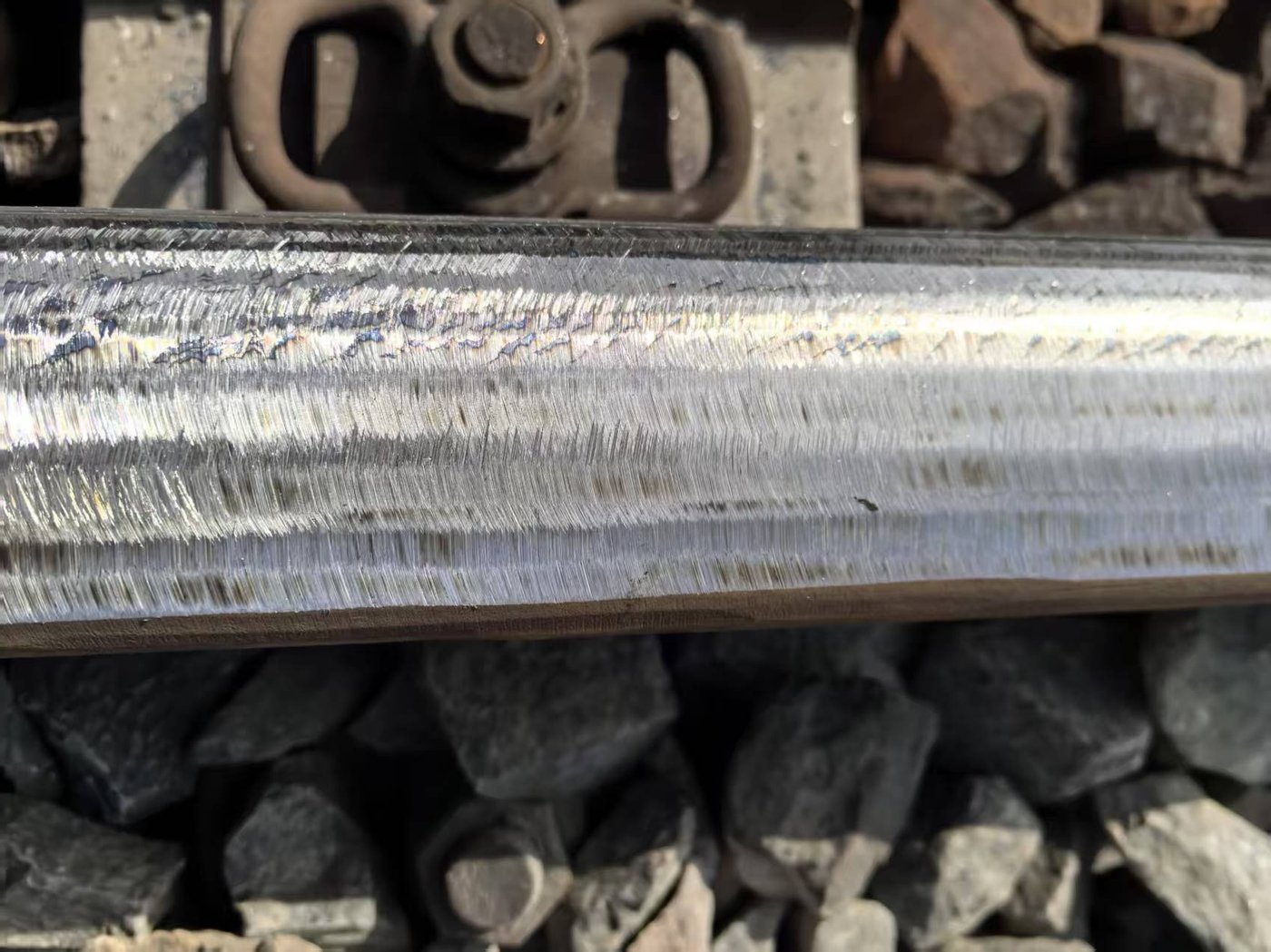
When corrugation reappears quickly after grinding, field experience points to four common execution failures:
- The cut was too shallow. Grinding that only polishes the crests removes the visible symptom but leaves the trough structure intact - the wavelength pattern re-establishes itself within a short time.
- The transition zone was too abrupt. A grinding site that starts and ends with a step creates a new dynamic impact at its boundary, which is itself an initiator of periodic wear.
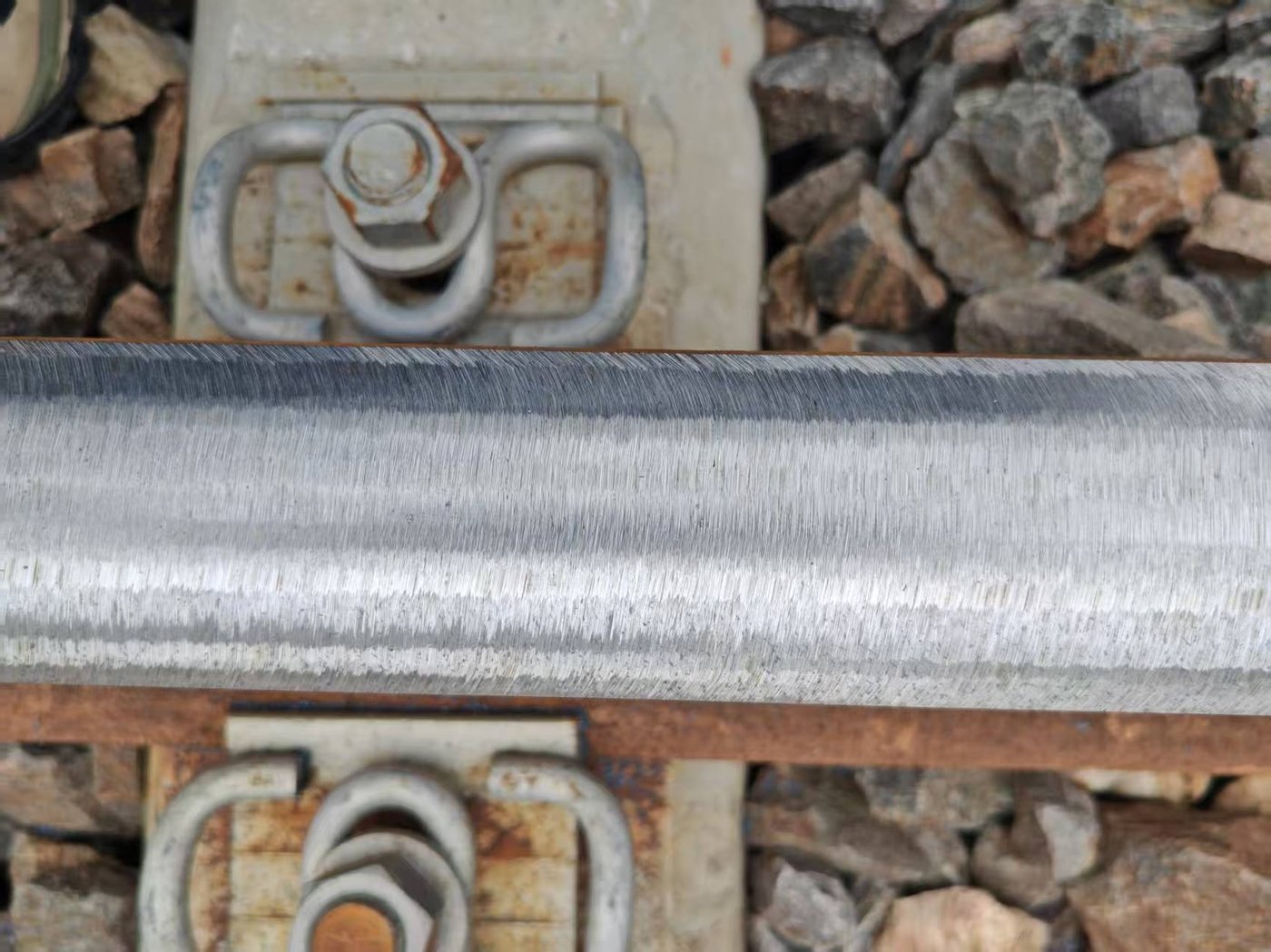
- The machine left its own pattern. Grinding modules rotate at 50-60 Hz; at working speeds of 5-10 km/h, the stone advances only 23-56 mm per revolution, and that pitch can be imprinted on the rail as cyclic scratch marks - which in turn can develop into short-pitch corrugation.
- The wavelength was never matched to the treatment. Short-pitch corrugation (10-300 mm) responds to grinding; long-pitch corrugation beyond 300 mm is generally a job for milling first, then grinding.
Understanding what corrugation is and why it forms is a subject in its own right - see our guide to rail corrugation causes and precision grinding solutions. The rest of this article assumes the defect is present and the question is how to remove it properly.
Step 1: Measuring Rail Corrugation by Wavelength Band
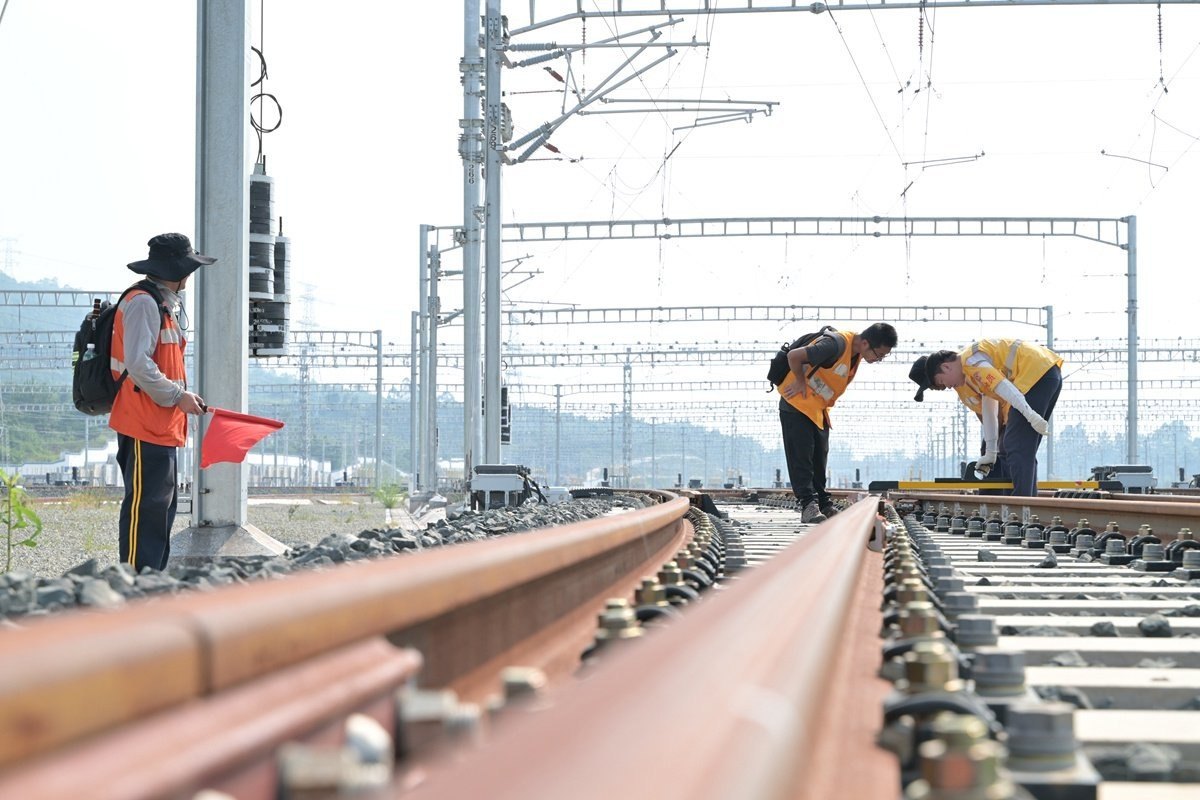
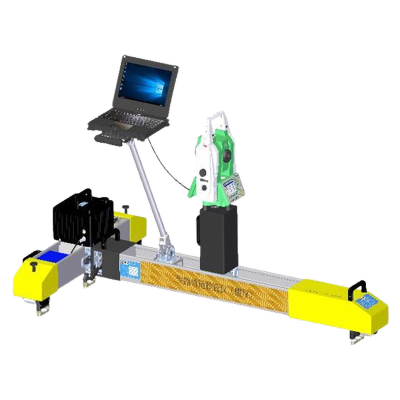
Corrugation acceptance and removal are organised by wavelength band, so the first step is always measurement. In Chinese railway practice, corrugation is assessed in four bands - 10-30 mm, 30-100 mm, 100-300 mm and 300-1000 mm - each with its own evaluation window length (typically 600 mm for the two shortest bands, 1000 mm and 1500 mm for the longer ones) and its own trough-depth limit.
Practical measurement rules that decide whether the numbers are trustworthy:
- Measure at the right place. Instrument ends must be located at the wave nodal points, not placed arbitrarily on the rail; trough depth is evaluated as an average over the stated window rather than as a single worst reading.
- Use instruments with at least 0.01 mm resolution, and evaluate trough depth over a length not shorter than the window size for that wavelength band.
- Measure within the acceptance window. Chinese practice requires post-grinding measurement within 8 days or before 0.3 million gross tonnes (MGT) of traffic has passed - after that, traffic wear begins to mask the grinding result.
- Use the right survey method. Continuous measurement over 100 m (vehicle-borne systems) or 30 m (hand measurement) is the reference for the allowable exceedance rate - typically 5% of the measured amplitudes per wavelength band.
- Complement with a 1-metre straightedge and roughness check. In Chinese maintenance practice, a corrugation trough deeper than 0.5 mm on lines below 120 km/h (or 0.3 mm above 120 km/h) is already classified as damage requiring action, and 1-m straightedge acceptance is set at a trough depth below 0.2 mm.
Before grinding, record the profile and the corrugation spectrum; after grinding, the same measurement repeats. Without the "before" data, there is no way to prove how much corrugation was actually removed - and no way to explain a quick recurrence.
Rail Corrugation Removal: Matching the Treatment to the Wavelength
Treatment follows wavelength, not habit:
- Short and medium wavelengths (up to about 300 mm). Grinding is the correct remedy. Chinese practice for conventional lines is to grind to a depth of at least the measured trough depth plus 0.2 mm, so that the new surface sits clearly below the old trough line. Under TB/T 2658.22, grinding machines are expected to leave trough depth below about 0.04 mm in the 30-300 mm band.
- Long wavelengths (300-1000 mm). Here the depth of material to be removed often exceeds what pure grinding can economically deliver, and the recommendation is to mill first (to at least trough depth plus 0.1 mm) and then grind to restore the profile.
- High-speed lines. Acceptance for 200-350 km/h lines is tighter: average trough depth of no more than 0.04 mm measured with on-board systems (0.08 mm with portable instruments), with wavelengths controlled below 300 mm. High-speed networks typically achieve this with frequent, light preventive passes rather than deep corrective cuts - the operating logic of high-speed passive grinding, which we cover in high-speed passive grinding parameters.
Rail Corrugation Grinding Parameters: Depth, Passes and Speed
Once the wavelength band and target depth are known, the grinding parameters decide whether the job is a one-pass success or a rework:
- Depth margin. Grind to at least trough depth plus 0.2 mm (conventional practice). The margin is what allows for the machine's own tolerance and for the fact that the deepest trough is not always where the measurement was taken.
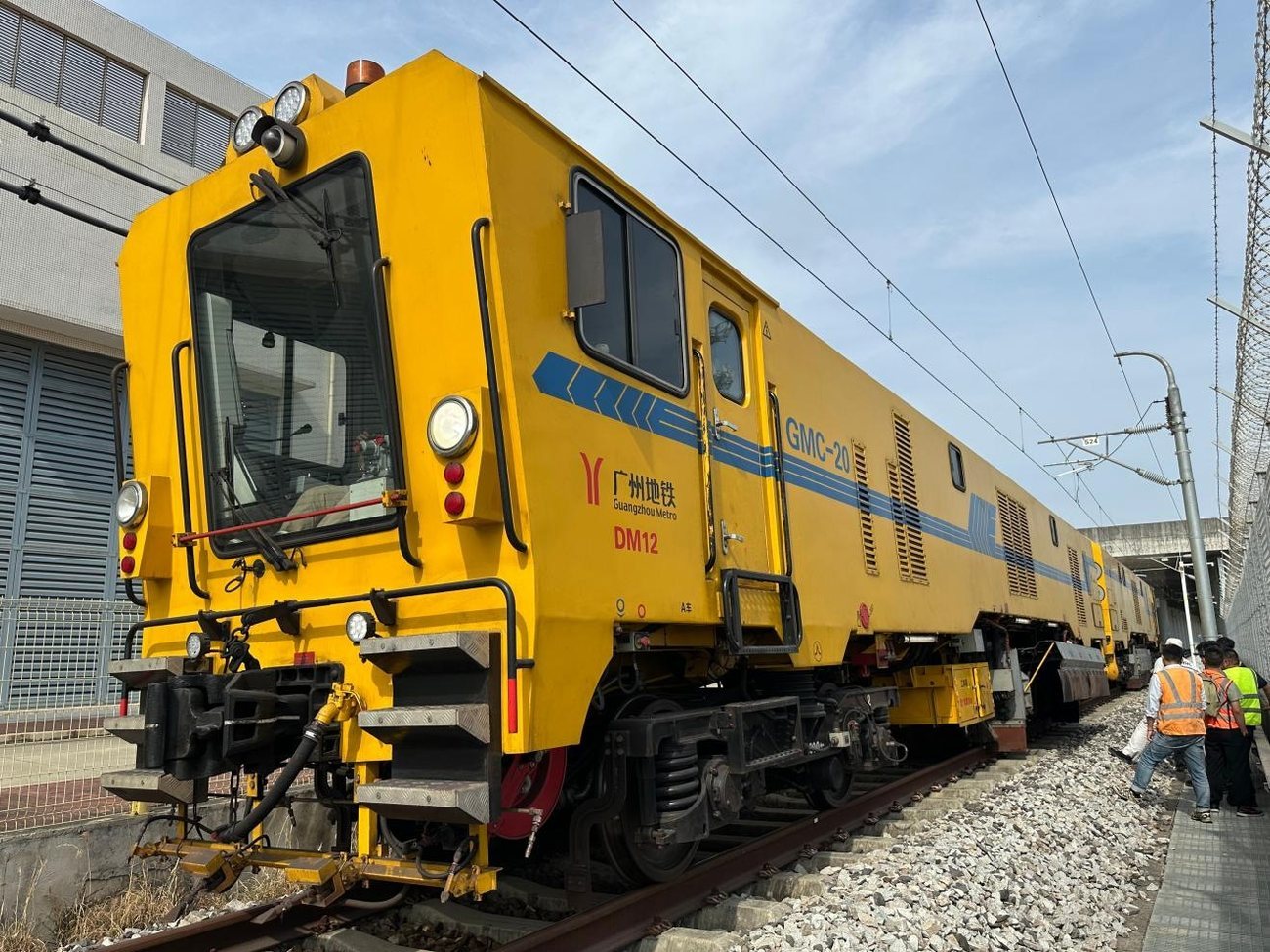
- Passes. In side-by-side work on a GMC-96X-class train, super-hard composite wheels cleared typical surface damage in 2-3 passes where conventional wheels needed 4-6 - the difference between one shift and two in a possession window.
- Speed and power. RailwayCare trials on a GMC-96X ran at 12-16 km/h with grinding power around 20 kW (about 68% of maximum) and motor speeds of 3,600 rpm; heavier removal needs slower travel, not more pressure.
- Removal per pass. A dedicated weld/profile machine like Autech's VM8000 12E removes 0.2-0.3 mm per pass at around 300 m/h - useful where corrugation is localised and a train is not justified.
- Transitions. Ramp the start and end of the grinding site over a distance long enough to avoid a step; a 1‰ longitudinal ramp is the usual acceptance floor, and longer, gentler transitions are better on high-speed track.
Don't Let Grinding Create New Corrugation
This is the failure mode that receives the least attention and causes the most repeat visits. Because grinding stones rotate about an axis normal to the rail, the geometry of the process leaves a small periodic pattern at the stone's advance-per-revolution pitch - typically 23-56 mm at normal working speeds. Normally this residue is negligible, but it becomes visible on the corrugation spectrum when:
- the machine travels too slowly for its spindle speed, compressing the pitch into the sensitive 10-30 mm band;
- spindle speed drops under load (worn drive, aggressive cut) so the pitch varies along the site;
- a stone is glazed or out-of-round, hammering the rail instead of cutting it;
- the site is stopped and restarted repeatedly, leaving overlapping start marks.
Standards address this directly: Australian practice (TMC 225) requires that ground rail show no cyclic grinding scratch marks at all, because such marks have the potential to develop into short-pitch corrugation. The practical countermeasures are steady travel speed within the machine's design envelope, sharp and round wheels, and a roughness check before leaving site - not just a profile check.
Machine and Wheel Selection for Rail Corrugation Grinding
Corrugation work spans two machine philosophies:
- Active grinding trains apply motor-driven, hydraulically loaded stones; they deliver the depth needed for corrective work on conventional and heavy-haul lines, and are the standard for the 30-300 mm bands.
- High-speed passive systems (HSG-class) grind at traffic speed with free-rolling stones - lower removal per pass, but the economics of frequent light passes make them the main tool against corrugation growth on long high-speed corridors. Their stones are a different family: zirconia alumina, typically Ø119-122.5 mm, rated up to 40 m/s.
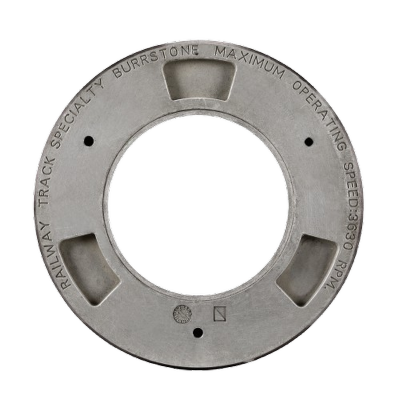
Whichever machine runs the job, the wheel determines whether the cut is cool and predictable. In heavy-haul grinding research, zirconia alumina achieved a grinding ratio of 41.0 against 22.4 for calcined brown fused alumina and 11.9 for white fused alumina, with compressive strength of 308 MPa versus 103-124 MPa for the fused aluminas. In Molaton's own thermal testing at 3,600 rpm, the workpiece ran at 124°C against 143°C for a Norton comparison wheel - the difference between a pass that scans clean and one that leaves blueing. Format coverage for the main machine families is set out in our rail grinding machine manufacturers directory.
Measuring the Result: What the Scanner Should Show
After a corrugation campaign, the profile scanner should show three things: the corrugation is gone by depth, the profile is restored, and the surface is not burnt.
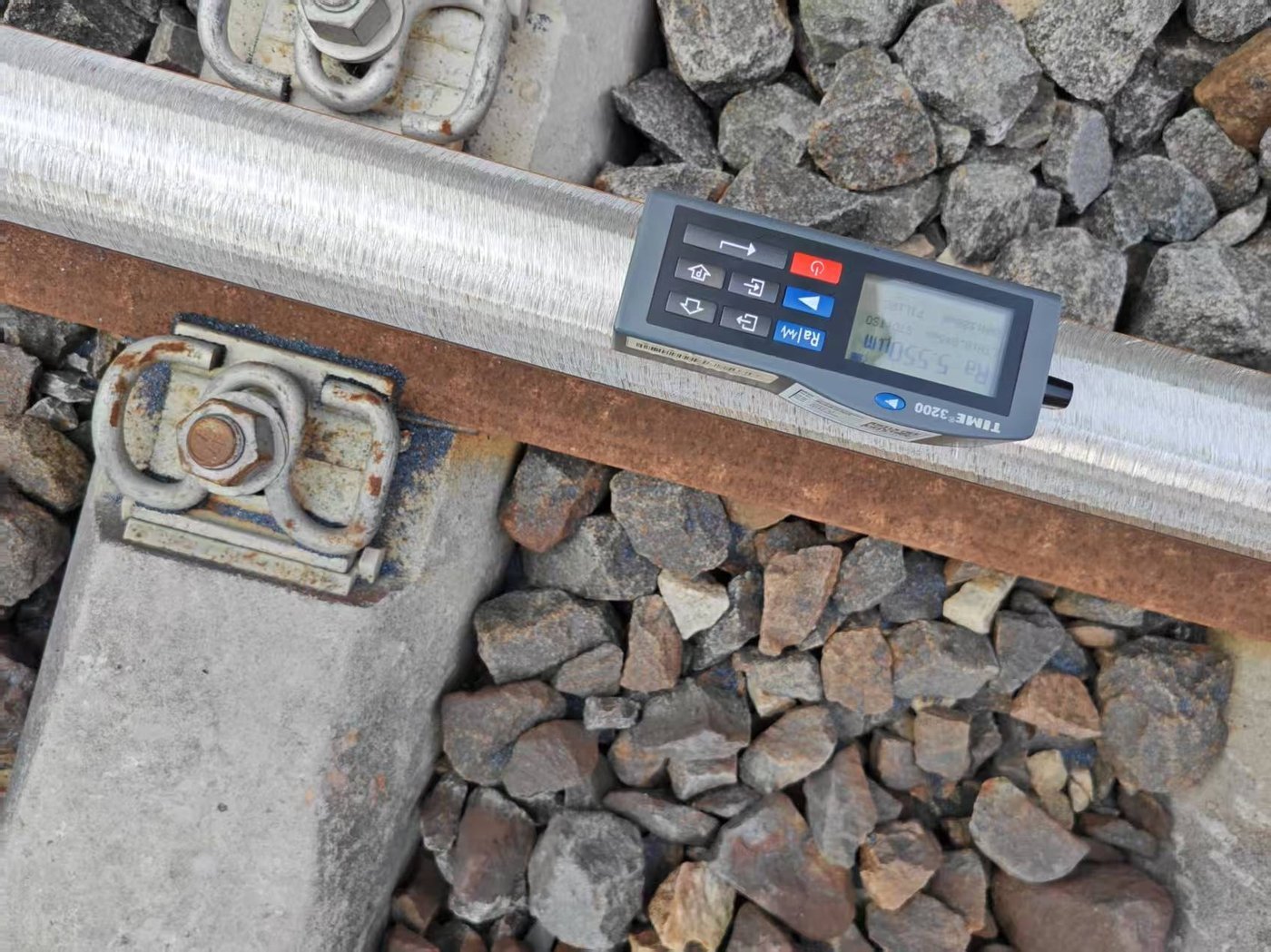
In a 2026 trial on a Loram-type grinding machine (DM01, 80% power, 7 km/h), Molaton stones were measured with a MiniProf-style scanner before and after every pass. Metal removal per pass measured 0.142-0.241 mm on the inner rail zone, 0.165-0.326 mm on the outer rail zone and 0.193-0.222 mm on the rail crown - enough to sit below a measured trough line - and the finished surface measured Ra 1.05-9.0 µm with no blueing. Those three numbers - removal depth, roughness, absence of blueing - are the ones to insist on in every measurement report.
Acceptance: The Numbers That Close the Job
Corrugation grinding is accepted against wavelength-specific limits rather than a single figure. The framework used in Chinese practice (and mirrored in international standards such as EN 13231-5 and TMC 225) works like this:
| Check | Typical requirement |
|---|---|
| Average trough depth, 10-30 mm band | ≤ 0.02 mm |
| Average trough depth, 30-100 mm band | ≤ 0.02 mm |
| Average trough depth, 100-300 mm band | ≤ 0.03 mm |
| Average trough depth, 300-1000 mm band | ≤ 0.15 mm |
| Exceedance rate | ≤ 5% of amplitudes per band |
| Measurement timing | Within 8 days or 0.3 MGT after grinding |
| Surface roughness | Ra ≤ 10 µm (≤ 6 µm in noise-sensitive areas) |
| Burn marks | No continuous blueing / no thermal damage |
| Cyclic grinding marks | None (they can become new corrugation) |
| Parent-metal removal | Within allowance (about 0.5 mm in repair grinding) |
Alongside the corrugation limits, the general acceptance criteria for ground rail still apply: profile match to target (GQI ≥ 85 is classed as good on networks that score it), longitudinal ramp of at least 1‰, and roughness within the Ra limits above. Our article on grinding acceptance standards covers how these criteria are applied in practice.
Rail Corrugation Grinding in Practice: Field Data
Rail corrugation removal rarely happens in isolation - it is executed as part of a grinding campaign, and the consumable data shows what a campaign can deliver:
- GMC-96X half-car comparison (China): Molaton wheels consumed 20-30 mm per wheel over the trial against 43.5-59 mm for Norton comparison wheels - roughly double durability - with equivalent surface quality and less smoke.
- Heavy-haul campaigns: on a 68 km heavy-haul line with fat-edge and fish-scale dominant, a GMC-96X-class train completed 145 pass-km at 5.7 pass-km/mm of wheel wear; on a 75 kg/m heavy-haul line, 172.8 pass-km at 4.98 pass-km/mm.
- High-speed line: 4.28 pass-km per mm of wheel wear against 3.27 for the incumbent wheel, averaging 214.22 pass-km per wheel.
- Possession windows: in one two-hour night window on a Chinese main line, a grinding train finished 18.72 pass-km - the practical scale on which corrugation programmes are budgeted.
- Environment: sulphur-free bonding cut SO2 in grinding fume by 30-35%, which matters for tunnels, metros and enclosed sites.
Keeping Corrugation Away: Prevention Strategy
Removing rail corrugation is expensive; preventing its return is cheaper. The maintenance loop that works:
- Baseline every sensitive section - curves, braking zones, metro tunnels, high-speed turnouts - with a corrugation spectrum, not just a visual check.
- Grind preventively with depth control. Preventive passes of about 0.1 mm on the rail crown stop the pattern from developing, against 0.2 mm or more for repair grinding.
- Re-measure within the acceptance window (8 days / 0.3 MGT) so the record shows the real trough depth that traffic is starting from.
- Track the trend per site. A site that needs repair grinding every year is telling you something about the wavelength, the machine or the wheel - link the corrugation ledger to your rail wear measurements (see our guide to rail wear measurement and grinding decisions).
- Standardise consumables per machine and band. Consistency of wheel format and abrasive is what makes year-on-year corrugation data comparable.
FAQ
How deep is "corrugation" that needs rail corrugation grinding?
In Chinese practice, corrugation trough depth beyond 0.5 mm on lines below 120 km/h (0.3 mm on faster lines) is classified as damage requiring action, and grinding acceptance is set so the remaining trough depth stays inside the band limits - 0.02-0.03 mm for wavelengths up to 300 mm, 0.15 mm for 300-1000 mm.
Is a 1-metre straightedge enough to measure corrugation wavelength?
It is a useful field check - acceptance in Chinese practice uses it at a 0.2 mm trough limit for conventional lines - but corrugation is defined by wavelength band and average trough depth measured over a specific window, so a corrugation gauge or profile scanner with 0.01 mm resolution is required for acceptance records.
Why does rail corrugation come back so quickly after grinding?
Usually because the cut was too shallow, the transition created a step, long-wavelength corrugation was ground instead of milled, or the grinding process left cyclic marks of its own at the stone's advance pitch.
Can rail grinding itself create corrugation?
Yes - cyclic grinding scratch marks at the stone's advance-per-revolution pitch (roughly 23-56 mm at normal working speeds) can develop into short-pitch corrugation. Standards such as TMC 225 therefore forbid cyclic grinding marks on the finished surface.
How often should rail corrugation grinding be scheduled?
It depends on the site: metros and small-radius curves need the tightest cycles, high-speed lines are managed with frequent light preventive passes, and heavy-haul lines follow wear and defect trends. The measurement programme should set the interval - not the calendar.
Get Corrugation Grinding Support
Whether you are fighting short-pitch corrugation in a tunnel or long-pitch waves on a heavy-haul line, RailwayCare supplies the wheels and the application data: grinding train wheels, high-speed stones and hand-machine wheels, backed by third-party test reports and field trials. Send us your corrugation spectrum, machine type and line conditions - we will recommend the wheel and the removal strategy for each wavelength band.
- WhatsApp: +86 15072332788
- Email: simon.wang@railwaycare.com
RailwayCare (Wuhan Huatie Ruijie Rail Transit Technology Co., Ltd.) – your professional partner in rail grinding, with Molaton grinding wheels field-proven on high-speed, heavy-haul and metro lines since 2004.