What is the target rail profile and who defines it?
What is the target rail profile and who defines it?
The target profile is not a machine setting. It is a maintenance specification owned by the track owner: a named template of rail-head coordinates, with tolerance zones drawn around it, chosen from the rail section, the traffic that runs on it and where the wheel actually contacts the steel. A grinding machine can follow a template perfectly and still leave the wrong shape, because the choice of template is made before the machine is switched on.
Three layers: who decides, what is written down, what gets checked
| Layer | Who owns it | What happens if the grinder decides instead |
|---|---|---|
| Template, the target head shape | Track owner, working to its national or company profile standard | Each pass copies whatever shape is already on the rail, so the error is inherited rather than corrected |
| Tolerance zones around that template | Track owner, or the acceptance standard it works to; the inspector applies them | Metal is spent polishing zones nobody asked about while the zone that governs ride quality is missed |
| Contact band position and width | Track owner, from wheel-rail contact studies | The band drifts to the field side or onto the non-working edge, the ride deteriorates, and the profile still "passes" |
| Depth and life budget | Permanent way engineers who hold the design wear allowance | Section is spent in the wrong place, and the rail is scrapped years before its planned life |
| Measurement reference | Agreed before work starts: same instrument class, same named positions | With no shared baseline, no result can be either proven or rejected |
The machine's part is execution. Profile control systems follow a stored template by copying the head closed-loop, and they follow it well — the accuracy of that following is a separate question, covered in how intelligent copying improves profile accuracy. But following is the whole of what it does. Nothing inside a grinding control system knows whether the loaded template suits a 60 kg/m main line carrying heavy axles rather than a lightly used siding; that judgement lives in the specification and in the engineer who wrote it.
UIC60, 60 kg/m, 60N: the rail name is not the target shape
| Name | What it actually designates | Where you meet it | What the grinder has to be told |
|---|---|---|---|
| UIC60 | A European rail section designation in the 60 kg/m class | European infrastructure managers and UIC-based track standards | The profile drawing and revision the owner works to — the name alone is not a shape |
| 60 kg/m | The Chinese standard rail section (TB/T 2344.1; switch and crossing rails under TB/T 2344.2) | Chinese main line, almost universally | Whether the target is the as-rolled head or the adapted profile below |
| 60N | An adapted, post-grinding rail-head profile rather than a rail section; Q/CR 583-2017 directs main lines to 60N or 75N | Chinese main line profile grinding specifications | This is the grinding target, and this is what gets loaded as the template |
| 75N | The adapted profile of the 75 kg/m family | Heavy-haul main line; the Shuohuang corridor runs 75N-U78CrV uphill and 60-U75V downhill | Which of the two templates applies to which track, direction by direction |
This is where enquiries go wrong. "Grind to UIC60" or "grind to 60 kg/m" states which rail is in the track; it does not state which shape is to be left behind. On the Chinese network the shape has an official designation and a clause behind it (60N, 75N); on UIC60 track the shape is issued by the infrastructure manager and has to arrive with the enquiry. If a package contains only the rail name, the correct response is a request for the profile drawing and its zone table — not an assumed template.
When the shapes do not match, the consequence shows up as a defect rather than as a paperwork error. Chinese permanent way guidance records the mechanism plainly: because wheel treads have adapted to the 60 kg/m and 60N profile, running on 50 kg/m rail readily produces abnormal rail-head wear and flange build-up. Nothing was ground badly in that example. The target shape and the wheel simply disagreed, and the rail paid for it. It is the same mechanism behind most complaints that "grinding does not last" on mixed-traffic networks.
How to write the target into a grinding specification
| Item in the specification | Why it must be explicit | How it is verified afterwards |
|---|---|---|
| Template identity: designation, drawing number, revision | Two drawings carrying the same name can differ between revisions | Loaded template record compared against the contract drawing |
| Zone definition and per-zone tolerances | The crown and the side zones do not share limits | Zone-by-zone comparison against the pre-work baseline |
| Contact band expectation | Band width and position are the outcome the wheel actually feels | Band checked at the same named positions, not "somewhere on the head" |
| Depth budget per campaign | Grinding spends a finite design allowance | Metal removed recorded and subtracted from the remaining allowance |
| Reference method | A result is comparable only if it was measured the same way twice | Same instrument class, same positions, pre and post, signed by both parties |
Chinese acceptance practice shows how tight the box is. At the crown the tolerance band runs +0.2 / −0.4 mm, and ±0.2 mm across zones 2, 3 and 4, with a profile quality index of 85 or better rated excellent and 70 or better acceptable. Contact band targets split by traffic: 25-30 mm on high-speed turnouts, 35-40 mm on conventional and heavy-haul. Depth is banded too — at least 0.2 mm per pass for pre-grinding and corrective work, at least 0.1 mm in preventive mode, and 0.5 mm on the parent metal as an acceptance ceiling that is never a target.
A wheel cannot choose a profile, but it can lose one. Shape-keeping depends on grade, balance and the way the wheel wears across its face, which is the manufacturing half of this same problem — the reason Molaton wheels are checked dimensionally and for balance batch by batch, and the reason RailwayCare treats the template and the consumable as two parts of one specification rather than two separate purchases. The Molaton range is listed by machine family in which wheel suits UIC60 and 60 kg/m profile work, which is the question that follows this one.
Related questions you may also ask
Rail profile grinding: techniques, standards and best practice What acceptance criteria decide whether a grinding job passed? What grinding depth is safe before you over-grind a rail? Target profiles and restricted zones in turnout grinding More answers on rail grinding strategy and equipmentNot sure which shape you are buying?
Send RailwayCare the rail section, the traffic mix and any profile drawing you hold. We will tell you which template applies, where the tolerance zones fall on your head, and which Molaton wheel family holds that shape on the machines you run.
Check the Template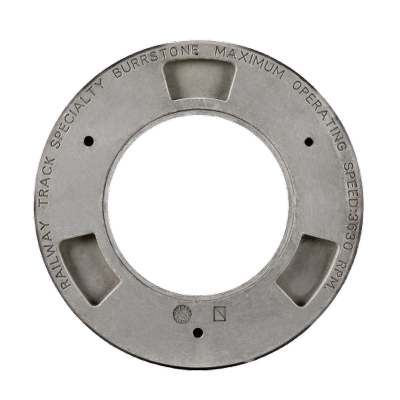
Are you looking for a reliable manufacturer of railway grinding and track maintenance equipment?
We can quickly provide customers with market analysis, technical support and customized services.
Safe Tracks Proven by China
- Name
- Phone
- *Title
- *Content