Millimeter-Level Wheel-Rail Profile Restoration: The Fundamental Solution for Abnormal Vibrations in High-Speed Trains
Vibration Types and Dynamic Mechanisms
During high-speed railway operations, any abnormal vibration detected on a train directly points to a deteriorated state of the wheel-rail contact system. Such vibrations are divided into two categories, both stemming from micron-level deviations in the wheel-rail contact geometry.:
1. High-Frequency Shaking and Bogie Alarms
When the contact point between wheel and rail becomes excessively concentrated on a certain area of the tread, resulting in excessive equivalent conicity, the bogie is prone to lateral self-excited oscillations at high speed – a phenomenon known as hunting motion. If the frequency of this oscillation couples with a low-order elastic mode of the car body, noticeable shaking occurs. If the vibration energy acts directly on the bogie frame and its acceleration amplitude exceeds the sensor alarm threshold, the train control system will trigger an alarm, potentially forcing deceleration or emergency stop, severely disrupting operations.
2. Low-Frequency Hunting and Reduced Ride Comfort
Conversely, if the wheel-rail contact geometry results in insufficient equivalent conicity, the steering capability of the train diminishes. In this state, the hunting frequency of the bogie may coincide with one of the car body's natural frequencies, inducing a low-frequency sway. This condition typically does not trigger a safety alarm, but the persistent rocking significantly degrades passenger comfort.
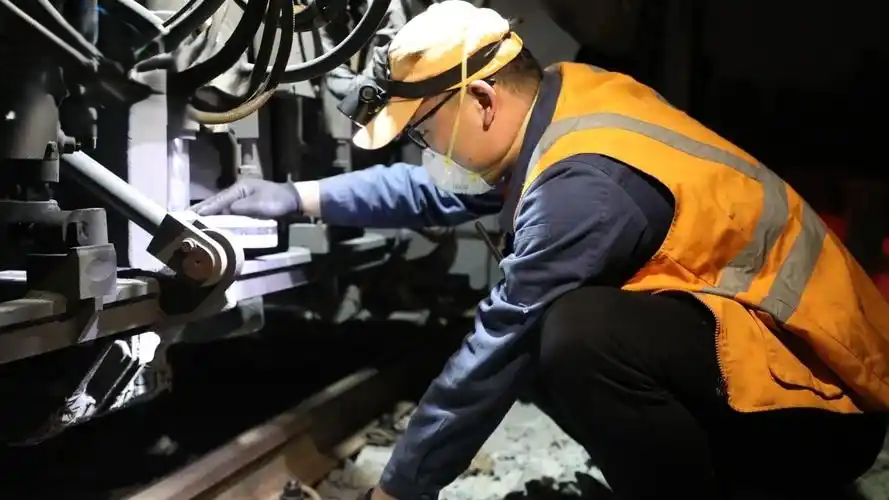
The root cause of these issues lies in the plastic deformation and wear (such as gauge corner fillet wear or head widening) that rails undergo during long-term service under repeated wheel loads and friction. This "profile degradation" alters the distribution of wheel-rail contact points, leading to abnormal fluctuations in equivalent conicity.
Diagnostic Process: Wheel-Rail Condition Assessment Based on Measured Data
Resolving vibration problems caused by profile degradation begins with an accurate diagnosis. The diagnostic procedure does not rely on subjective judgment but follows a quantitative technical path:
● Vibration Spectrum Analysis
Onboard monitoring systems capture acceleration data during anomalous vibration events. Fast Fourier Transform analysis is then used to identify the dominant frequency components. Different vibration modes have characteristic frequency ranges, which serve as the first step in identifying the nature of the problem.
● Precision Wheel-Rail Profile Measurement
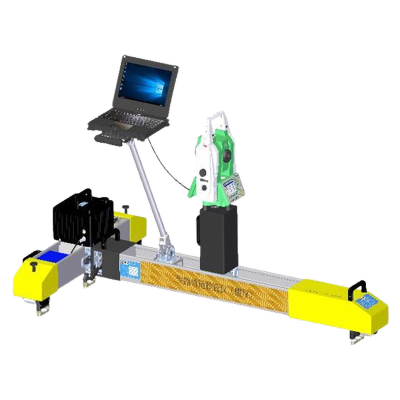
High-precision non-contact rail profile measurement instruments are used to densely sample the cross-sections of rails in suspected sections. These devices reproduce the actual rail contour with micron-level accuracy and overlay it with the standard profile, visually presenting the location and extent of wear.
● Equivalent Conicity Calculation and Matching Verification
Eq ivalent Conicity Calculation & Matching Verification: Based on the measured data of both the wheel tread and rail profile, wheel-rail contact geometry algorithms are used to calculate the actual equivalent conicity curve for the section across different lateral displacements. By comparing this curve with the design target, engineers can precisely locate the "crux" of the vibration issue.RailwayCare solution: Rail Profile Measuring Instrument – accurately measures rail profiles and calculates key parameters such as side wear, vertical wear, superelevation, track gauge, equivalent conicity, and wheel-rail contact characteristics.

Process Core: The Subtractive Manufacturing Logic of Target Rail Profile Grinding
After diagnosis comes treatment. Rail profile grinding is a precision subtractive manufacturing process aimed at "profile restoration" and "parameter optimization." Its core lies in target profile design and precise material removal.
1.Customized Target Profile Design
Engineers do not simply grind the rail back to its as-manufactured state. Instead, based on line-specific parameters – vehicle types, tonnage, curve radii, and measured wear characteristics – they design an “optimal target profile.” The design objectives include: eliminating surface defects (corrugation, head checks, shelling); centering the wheel-rail contact patch and controlling equivalent conicity within an ideal range; and improving stress distribution to reduce future wear.
2.High-Precision Grinding Execution
Modern rail grinding trains are the core equipment for executing this process. Operators input the designed target profile parameters into the grinding train’s computer control system. During operation, dozens of independently driven grinding motors drive abrasive stones to cut the rail at preset angles, pressures, and passes.
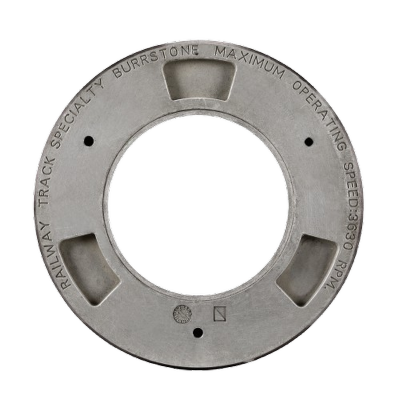
RailwayCare solution: Rail Grinding Vehicle for mainline continuous grinding and micro-defect removal; Rail Grinder Wheel (precision grinding stones) for profile restoration and defect elimination; Rail Grinder Machine for turnout, localized or corrective grinding.
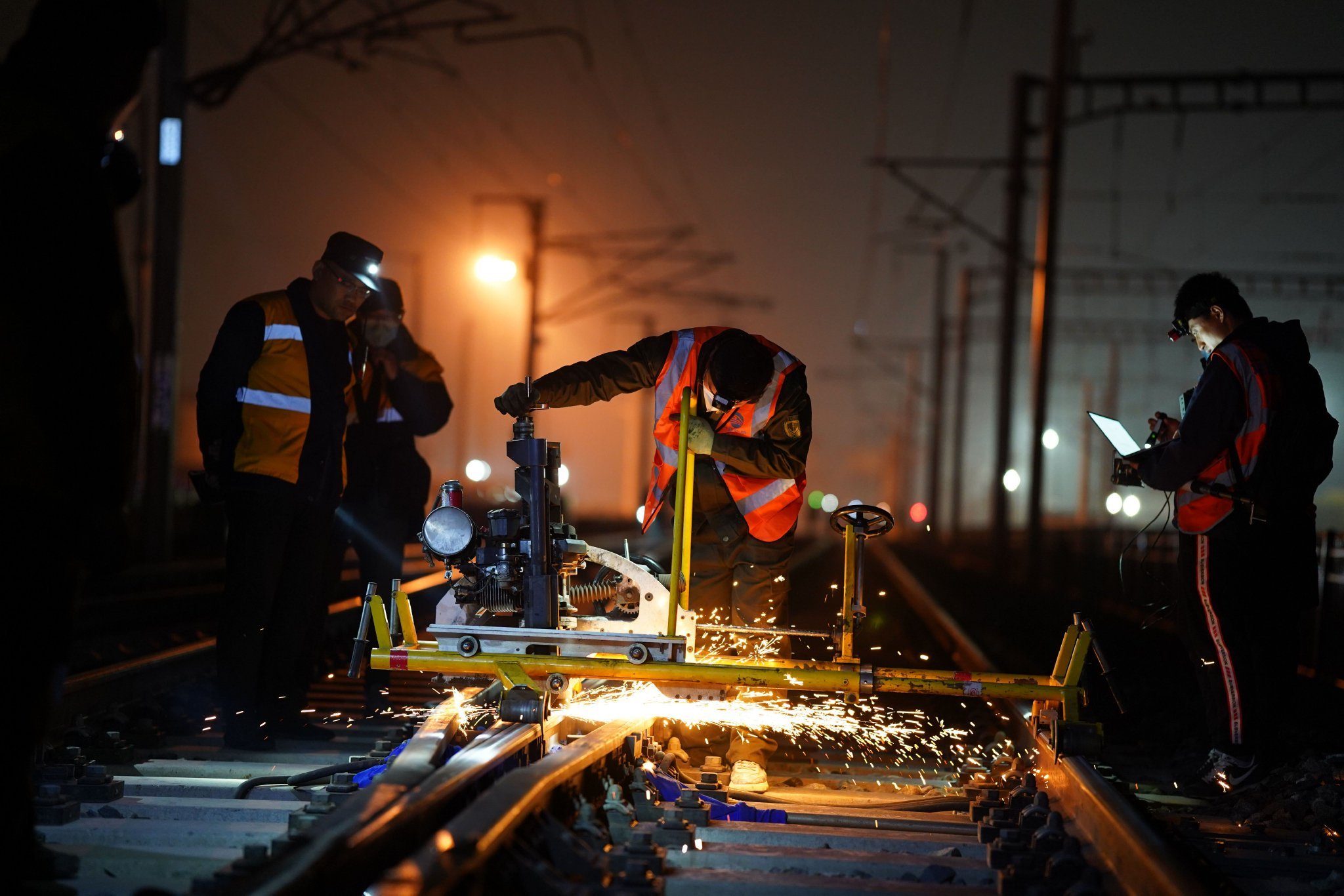
RailwayCare’s Integrated Solution: Full Lifecycle Grinding Process
To ensure the above theory translates into reliable on-track results, RailwayCare implements a four-stage closed-loop lifecycle:
1. Grinding Inspection
Track surface and internal defect analysis using visual and ultrasonic inspection tools.
RailwayCare applied equipment: Rail Profile Measuring Instrument, portable flaw detectors.
2. Grinding Planning
Selection of grinder wheel type and parameters based on rail material, defect severity, traffic conditions, axle load, speed, and track curvature. Target rail head profile is designed according to operational parameters (train type, axle load, speed, curvature).
RailwayCare applied equipment: Profile design software + grinding wheel selection database.
3. Grinding Execution
Controlled removal of metal layers using specialized grinder wheels. For mainline continuous grinding, the Rail Grinding Vehicle is used; for turnouts, small-radius curves, or spot correction, the Rail Grinder Machine is deployed.
Grinding strategy adapts to: mixed passenger-freight lines (short-pitch corrugation + head crushing), heavy freight lines (30-ton axle load, curve side wear up to 5–8 mm/year), and high-speed lines (sub-mm ripple elimination).
4. Grinding Verification
After grinding, rail geometry is checked using profile gauges or optical systems. Comprehensive verification includes: contour compliance, surface roughness (avoiding both over-polishing <10 μm Ra and excessive roughness), and structural integrity.
RailwayCare applied equipment: Rail Profile Measuring Instrument + roughness tester.
RailwayCare Professional Services
The millimeter-level rail profile restoration technology described herein is an engineering system covering vibration spectrum analysis, wheel-rail contact geometry calculation, and precise reproduction of target profiles. Based in Wuhan, China, RailwayCare (Wuhan Huatie Ruijie Rail Transit Technology Co., Ltd.) has transformed the rigorous challenges posed by China's complex geographical environment into a successful maintenance record spanning over 160,000 kilometers.
Contact us
The company offers the following end-to-end services:
Precision Diagnosis: Utilizing high-precision profilers and vibration data to pinpoint the root cause of conicity mismatch.
Customized Grinding: Providing compatible grinding wheels and grinding vehicles to execute the "subtractive art" and restore optimal rail geometry.
Intelligent Maintenance: Combining AI prediction and digital twin modeling to deliver proactive maintenance strategies.
If you are facing challenges with wheel-rail mismatch, anomalous vibrations, or high maintenance costs, contact us today. Backed by the practical experience of China's railways, we will provide the most reliable optimization solution for your network.