How to Grind Subway Rails: Urban Transit Grinding Programs
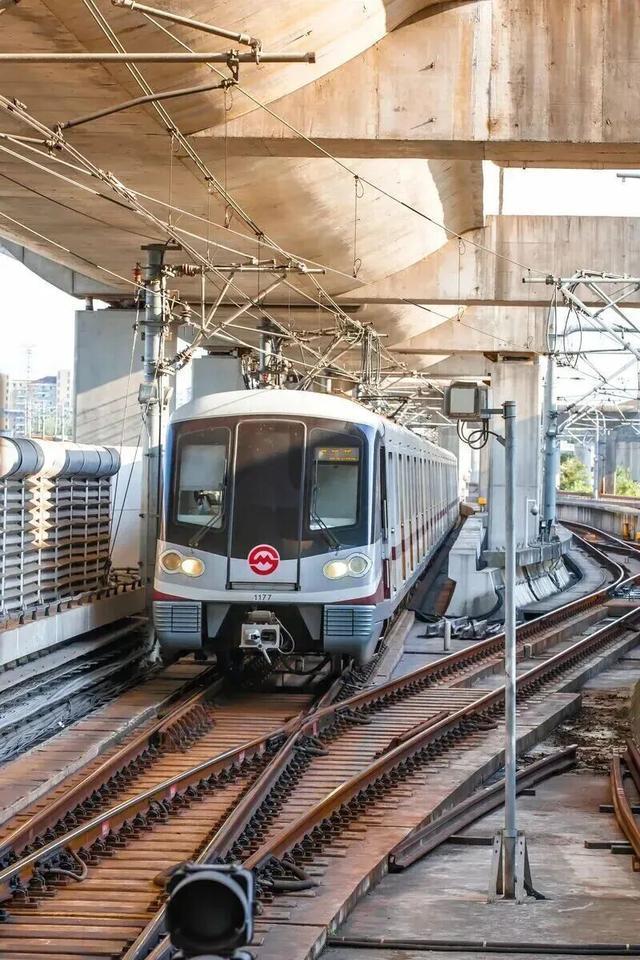
Subway and light rail systems ask more of a grinding programme than any mainline railway does. The window is three hours instead of a weekend, the working environment is a tunnel rather than open track, and the people who notice whether the job worked are not track engineers but residents living above the line and passengers sitting in the carriage. This guide sets out how transit grinding programmes are actually built — how much track a night really yields, what the tunnel changes about the method, where the equipment landscape sits, and how to accept the finished surface.
In one sentence: Grinding subway rails is a short-window, low-emission operation in a confined space, where progress is governed by the possession length rather than by machine capability, and where the finished profile has to satisfy acoustic as well as geometric criteria.
Why Grind Subway Rails in Metro and Light Rail Tunnels
Two mechanisms drive the case, and they reinforce each other.
The first is surface degradation. Transit track accumulates short-pitch corrugation and surface fatigue faster than mainline track at comparable tonnage, because the traffic is applied in a different pattern: many light axle passes at close intervals rather than heavy axle loads at long intervals, and a large share of those passes on curved track. Corrugation, fatigue cracking and side wear on tight-radius curves dominate the defect population on urban networks — the same defect families that dominate on mainline track, but arriving at different rates and in different places. What rail grinding does and why the schedule is set by defect type rather than by a fixed calendar is treated in full in our process guide.
The second mechanism is the consequence of not grinding. On a metro network the rails are hard and the wheels are softer steel, often imported and expensive to replace. When the rail surface develops corrugation and pit marks, the damage transfers to the wheel, and the wheel is the more costly asset. That is the argument several operators have used to justify grinding programmes ahead of any track-side failure: grinding the rail protects the fleet.
There is also an acoustic mechanism that has no mainline equivalent. Corrugation on rail generates noise that propagates through the tunnel structure into buildings above and alongside the alignment. Transport for London's own published position is precise about this and worth reading carefully: rail grinding is not treated as an engineering method for reducing noise, but residents on sections that were ground have reported lower noise levels, and the operator runs an enhanced grinding programme that triples the volume of grinding at prioritised sites. TfL also notes that the improvement from grinding is temporary — corrugation returns, and the programme has to keep running. That is an honest characterisation of what transit grinding can and cannot promise.
What Makes Urban Transit Rail Different from Mainline Track
Treating a metro grinding job as a scaled-down mainline job is the most common planning error. The constraints differ in kind, not just in degree.
| Constraint | Mainline | Urban transit |
|---|---|---|
| Possession length | Hours to a full weekend | Typically 2–4 hours nightly |
| Working envelope | Open track, generous clearances | Tunnel or viaduct, tight structure gauge |
| Curve radii | Rarely below 300 m | Frequently below 25 m; tramway curves below 20 m |
| Gauge-face access | Generally available | Often must be avoided in embedded and shared track |
| Axle load | Up to 30 t plus on heavy haul | Low maximum axle loads |
| Dominant defects | Profile loss, fatigue, corrugation | Short-pitch corrugation, side wear, surface fatigue |
| Acceptance driver | Geometry and rail life | Geometry, rail life and noise |
| Emissions | Dust nuisance | Dust that can damage catenary and signalling equipment |
Two entries deserve emphasis. The curve radii on urban networks are an order of magnitude tighter than the numbers most track engineers carry in their heads from mainline work; below roughly 25 m the steering geometry of a conventional grinding unit stops working, which is why the machines used on transit have bespoke guidance systems. And the gauge face is often not available for grinding at all: on embedded track shared with road traffic, the running surface can be treated while the gauge face must be left alone.
Night Windows: How Much Track Can Actually Be Ground
The published numbers here are sobering, and they are the single most useful planning input for a transit programme.
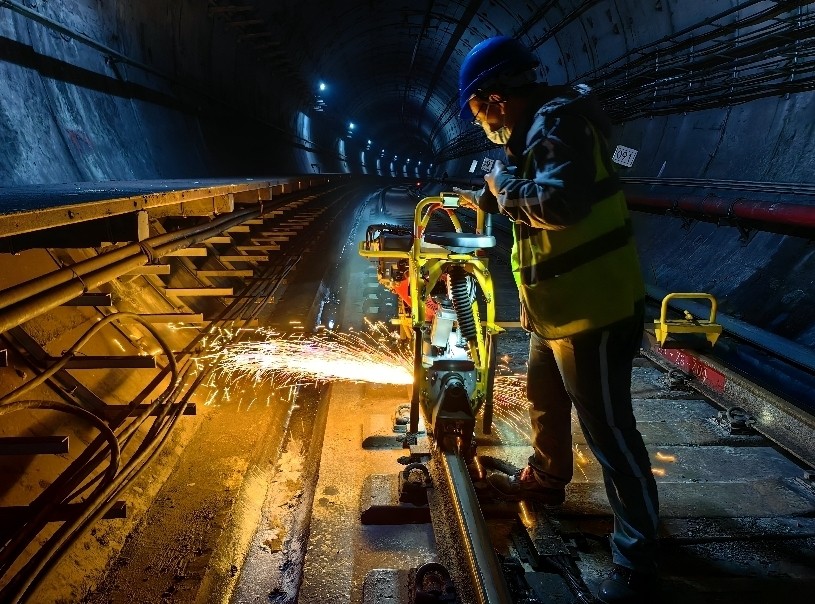
On Beijing metro Line 4, grinding is the last task of the night and must follow de-energisation of the track. The window runs from 00:30 to 03:30. In that window the grinding machine covers roughly 300 metres of track. Where the alignment carries many curves and small radii, progress is slower still, and in the most complex sections the large machine is abandoned altogether in favour of a small hand-guided grinder pushed along the rail by the crew.
Compare that with a mainline campaign, where a grinding train can cover several kilometres in a comparable possession. The difference is not machine quality. It is that a transit possession has to absorb travel to and from the worksite, de-energisation and re-energisation, protection, and the slower grinding speeds that tight curves and short wavelength targets demand — and it has to do all of it inside a window that ends before the first empty train runs. A recent Chinese-developed metro grinder, the GMCZ-10, is specified around exactly this problem: a 6 km/h grinding speed and a 45 km/h self-propelled transfer speed, with the transfer speed treated as a headline specification because it is the transit time that consumes the window.
Chennai Metro's programme illustrates the alternative approach. Work is carried out after operating hours, between midnight and 04:30, and the operator planned a 54 km stretch across 90 days. When a network cannot buy enough nightly capacity to cover its length at once, the programme has to be sequenced over months, and the sequencing logic becomes a maintenance decision in its own right.
The planning consequence: on a transit network, grinding capacity is measured in metres per night, not kilometres per shift. Interval planning, prioritisation between sections, and the choice between high-speed and conventional grinding all follow from that one number. Any programme built on mainline throughput assumptions will miss its own schedule.
Noise Limits and the Residential Constraint
Noise is where transit grinding differs most sharply from mainline practice, and it cuts both ways.
On the positive side, grinding is the most direct available intervention against the corrugation that produces tonal noise. Measured results are substantial: Plasser & Theurer's compact urban grinding trailer, developed under the Shift2Rail initiative, has demonstrated noise reductions of up to 8 dB after corrugation removal, dependent on train type. That is a large figure in acoustic terms, and it is achieved by restoring the running surface rather than by adding absorbers or barriers.
Three caveats belong alongside it. First, the improvement depends on actually removing the corrugation, not merely dressing it — one documented case required 10 to 20 passes at 30 km/h to clear corrugation in oscillating mode, and in another network, removing severe corrugation of 1.1 mm amplitude took 160 passes, against 60 passes for moderate corrugation of 0.35 mm amplitude. Second, the effect is temporary; TfL's assessment is that grinding achieves temporary improvements and the programme must continue. Third, noise from grinding works itself is a constraint: in enclosed tunnels the sound of the grinding stones against the rail is intense enough that crews cannot communicate without shouting, which is why transit work is scheduled after service rather than during it.
Dust and Spark Control for Grinding Subway Rails Underground
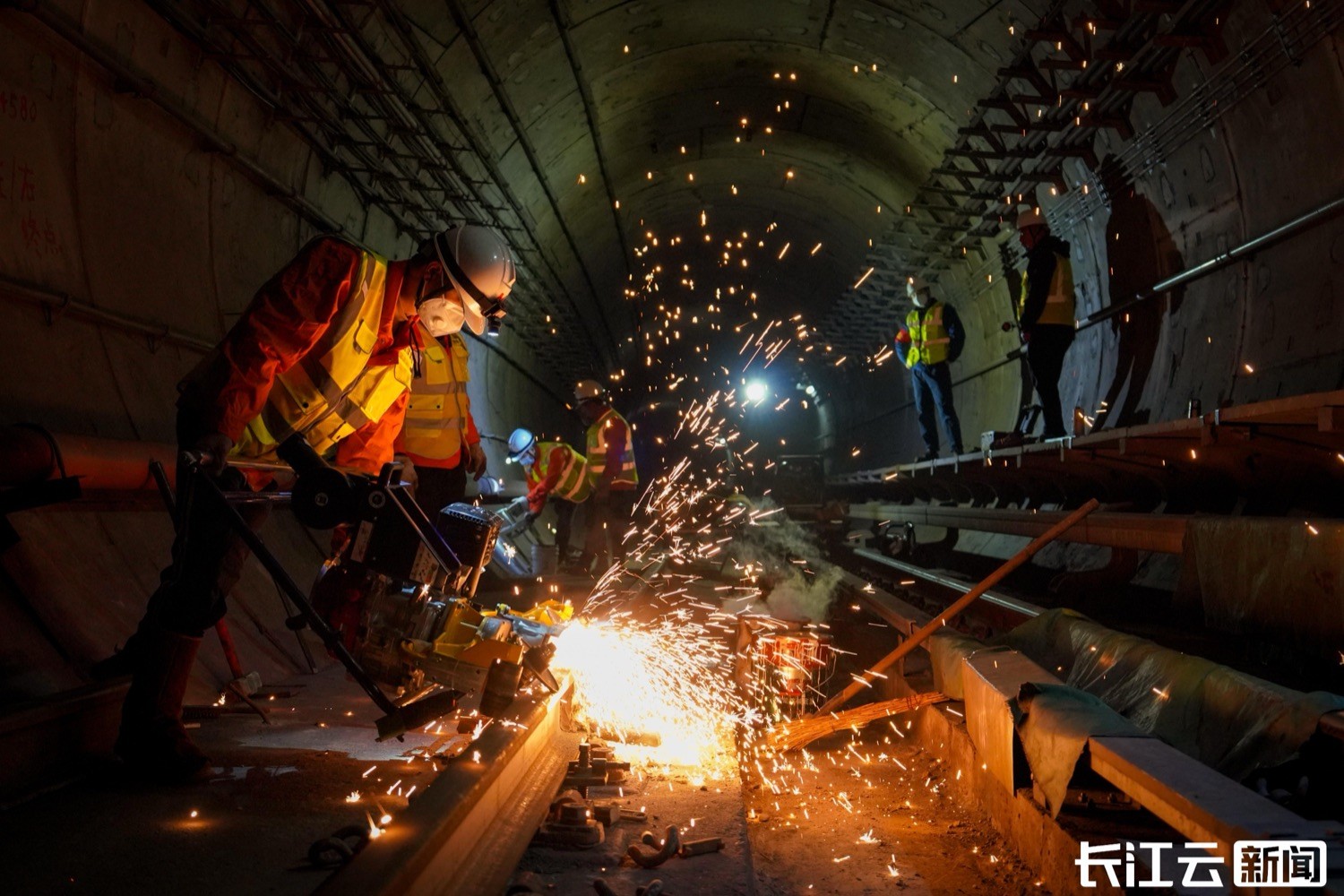
In a tunnel, the grinding swarf has nowhere to go, and what it lands on matters. Dust from conventional grinding can damage overhead catenary and signalling equipment, and a tunnel section is far less able to disperse heat, smoke or sparks than open track.
The requirements this generates are specific and testable:
- Extraction performance at the fine end. The specification to ask for is particle capture rate at sub-micron sizes, not a nominal extraction figure. The GMCZ-10 states capture of 99.9% of particles above 0.5 μm, together with a self-cleaning collection system so that captured dust does not re-entrain.
- Spark suppression. Water spray or wet grinding is standard for tunnel work. Plasser & Theurer's transit trailer carries a 2,600-litre water tank specifically to combine grinding-output enhancement with spark suppression, and the Chinese metro machine couples extraction with automatic spray to achieve spark-free operation. On a network with cables, drainage and signalling in the same envelope, spark suppression is a safety requirement rather than a housekeeping preference.
- Continuous working time. Tank and collection capacity set how long the machine can work before it must leave the tunnel. A tank sized for four hours of continuous operation matches a typical transit window; a smaller one converts your window into a cycle of exits and re-entries.
- Fire watch and housekeeping. Retention of swarf inside the machine is the control; the acceptance question is whether anything left the machine during the pass.
When to Grind Subway Rails: Metro and Light Rail Schedules
Transit programmes generally run on a mixture of scheduled and condition-triggered work, and the balance is the main strategic choice an operator makes.
Condition-based corrective work responds to measured corrugation, measured profile deviation or reported noise. It concentrates effort where complaints and measurements point, and it is how a network with limited nightly capacity gets the largest visible improvement per metre. Chennai Metro's sequence — grinding in 2015 shortly after opening, then in 2019 and 2021 — is characteristic of this approach.
Scheduled preventive work applies a shallow pass at a known interval to hold the surface below the threshold at which corrugation becomes audible and self-reinforcing. The relevant parameters are the shallow cut depths used in preventive grinding, generally at the lower end of the permitted range, and the noise benefit arrives as a by-product of keeping the surface smooth rather than as a remedial action.
High-speed preventive work is the third model and the one that changes the arithmetic. Because a high-speed grinder can work while travelling at speeds approaching the service speed of the line, the programme can be inserted into the timetable instead of fighting it. On the Stockholm metro, a network of around 110 km of double track, high-speed grinding is carried out at night during service breaks, removing corrugation and slip waves as a preventive measure. The trade-off is metal removal per pass: high-speed passes are shallow by design, so they suit prevention and light correction rather than the deep removal of established corrugation.
Whichever model a network chooses, the interval decision needs a measured input. That means a corrugation survey by wavelength band rather than a visual assessment, and a profile measurement that can be compared against the design profile — the same measurement discipline used on mainline track, applied to shorter wavelengths.
Grinding Equipment for Urban Transit Track and Depot Areas
The transit equipment market splits into three families, and most networks end up using more than one.
High-speed grinding machines. These grind while moving, at speeds up to around 60 km/h, and can be hauled or pushed by a locomotive. They are the only class that can work inside a live timetable, which makes them the tool of choice for preventive programmes on large networks.
Compact and light grinding units. Plasser & Theurer's transit trailer is the clearest example of the class: a unit that can be pushed or pulled by almost any suitable rail-bound or high-rail vehicle, including ordinary tramway vehicles, with its own power supply for the grinding units. This matters because it removes the need to bring a dedicated grinding consist into a depot that may not have the capacity to hold one. On the Chinese metro machine, a three-mode drive system covering self-propelled travel, grinding and emergency traction — switchable in around ten seconds — serves the same purpose of squeezing flexibility into a short window. Whichever machine is used, the consumable has to be matched to it, which is the subject of our article on matching rail grinder wheels to the grinding vehicle.
Hand-guided machines for the residual work. Turnout work, depot roads, the final metres before a buffer stop and the tight-radius sections that defeat a mounted unit all fall to hand-guided or small machines. This is not a fallback for want of a better option; it is how the work is done on complex sections, and it should be planned for in the programme and costed into it.
High-Speed Grinding: Working Within the Timetable
The distinguishing capability is the ability to grind at line speed. On the Stockholm metro the machine works at speeds of up to 60 km/h, which allows the programme to run alongside normal operations rather than displacing them. The value of that is not merely convenience. It removes the possession constraint entirely, which converts a programme that competes for track access into one that does not — and on a transit network, track access is the scarcest resource in the whole maintenance system.
The limit of the class is cut depth. High-speed passes are shallow by design, which makes them the right tool for prevention and light correction and the wrong tool for deep removal of established corrugation. A network that buys a high-speed machine expecting it to replace conventional grinding in a corrective programme will find the metal removal disappointing. Match the class to the task, and plan for both.
Compact Grinders for Tight Curves and Embedded Track
Tight curves are where the engineering gets interesting, because the two things a mounted grinder needs — a stable reference and access to the gauge corner — both disappear.
Two solutions have emerged. The first is a guidance system that keeps the grinding stones centred on the rail through very tight curves and compensates for gauge variation; one production unit is rated to hold alignment down to 17 m radius, well inside the range where a conventional unit would simply ride off the rail head. The second is a grinding strategy that treats only the running surface and deliberately avoids the gauge face — the correct approach for embedded track, and increasingly the approach used where the gauge corner is not the defect being addressed. Conventional grinding units use block grinding in two modes: oscillating, where the blocks move back and forth at adjustable frequency and amplitude, and sliding, where they are dragged along the rail. Oscillating mode can work from a standstill, with no minimum speed, and in one documented trial removed 0.01 mm per pass at 4 km/h — a light preventive cut, and exactly the sort of pass a transit network can fit into a nightly window.
Curves, Turnouts and Depots: Where Transit Grinding Concentrates
Programme effort on a transit network concentrates in three places, and the reasons differ.
Small-radius curves. Side wear concentrates on the gauge corner of the high rail. On urban networks the radii are tight enough that conventional wheel-rail steering is compromised and the lateral forces are correspondingly high, so these sections both wear fastest and benefit most from a correctly restored profile. The grinding approach for curved track — how to manage side wear, and how to verify the result — is treated in detail in our guide to rail grinding on curves.
Corrugation sections. Short-pitch corrugation is the defect that drives the noise programme, and removing it needs a wavelength-aware treatment. Removal is matched to the wavelength band, and the parameters differ between coarse and fine corrugation; our article on rail corrugation grinding explains how this works.
Turnouts and depot areas. Turnouts carry the defect population that mainline grinding units handle poorly: restricted zones at the frog, thin switch rail sections, and geometry that changes within metres. The large machine and small machine division of labour that this forces on an operator is a programme decision in its own right. Depot roads and sidings are usually addressed with small machines, and the same is true of the last section of a night's work where the alignment is too complicated for the mounted unit.
Acceptance Criteria for Transit Rail Grinding
Transit acceptance starts from the same foundation as mainline work, then adds indices.
The classic measurements remain the starting point, and a job can be judged against them before any more sophisticated metric is applied:
- Surface irregularities within 0.3 mm under a 1 m straightedge
- Surface roughness no coarser than 10 μm
- No burn or oxide layer on the running surface
- A fillet gradient better than 1‰
- Maximum cut into the parent metal of 0.5 mm
On top of those, the sector has moved towards profile-fit indices. The Grinding Quality Index published for Guangzhou intercity rail in 2024 scores the fit between the measured profile and the design profile from 0 to 100 across four zones of the rail head, with zone-specific tolerances, and sets explicit gates: an individual profile is excellent at GQI ≥ 85 and acceptable at GQI ≥ 70, while section acceptance requires the excellent threshold to be met with a standard deviation no greater than 8 and at least 70% of profiles rated excellent. Separate limits govern cut depth — at least 0.2 mm for pre-grinding and corrective grinding, at least 0.1 mm for preventive grinding — and the finished surface must show no continuous blue band and no periodic grinding marks.
Two of those requirements matter more in transit work than they do on mainline. The prohibition on periodic marks exists because a periodic pattern on the rail is itself a corrugation seed; on a network where the next grinding opportunity is months away, creating one is an expensive mistake. And the blue band prohibition is a heat-damage check — a burn on a small-radius curve becomes a crack initiation site in the section least able to tolerate it.
Common Mistakes in Urban Transit Grinding Programs
Planning to mainline throughput. The night yields hundreds of metres, not kilometres. Programmes built on the wrong number either miss their schedule or quietly reduce the area covered until the plan becomes meaningless.
Choosing the machine before the task. High-speed grinders, compact trailers and hand-guided machines solve different problems. A preventive programme and a corrective corrugation-removal campaign may need two different classes on the same network in the same year.
Ignoring the fine end of dust capture. A nominal extraction rate says nothing about whether sub-micron swarf is reaching the catenary. Ask for capture performance by particle size, and for evidence that captured dust stays captured.
Treating grinding as a permanent noise fix. It is not, and the operator that presents it as one will be answering the same complaints in two years. It is a recurring programme whose benefit depends on the interval being held.
Skipping the post-grind measurement. Removing corrugation cannot be confirmed by looking at the rail. It needs a measurement against the same wavelength bands that identified the defect, plus a profile record for the section.
Underestimating the residual hand work. Turnouts, depot roads and the tightest curves will not be machine-ground. Budget the labour for them at the planning stage or discover it at 02:00.
Plan Your Transit Grinding Work with RailwayCare
RailwayCare supplies the bonded abrasive rail grinding wheels that transit grinding machines run on — the consumable side of the rail grinder is where the profile is actually reproduced — matched to the machine's mounting and drive format rather than to a generic profile. The company took part in drafting JB/T 11431, the Chinese national standard for bonded abrasive rail grinding wheels, and the current edition dates from 2020.
For a transit programme, the wheel specification follows from the task. Shallow preventive passes on a scheduled programme, deep corrective removal of established corrugation, and hand-guided finishing at turnouts and depot roads each impose different demands on the stone, and the difference shows up in how consistently the profile is reproduced metre after metre — which, on a network that measures progress in hundreds of metres a night, is the whole basis for planning the next window.
The wider scope of what we supply for track work, from wheels to on-track measurement, is set out in our rail maintenance solution overview, and the operator-side side of the programme in our rail grinding training material. If you are specifying wheels for a transit grinding machine, or reviewing a subway grinding programme against profile and noise acceptance criteria, we are happy to work from your machine specification and your track conditions.
WhatsApp: +86 15072332788
Email: simon.wang@railwaycare.com
How do you grind subway rails in a tunnel?
With an enclosed machine that captures its own swarf and suppresses sparks. Grinding is carried out after the track has been de-energised, using a machine fitted with dust extraction rated at sub-micron particle sizes and a water or spray system that prevents sparks. Extraction and water capacity set how long the machine can work before it has to leave the tunnel, so both are sized against the possession length rather than chosen from a catalogue.
Can metro rails be ground at night?
That is when almost all of it happens. On Beijing metro Line 4 the window runs from 00:30 to 03:30 and must follow de-energisation, and in that window the machine covers roughly 300 m of track. Chennai Metro works between midnight and 04:30. The alternative on networks that can support it is high-speed grinding, which works while travelling at up to around 60 km/h and can therefore be inserted into the timetable instead of displacing it.
What grinder is used for light rail?
It depends on the track. High-speed grinding machines for preventive work across a large network; compact grinding trailers, which can be pushed or pulled by almost any suitable rail-bound or high-rail vehicle including tramway vehicles, for constrained depot and street sections; and hand-guided machines for turnouts, depot roads and curves too tight for a mounted unit. Tight street-running curves, sometimes below 25 m radius, are the reason compact units with dedicated guidance systems exist at all.
How often should subway rails be ground?
There is no single interval, because the drivers differ. A condition-based programme grinds when measurement shows corrugation or profile loss past threshold; a preventive programme grinds on a fixed interval at shallow depth to hold the surface below the point where corrugation becomes audible. The practical constraint on how often is nightly capacity — if a window yields a few hundred metres, the interval is decided by how long it takes to cover the network, not only by wear rate.
Why do metro rails corrugate so quickly?
Because of how the traffic is applied. Urban rail sees many light axle passes at short intervals, and a large share of them on tight-radius curves, rather than heavy axle loads at long intervals. Short-pitch corrugation and surface fatigue develop quickly under that pattern, and once corrugation is established it reinforces the dynamic load that created it. Removing it requires passes matched to the wavelength band — one documented severe case took 160 passes, against 60 for moderate corrugation.
Does grinding subway rails reduce noise?
It reduces the noise caused by rail surface condition, and that benefit can be significant — measured reductions of up to 8 dB have been recorded after corrugation removal, depending on train type. But it is not a noise-reduction method in the engineering sense. Transport for London's published position is that grinding is used to address rail defects and prolong rail life, that some residents report lower noise afterwards, and that the improvement is temporary because corrugation returns.