High-Speed Turnout Grinding: Large Machine and Small Machine Synergy for Rail Profile Excellence
High-speed railway turnout grinding is one of the most demanding operations in rail maintenance — and it is also where the quality of your railway grinder wheel matters most. A single turnout contains switch rails, stock rails, movable point rails, wing rails, and closure rails, each with different geometries, stress distributions, and accessibility constraints. The Beijing Railway Bureau's landmark study across 603 high-speed turnouts proves that success depends on one principle: large machine primary grinding plus small machine supplementary finishing, with a purpose-built railway grinder wheel for every stage of the process.
What Makes High-Speed Railway Turnout Grinding Different from Line Grinding
Turnouts are the most complex structures on any railway. Unlike straight-line track where a large grinding vehicle can pass through with consistent contact geometry, a turnout forces trains to transition between diverging routes through a series of precision-engineered components. The switch rail must move laterally while maintaining perfect contact with the stock rail. The movable point rail must bear heavy axle loads at the frog area where two tracks converge.
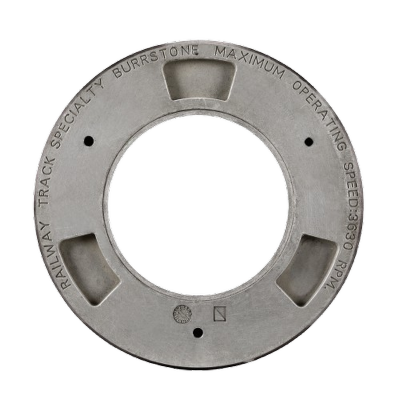
This structural complexity means that a standard railway grinder wheel designed for open-line grinding cannot simply be dropped into a turnout operation. The wheel must handle variable contact angles, restricted access zones, and the need for sub-millimeter profile accuracy. Molaton's hot-pressed zirconia alumina wheels are engineered specifically for this challenge: their self-sharpening zirconia grains maintain cutting efficiency through the varying pressure zones of turnout grinding, while the hot-pressed bond system provides the controlled wear rate needed for precision material removal.
High-speed railway turnout grinding requires coordinated effort between large grinding vehicles and small portable machines.
The Scale: 603 Turnouts and Why Every Railway Grinder Wheel Must Be Matched
The Beijing Railway Bureau's high-speed network includes 603 turnouts: 398 on mainlines, 117 on departure/reception tracks, and 87 on station sidings. The mainline high-speed turnout models include CN6118AS (1:18), CN6142AS (1:42), CN6139AS from China Railway Tiedeao, as well as the Kezhuanxian series: (07)006, (07)011, (07)009, and (07)004. Each model has unique profile specifications that demand precise matching between the railway grinder wheel formulation and the target rail profile.
From October 2014 to July 2015, the bureau conducted systematic turnout grinding operations on the Beijing-Shanghai High-Speed Railway (Cangzhou West Station and Dezhou East Station) and the Beijing-Guangzhou High-Speed Railway (Dujiaqian Interlocking). The conclusion was clear: generic wheels cannot achieve consistent results across this diversity of turnout types and operating conditions. Every railway grinder wheel in the operation needed to be selected based on its specific role in the grinding sequence.
Typical rail surface defects found in turnout areas before grinding intervention.
The Core Principle: Through-Grinding With Large Machine Primary and Small Machine Supplementary
The Beijing Bureau established a fundamental rule for high-speed railway turnout grinding: through-grinding. This means that the internal rail profile of the turnout — including the combined profile of switch rail with stock rail, and movable point rail with wing rail in the transition zone — must remain consistent with the line rail profile outside the turnout.
To achieve this consistency, the operation follows a clear division of labor:
- Large grinding vehicle (primary): Handles overall profile shaping within the turnout. The large machine processes the bulk material removal across accessible areas, establishing the baseline profile geometry.
- Small portable machine (supplementary): Addresses three critical gaps that the large machine cannot reach: (1) restricted zones where physical clearance prevents large-machine access; (2) profile deviations remaining after large-machine grinding; and (3) localized surface defects such as fish-scale cracks, rollover edges, and weld irregularities.
In this dual-system approach, the choice of railway grinder wheel for each machine category is equally important. Large-machine wheels must deliver high material removal rates over extended passes, while small-machine wheels require fine control and minimal heat input for delicate finish work near sensitive turnout components.
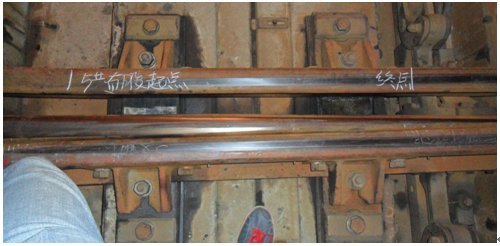
Light band condition in turnout transition zones — uniform light bands indicate proper profile matching.
Pre-Grinding Survey: Geometry, Profile, Light Band, and Disease Mapping
Before any railway grinder wheel touches the rail, a comprehensive survey is conducted across four dimensions:
Geometry Check & Precision Adjustment
A track measuring instrument surveys both straight and curved alignments. Any geometric deviations are corrected before grinding begins.
Profile Measurement
Rail profilometers measure actual profiles at designated sleeper positions. For complex turnout sections, additional measurement points are added at switch-rail-to-stock-rail and point-rail-to-wing-rail transitions.
Light Band Recording
Contact light band width is recorded at each measurement position for both left and right rails, revealing uneven load distribution patterns.
Disease Documentation
Surface defects including corrugation, head checks, spalling, and fish-scale cracking are photographed and catalogued before intervention.
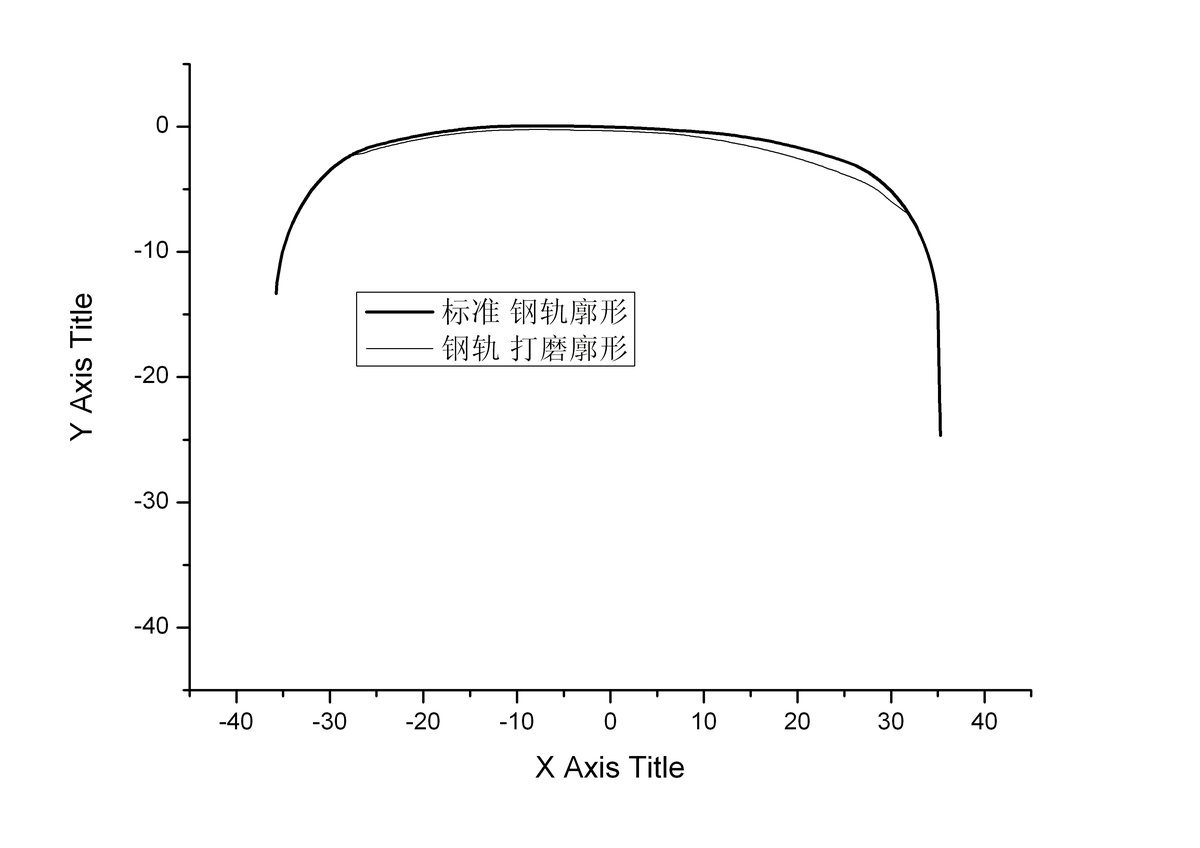
Target profile design — the reference standard against which every railway grinder wheel pass is measured.
Large Machine Grinding Strategy: Target Profiles and Restricted Zones
The large grinding vehicle operates at 4–10 km/h through the turnout, completing approximately 20–24 passes to achieve the target profile. The target profile used by the Beijing Bureau follows the China Academy of Railway Sciences' high-speed rail design profile — a precisely defined cross-section that optimizes wheel-rail contact stress distribution.
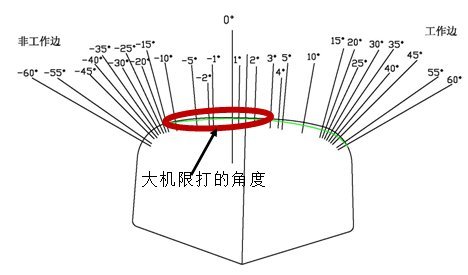
However, not every part of the turnout is equally accessible. The movable point rail frog section has strict grinding restriction zones: from 200 mm ahead of the wing rail bend point to 500 mm behind the point rail tip, only the region from Y−5 mm to Y−33 mm can be ground, with allowable angles limited to +3° to +40°. Where the distance between wing rail stock rail and point rail is less than 100 mm, only the inner side can be ground, with angles from +3° to +70°.
These restrictions mean that the railway grinder wheel on the large machine must be capable of aggressive material removal within the allowed zones while leaving untouched areas completely undisturbed. Molaton's wheels are formulated with precisely calibrated grain exposure and bond hardness to deliver clean cuts at specific angles without causing collateral damage to adjacent rail surfaces.
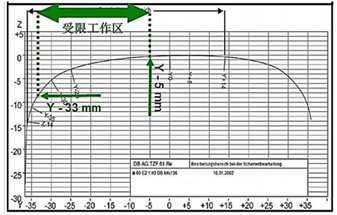
Restricted grinding zones in the turnout frog area — the railway grinder wheel must operate within strictly defined angle ranges.
Small Machine Grinding: The Critical Role of Portable Railway Grinder Wheels
When the large machine completes its passes, small portable machines take over for the precision work. Two types of equipment are deployed:
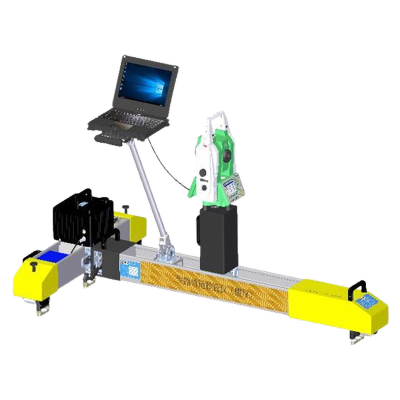
- Vertical rail grinding machine: Suitable for special turnout locations. The wheel has 385 mm horizontal travel and 185 mm vertical travel, with ±30° angle adjustment capability. Ideal for gauge corner and rollover edge work.
- Dedicated turnout grinding machine: Covers all rail top surfaces and gauge corners within the turnout. The wheel has 385 mm horizontal travel and ~200 mm vertical travel, with ±30° angle range. Used in combination with the vertical machine for full-angle coverage of switch rails and point rails.
The railway grinder wheel on these small machines faces unique demands. It must cut cleanly at low feed rates without generating excessive heat that could alter the metallurgical properties of hardened switch rail steel. Molaton's zirconia alumina abrasive grains provide consistent sharpness at low pressure, making them ideal for this application.
Small portable machine working on the switch rail transition zone — where large machines cannot reach.
Profile Control: Template Rulers and Sub-Millimeter Tolerance Standards
Quality control during small machine grinding relies on custom-designed profile template rulers. These templates are fabricated to match the target profile at specific cross-sections — typically at 25 mm, 35 mm, and 40 mm widths from the rail centerline. During grinding, operators continuously compare the actual rail surface against these templates.
The acceptance criteria are strict: within the −25 mm to +25 mm range from the rail center, positive deviation must not exceed 0.2 mm. From 25 mm to the gauge corner edge, positive deviation must not exceed 0.3 mm. Achieving this level of precision requires a railway grinder wheel that delivers predictable, consistent material removal pass after pass — exactly what Molaton's hot-pressed manufacturing process ensures.
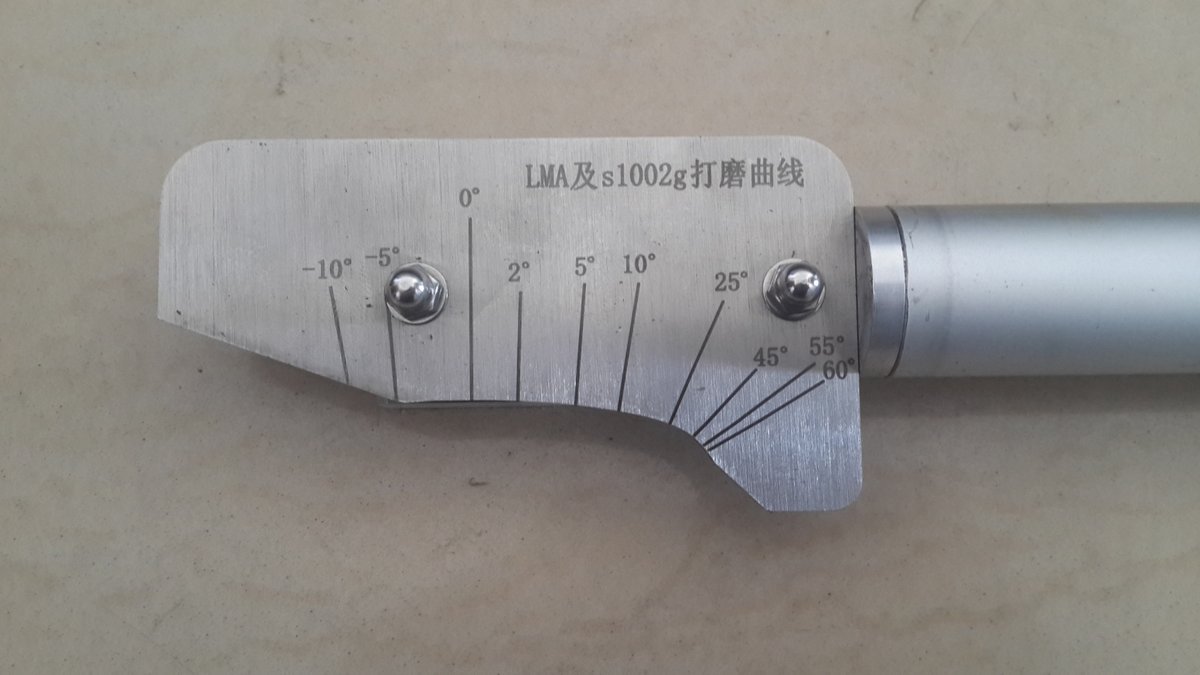
Custom profile template rulers — the quality control tool that validates every railway grinder wheel pass.
Results: Proven Success Across 13 Turnout Groups at Cangzhou West Station
After the complete grinding program was executed, the Beijing Bureau measured the results across 13 turnout groups at Cangzhou West Station. The findings were impressive:
- Maximum positive deviation in the −25 mm to +25 mm range: +0.2 mm
- Maximum negative deviation in the −25 mm to +25 mm range: −0.15 mm
- Maximum positive deviation from 25 mm to gauge corner: +0.2 mm
- Maximum negative deviation from 25 mm to gauge corner: −0.6 mm
These results were achieved using a carefully coordinated combination of large-machine and small-machine operations, with each stage relying on a properly matched railway grinder wheel. The fact that deviations remained well within acceptance tolerances across 13 separate turnout groups demonstrates the repeatability and reliability of the approach.
Post-grinding profile analysis showing deviations well within tolerance — proof that the right railway grinder wheel strategy delivers consistent results.
Why Molaton Railway Grinder Wheels Are Built for This Exact Challenge
The Beijing Bureau's turnout grinding program reveals a truth that every rail maintenance professional knows: turnout grinding is not just about removing metal — it is about removing the right amount of metal, in the right place, at the right angle, with zero collateral damage. This demands a railway grinder wheel that combines three properties simultaneously:
- Cutting aggressiveness: Zirconia alumina grains with micro-fracturing behavior maintain sharp cutting edges throughout the wheel's service life, reducing the number of passes needed.
- Wear resistance: Hot-pressed bonding creates stronger grain retention than cold-pressed alternatives, extending wheel life under the high-pressure conditions of turnout grinding.
- Precision: Controlled bond erosion ensures predictable material removal, enabling operators to hit sub-millimeter targets consistently.
Molaton's manufacturing process is optimized for exactly this combination. Our wheels have been proven on Loram, Harsco, Speno, Geismar, and Robel equipment across turnout grinding applications worldwide. If you are managing a turnout grinding program — whether for high-speed passenger lines or heavy-haul freight corridors — the right railway grinder wheel makes the difference between acceptable results and exceptional ones.
FAQ
Why can a large grinding machine not finish a high-speed turnout on its own?
Because parts of the turnout are physically out of reach. In the movable point rail frog section only the Y−5 mm to Y−33 mm band can be ground, and where the wing rail to point rail spacing falls below 100 mm only the inner side is accessible. The large machine also cannot correct the localised deviations and surface defects it leaves behind, so a small portable machine is used to finish the restricted zones, the residual profile deviation, and defects such as fish-scale cracking and rollover edges.
What is through-grinding in turnouts and why does it matter?
Through-grinding means the internal profile of the turnout — including the combined switch rail and stock rail section, and the movable point rail and wing rail section — is ground to match the line rail profile outside the turnout. Without it, the vehicle encounters a step change in contact geometry at the turnout, which feeds impact loads straight into the frog and switch components.
What tolerance is acceptable after high-speed turnout grinding?
In the Beijing Railway Bureau programme, positive deviation within the −25 mm to +25 mm band had to stay within 0.2 mm, and within 0.3 mm from 25 mm out to the gauge corner. Measured across 13 turnout groups at Cangzhou West the worst results were +0.2 mm and −0.15 mm in the central band. The profile measurement practice behind those checks is covered in rail profile grinding.
Which railway grinder wheel is used on small turnout grinding machines?
A wheel that cuts cleanly at low feed rate with minimal heat input, because it works close to hardened switch rail steel and thin section components. Small machines on the Beijing Bureau network used a vertical rail grinding machine and a dedicated turnout grinding machine, both with about 385 mm of horizontal travel and ±30° of angle adjustment. Wheel formulation for these units is discussed in matching the wheel to the grinding vehicle and the large-machine side in large machine turnout grinding.
What defects are removed by high-speed turnout grinding?
Corrugation, head checks, spalling, fish-scale cracking, rollover edges and weld irregularities are the usual targets, with the pre-grinding survey documenting each one by position before work starts. The defect families and their formation mechanisms are catalogued in rail defects and their solutions, and the acceptance checks at the end of the campaign in rail grinding acceptance standards.
Ready to Upgrade Your Turnout Grinding Program?
Molaton offers free technical consultation to help you match the optimal railway grinder wheel formulation to your specific grinding vehicle fleet and turnout types. Contact our engineering team today.
Contact Molaton for Technical Consultation →WhatsApp: +86 15072332788 | Email: simon.wang@railwaycare.com