Precision Rail Turnout Grinding by the Wheel Maker the Grinders Depend On
RailwayCare (Molaton) has specialized in rail and turnout grinding since 2004 — China's first manufacturer of rail grinding wheels. We supply the complete package for switch, stock rail and frog maintenance: purpose-built grinding machines, turnout grinding-train wheels, profile & gauge inspection tools, plus the process know-how written into national standard JB/T 11431.
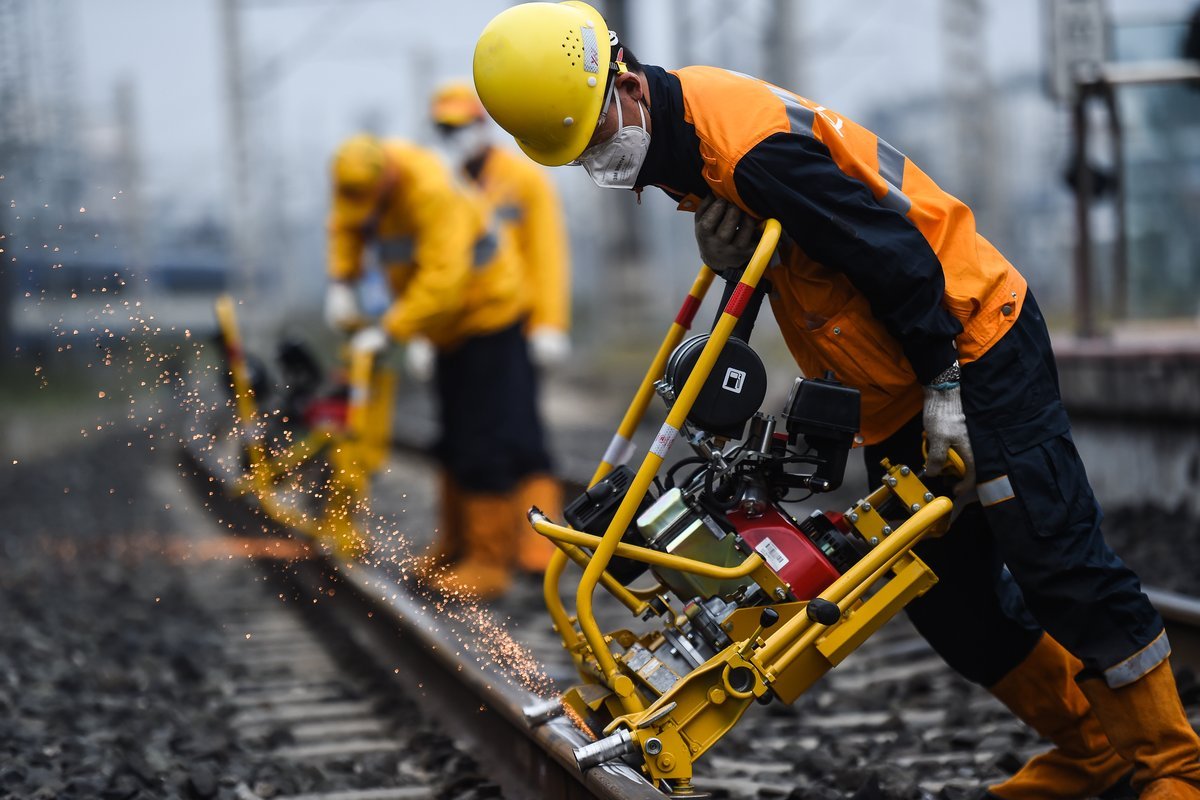
Why Rail Turnouts Need Dedicated Rail Grinding on Switches, Frogs & Crossings
Turnouts concentrate the highest wheel-rail forces on the network. Switch rails, stock rails and frogs each develop characteristic defects that ordinary straight-track grinding cannot correct — they need zone-specific profiles, angles and machines.
Impact & Lateral Forces
Wheel transitions across the frog and switch create dynamic impacts and gauge-side thrust that flatten, wear and crack the rail head 2–3× faster than plain line.
Confined Grinding Envelope
Large grinding trains cannot reach the switch point area or frog nose. Restricted zones — from the switch point to where the non-working edge stands 75–100 mm from the stock rail — require small machines.
Target-Profile Accuracy
Restored profiles must fit the wheel tread within ±0.2 mm (HSR) to ±0.3 mm (conventional), with the light band 25–30 mm wide on high-speed turnouts, so contact stays away from the non-working edge.
Measurable Safety Payback
Field case records show lateral car-body acceleration across turnouts dropping from ~0.20 to 0.04–0.08 m/s² after systematic grinding — better ride quality and lower derailment risk.
Common Switch Rail & Frog Defects and the Grinding Repair
Every defect below is diagnosed before work (track gauge, 1 m straightedge, reduction-value gauge, cross-section caliper, profile instrument) and treated with the specific process and machine shown.
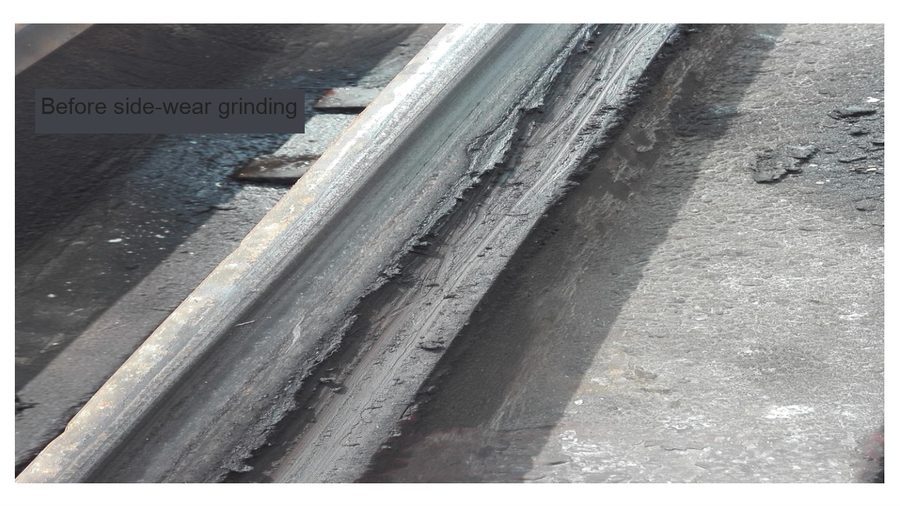
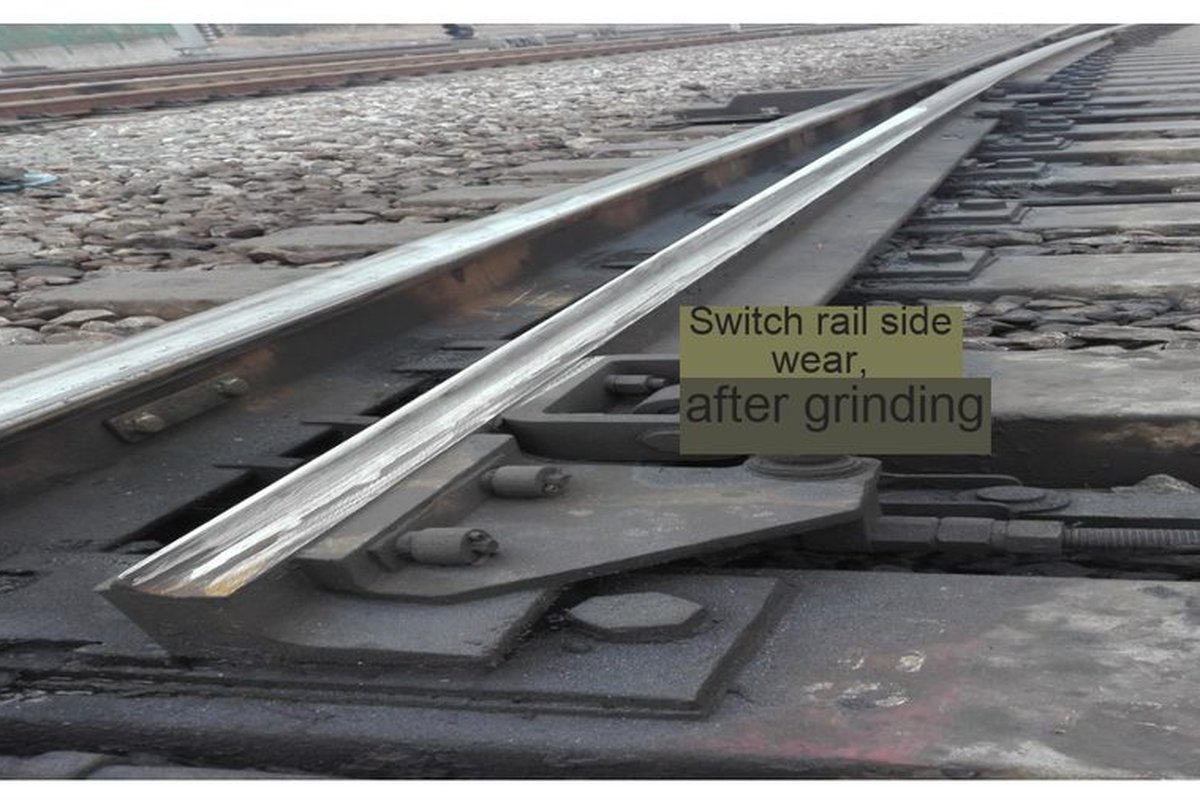
Switch Rail Grinding — Working Edge, Top Surface & Flash Removal
Defects: gauge-side wear step, edge flash, fish-scale cracks, spalling and poor light band on switch and stock rails.
Response: with the switch in the open position, grind the working edge from bottom to top in 2° angle steps with the wheel parallel to the planed surface; grind the top surface 30°→0° (closed) and 30°→−30° (open) in 2–4° steps. Chamfer edge flash to R3–4 mm over the 20–30 mm section width and R4–5 mm over 30–50 mm.
Machines: MC3 edge grinder · MV3 top grinder · portable angle grinder for finishing.
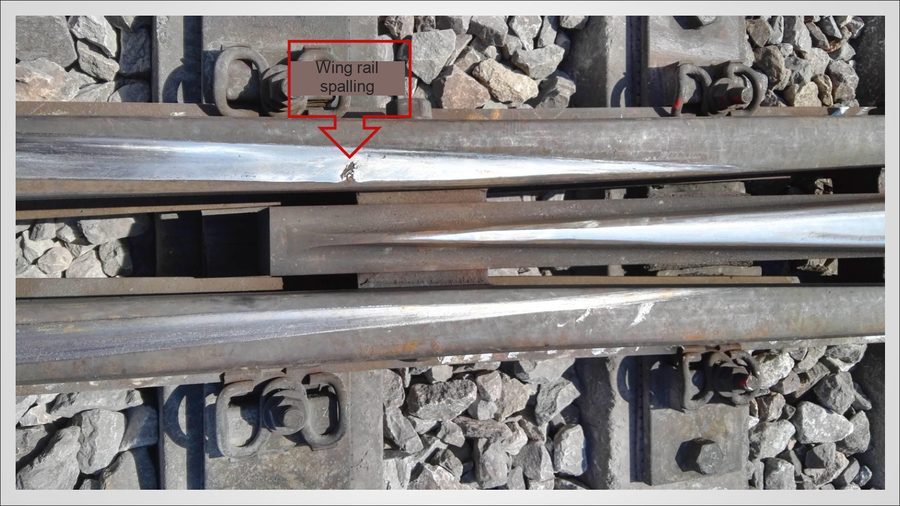
Frog Grinding & Crossing Repair — Nose Rail, Wing Rail & Guard
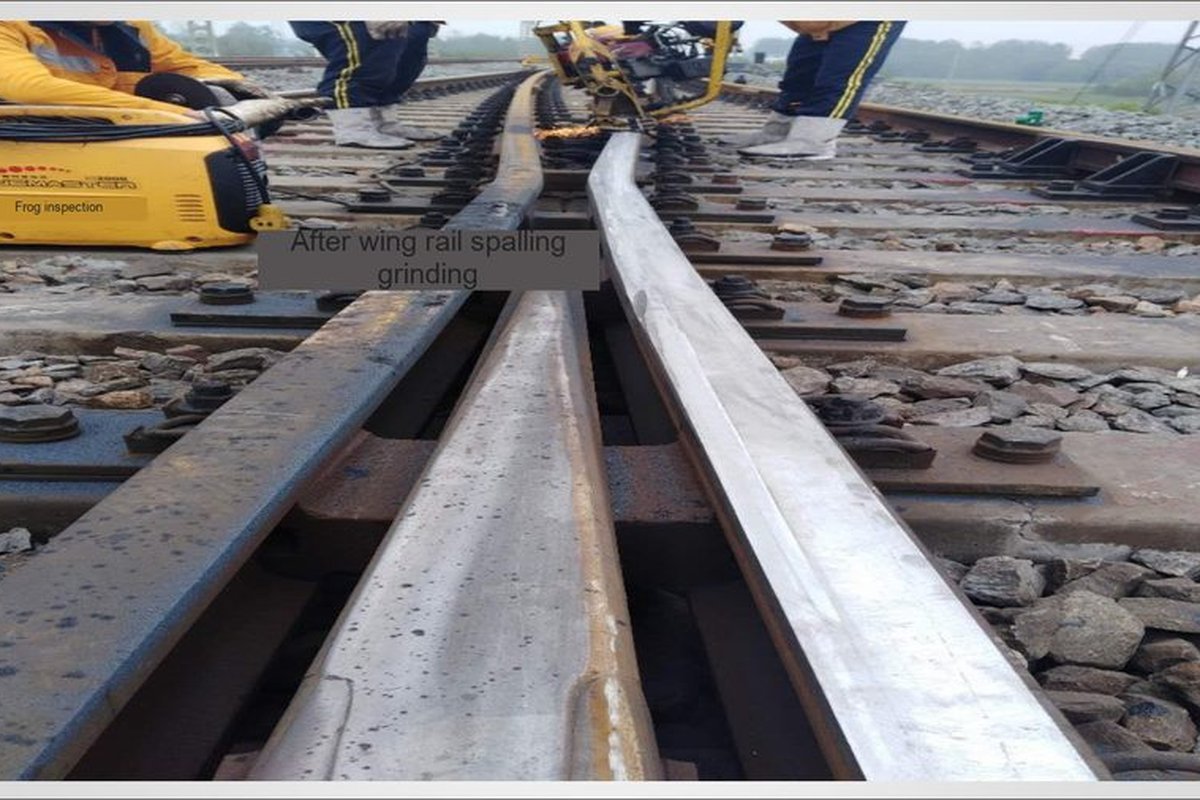
Defects: wing-rail vertical wear, nose and wing spalling, alloy-frog joint flash, mismatched nose reduction values at the 20 mm and 50 mm sections.
Response: reprofile the wing rail from the deepest wear point outward, chamfer wing-rail flash 4–6 mm wide × 0.5–1.5 mm deep at the nose 20–50 mm section, and blend the three nose slopes across the 20 mm and 50 mm transition points, checking with the reduction-value gauge and a 1 m straightedge.
Machines: MP12 profile-following grinder · MV3 · angle grinder for nose slope work.
Rail Turnout Inspection Tools & Acceptance Workflow for Grinding Quality
Pre-Grind Survey
Track gauge for geometry, 1 m straightedge and feeler for profile deviation, reduction-value gauge at 20/50 mm nose sections, visual check for flash, spalling, fish-scale cracks.
Rail Turnout Profile Measurement & Target-Template Design
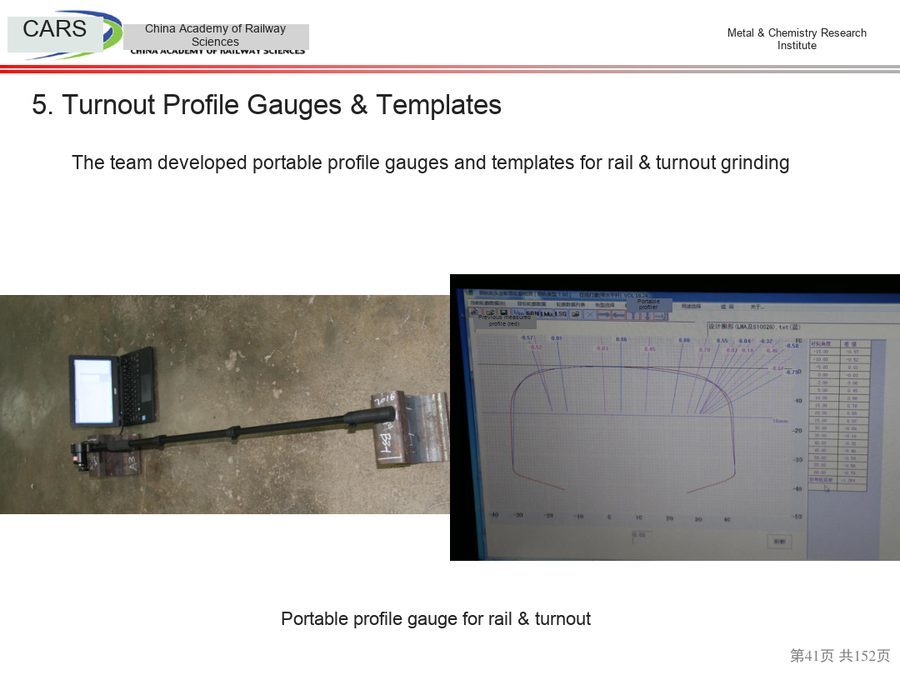
Portable rail profile instrument records the actual profile against the target template (LMA / S1002G / 60N) to design the grinding pass list.
Post-Grind Check
1 m straightedge ≤0.2–0.3 mm, roughness ≤10 μm, no continuous blue band, hardness rise ≤50 HB, light-band position verified before line opening.
Instruments We Supply
- Portable rail/turnout profile instrument & design-profile templates
- Digital track gauge for switch-zone geometry
- Reduction-value gauges for nose rail 20 mm / 50 mm sections
- Cross-section calipers, 1 m straightedges, surface-roughness gauges
Quality Standard for Rail Turnout Grinding
Consistent with the practice of Chinese railway administrations (Wuhan HSR, China Academy of Railway Sciences manuals) and our national standard experience.
| Item | Acceptance Criterion | Measuring Method |
|---|---|---|
| Profile deviation vs target | ≤±0.2 mm (HSR & passenger) / ≤±0.3 mm (conventional) | Profile instrument · GQI ≥85 graded excellent |
| Running-surface flatness | Concave/convex ≤+0.3 mm / 0 mm | 1 m straightedge & feeler gauge |
| Surface roughness | Ra ≤10 μm | Roughness gauge |
| Thermal damage | No continuous blue/black band | Visual inspection |
| Nose reduction value | Optimal ±0.5 mm, not exceeding ±1 mm | Reduction-value gauge at 20/50 mm |
| Metal removal depth | ≤0.5 mm, transition slope >1‰ | 1 m straightedge / section caliper |
| Corrugation over limit | <5% of measured bands in the turnout zone | Wave band measurement |
| Ground-surface hardness | No more than 50 HB above parent rail | Portable hardness tester |
Complete Rail Turnout Grinding Product Portfolio
Rail Grinding machines, Rail turnout grinding-train wheels and inspection instruments — engineered for the switch, stock-rail and frog zones above, and supplied worldwide under the Molaton brand.
Rail Turnout Grinding Machines
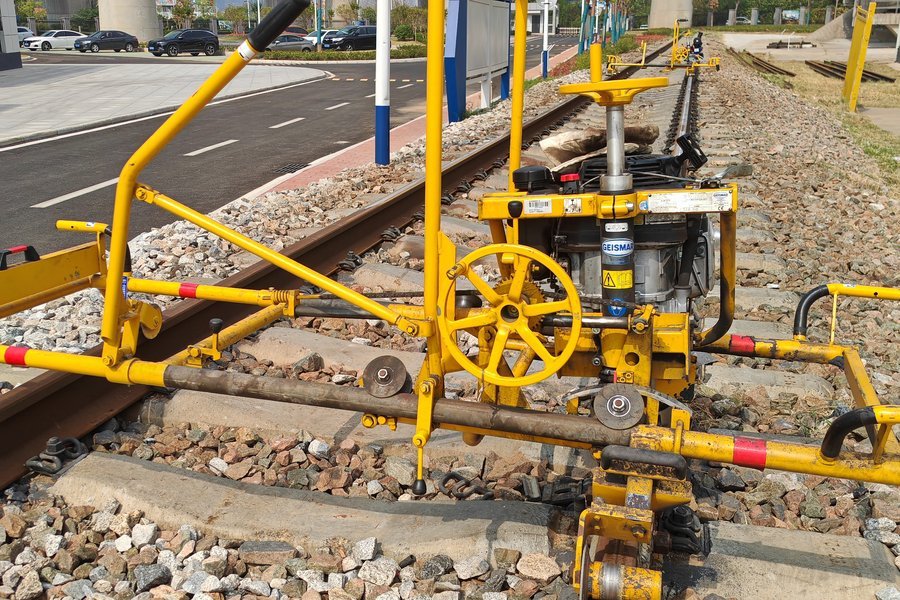
Current production grinders for turnout work: RCG-L50 lithium intelligent turnout grinder for working-edge and high-angle passes, RCG-V50 multifunctional vertical-axis grinder for top-surface work, and RCG-C65 CNC intelligent copying grinder for frog profile-following.
RCG-L50 Turnout Grinder → RCG-V50 Vertical-Axis Grinder → RCG-C65 Copying Grinder → View the Full Grinder Series →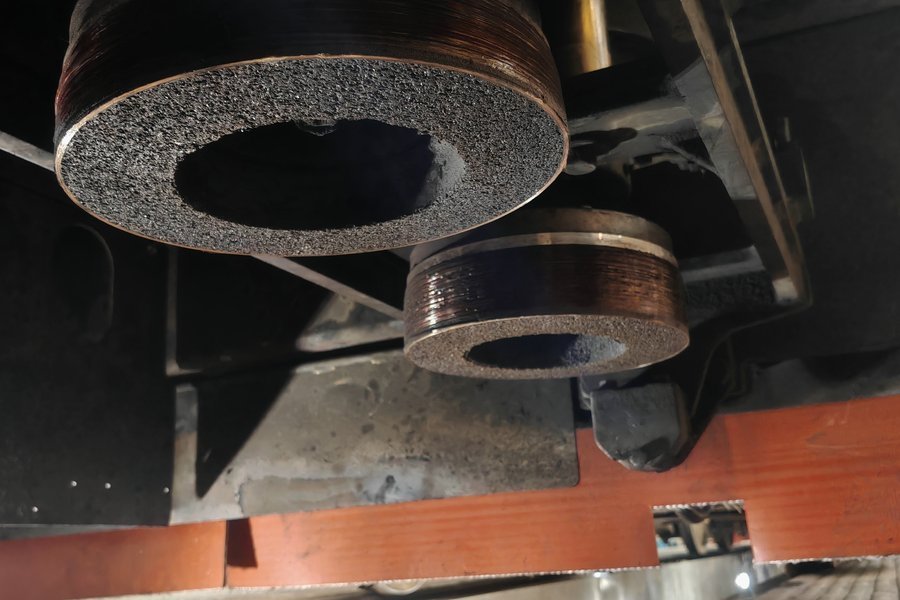
Rail Turnout Grinding Wheels for Switch Grinding Trains (RGH20C / G6)
MRC turnout wheels for Harsco switch grinding vehicles — MRC-L150080 (150×80×5/8") and MRC-L150077 (150×77×M20), plus the G6 type — zirconia-alumina, glass-fiber reinforced, 50 m/s, 16 grit, CARS-certified.
MRC-L150080 Turnout Dressing Wheel → MRC-L150077 M20 Turnout Wheel → View the Full Wheel Range →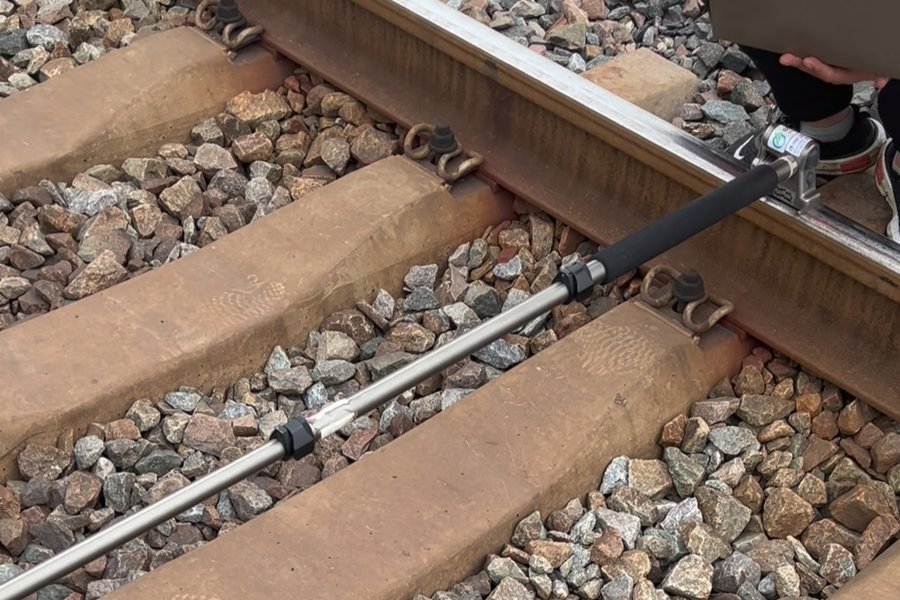
Inspection & Gauging Tools
Portable rail profile measuring instruments, digital track gauges and frog wear gauges used before, during and after turnout grinding to close the measure–grind–verify loop.
Rail Profile Measuring Instrument → Digital Track Gauge → Frog Wear Gauge → View All Inspection Tools →Molaton Rail Turnout Grinding Wheel Range for Harsco & Loram &Autech
Dimensions, composition and operating parameters of every Molaton turnout wheel, matched to Harsco RGH20C switch grinding vehicles and G6-type turnout grinding trains.
| Application | Dimension (mm) | Composition | Speed | Grit |
|---|---|---|---|---|
| Harsco RGH20C turnout grinder | 280 × 25.5 × 11.6 | ZA zirconia-alumina + glass fiber, iron hub | 50 m/s | 16 |
| 150 × 80 × 5/8" | ZA zirconia-alumina + glass fiber, iron hub | 50 m/s | 16 | |
| 150 × 77 × M20 | ZA zirconia-alumina + glass fiber, iron hub | 50 m/s | 16 | |
| Loram (RGH8) | 260x84x154 | ZA zircomia-alumina+glass fiber,ironhub | 50m/s | 16/20/36 |
| Autech | 120x110xM20 100x110xM20 | ZA zircomia-alumina+glass fiber,ironhub | 16/20 | |
| Rail Turnout grinding machine (geismar/robel) | 150 × 70 ×55-4*M8 150x80xM20 125x65xM20 |
High-performance zirconia-alumina abrasive | — | 16/20 |
Qualified under CARS technical review (TKTJ-19-0007-ST, G1/G2/G6). The G6 turnout wheel metal-removal rate exceeds the technical requirement by 1.4–2.6× in national laboratory testing, with 3+ million km of field operation across China's high-speed, heavy-haul and metro networks.
The Rail Turnout Grinding Manufacturer Behind China’s Rail Practice
From national-standard drafting to certified wheel manufacture and field validation on real grinding trains — here is the proof behind the products.
National Standard Drafter
Molaton participated in drafting JB/T 11431, the industry standard for rail grinding wheels, and supplies wheels to the test requirements of GB 2494 — technical authority written into every wheel.
CARS-Certified Wheels
Rail Turnout and grinding-train wheels (G1/G2/G6) pass China Academy of Railway Sciences technical review TKTJ-19-0007-ST; the G6 turnout wheel removes metal at 1.4–2.6× the required rate in national lab tests.
Saint-Gobain Abrasive & Joint Lab
Zirconia-alumina from Saint-Gobain and resin from SI Group, pressed on precision hot/cold presses and verified in the rail-grinding-wheel laboratory co-built with Wuhan University of Technology.
Field-Proven on Real Grinding Trains
Batch-validated on Harsco, Speno, Loram and Chinese grinding trains — customer trials measured 1.5–2× the wheel life of imported wheels, with 3+ million km of accumulated operation.
Rail Turnout Grinding FAQ
How often should railway turnouts be ground?
Preventive rail turnout grinding intervals are set from measured changes in rail hardness, profile deviation, surface condition and noise — the method used by Chinese railway research institutes. Many high-speed operators grind turnouts on the same campaign as adjacent plain line, then add targeted switch and frog repairs between campaigns. We help you set the interval from your own profile-measurement records.
Which machines are used for switch rail and frog grinding?
Rail Turnout grinding records typically describe MC3 / MV3 / MP12-type machines for working-edge, top-surface and frog profile-following passes. Our current production series covers the same duties: the RCG-L50 lithium intelligent turnout grinder, the RCG-V50 vertical-axis grinder and the RCG-C65 CNC copying grinder — each supplied with matching grinding wheels.
Can Molaton wheels fit Harsco RGH20C and other switch grinding trains?
Yes. The RGH20C turnout grinder is covered by Molaton wheels in 280×25.5×116, 150×80×5/8" and 150×77×M20, and the G6 type (150×27×92) serves other switch grinding trains. All pass CARS technical review; custom dimensions and formulas are developed on request.
What is the acceptance standard for turnout grinding quality?
Chinese administration practice requires profile deviation within ±0.2 mm (HSR) to ±0.3 mm (conventional) of the target template, running-surface flatness within +0.3/0 mm on a 1 m straightedge, roughness Ra ≤10 μm, no continuous blue band, nose reduction within ±0.5–1 mm, and a ground-surface hardness rise no more than 50 HB above the parent rail.
Do you provide process support beyond supplying machines and wheels?
Yes. RailwayCare engineers support grinding-program design from profile measurements, assist on site with maintenance crews, provide training on machine and wheel selection, and supply the inspection tools to verify every pass.
Let Us Design Your Rail Turnout Grinding Program
Send us your turnout type (9/12/18/30/42#), rail grade (U71Mn / U75V / U78CrV), current defects and acceptance standard — we will recommend the machine, wheel and process configuration, or carry out the grinding together with your crew.

Safe Tracks Proven by China
- Name
- Phone
- *Title
- *Content