How long does a rail grinding wheel last per grinding cycle?
How long does a rail grinding wheel last per grinding cycle?
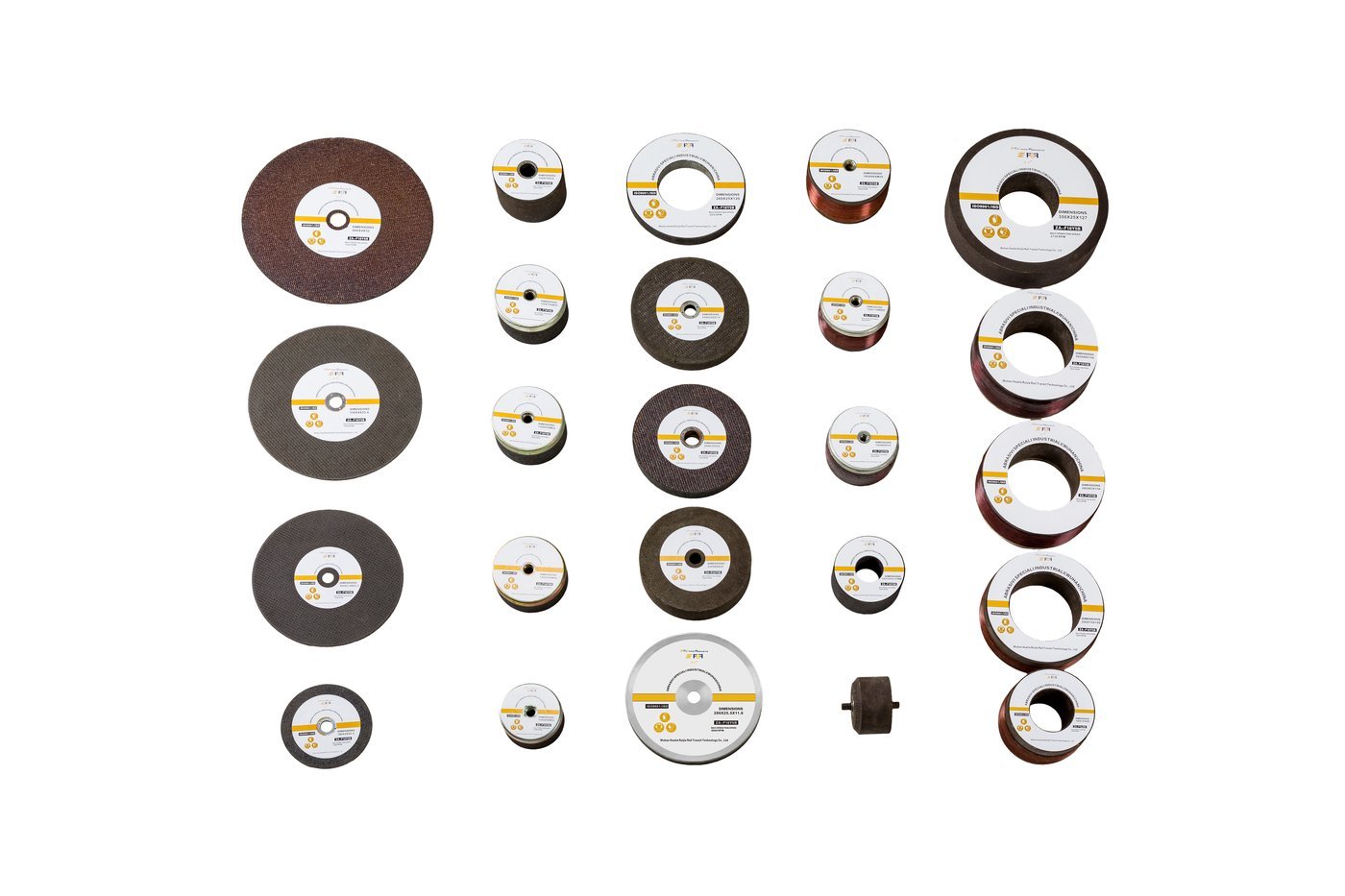
A rail grinding wheel is not consumed by one grinding cycle — it survives many. Ask the question in pass-kilometres, not in cycles: budget 100–250 pass-km per wheel, with 199–228 pass-km measured on Chinese heavy-haul and 214 pass-km on high-speed track. The planning formula is life = pass-km per mm of wear × usable thickness, where usable thickness is the nominal thickness minus the 25 mm that must never be ground away.
First, fix the unit: what a pass-kilometre is
A grinding cycle is a night's work, or one campaign along a section. A wheel is a consumable that spans many of them, so the metric the industry uses is the pass-kilometre (pass-km):
pass-km = grinding length × number of passes
So a campaign recorded as 172.8 pass-km is either 172.8 km of track ground once or, say, 57.6 km of track ground three times. The wheel does not care which. That is why a pass-km figure from one line can be compared with another, while "how many nights" cannot.
Two further conventions matter. Wheel wear is quoted as pass-km per millimetre of consumed thickness — the higher the number, the more work per millimetre. And the wheel cannot be used down to nothing: every rail grinding wheel carries a wear-limit marker, and the standard bookkeeping keeps the last 25 mm as unusable. Hence:
life (pass-km) = pass-km per mm × (nominal thickness − 25 mm)
For a 75 mm heavy-haul wheel that usable thickness is 50 mm; for a 90 mm high-speed wheel, 65 mm. The formula set is the one used in the PGM-96C class on-track trial report for high-speed track, and it is the fastest way to sanity-check a supplier claim.
What the wheels actually delivered on track
| Trial | Machine and settings | Wear rate | Life per wheel |
|---|---|---|---|
| Shuohuang heavy-haul, 2024 (China Energy) | 250×75×150 mm class, 15 km/h, 13.8 kW | 4.98 pass-km/mm | 172.8 pass-km measured in the campaign; 199 pass-km average life |
| Yiyang line, 2024 (Shandong Hi-Speed) | 250×75×150 mm class, 12 km/h, 15.6 kW | 5.7 pass-km/mm | 145 pass-km measured in the campaign; 228 pass-km average life |
| Shuohuang single-trolley test, 2023 | 4 sample wheels vs 4 original wheels, same train | 5.96 vs 4.99 pass-km/mm (+19.4%) | up to 332.3 pass-km on one wheel before removal |
| Hewu high-speed, 2020 | PGM-96C (GMC-96X) No. 07701, 68% power (20.4 kW), 3,600 rpm, 16 km/h, 260×90×154 mm | 4.28 vs 3.27 pass-km/mm for the in-service wheel (1.31×) | 214.22 pass-km per wheel |
| Third half-car trial, 2024 | 112.6 pass-km campaign | 4.93 pass-km/mm | 190 pass-km average, finish Ra ~5.5 μm |
| Liuzhou laboratory, NC grinder | 7 km/h, 8 kW, 2,400 rpm, 15 min | — | 50–60 pass-km (conventional) vs 100–150 pass-km (super-hard composite) |
Two reference points bracket all of it. The type approval granted for the PGM-96C class wheel required at least 100 pass-km per wheel, and the heavy-haul development specification set the target at an average life of no less than 150 km so that wheel changes fall inside the railway's possession cycle rather than dictating it. Across the Shuohuang programme, 808 wheels of the composite design have been fitted and tracked, averaging around 200 pass-km each.
The five things that move life up or down
- Depth of cut and pass count. This is the biggest lever. Removing rolling-contact-fatigue cracks is most efficient while they are still shallow — at or below 0.2 mm of depth, one routine pass takes the whole cracked layer, and a super-hard composite wheel has cleared the same defect in 2–3 passes against 4–6 for a conventional wheel. Fewer passes per campaign means more campaigns per wheel.
- Rail steel and condition. On Shuohuang the wheels ran against 75N-U78CrV rail (up line) and 60-U75V rail (down line), and the deeper grinding marks observed there were attributed to the higher hardness of the rail material. Hard rail costs wheel life; there is no wheel that changes that physics, only ones that manage it.
- Machine settings. Power and working speed set the removal rate, and the removal rate sets the wear rate: 13.8 kW at 15 km/h on heavy-haul versus 20.4 kW at 16 km/h on high-speed produce different consumption per pass-km for the same wheel.
- Wheel construction — harder is not longer in the way buyers expect. In controlled tests, three bond formulations removed 1.0 g, 0.7 g and 0.2 g of material with grinding ratios of 12.8, 16.0 and 24.1. The hardest wheel wore slowest and cut least: it will report a long life and still cost you more per kilometre because it needs more passes. Life and cutting power have to be bought together.
- Usable thickness, not nominal thickness. A claim of "200 pass-km" is only comparable when both parties use the same end point. Confirm whether the number is based on nominal thickness or on the thickness above the wear limit.
Turning life into a replacement plan
Life per wheel becomes a maintenance plan as soon as you divide it by the number of grinding heads. A full set of wheels wears as a set, so one 96-piece set on a 96-stone train covers roughly one wheel life of grinding — around 199 pass-km at heavy-haul rates, or 214 pass-km at high-speed rates. At Liuzhou in 2022 a GMC-96X completed 18.72 pass-km inside a single 2-hour night possession, which is the arithmetic a planner needs: how many possessions one set buys, and where the change-out falls.
When the answer is "about every ten possessions", the wheel stops being an item you reorder reactively and becomes a calculated line in the possession plan. The same logic governs how the grinding cycle itself is set, and it is why life and maximum operating speed have to be specified together. If wheels are failing well short of these figures, the cause is usually not the wheel alone — see why a rail grinding wheel wears unevenly.
For the wider context of how the Molaton rail grinding wheel range is specified by machine class, and how our wheels compare with imported references on the five indicators buyers check first, see the domestic-versus-import comparison.
Related questions you may also ask
What is the maximum operating speed for a rail grinding wheel? Why is my rail grinding wheel wearing unevenly? What factors determine the rail grinding cycle? How does rail grinding prevent rolling contact fatigue? More answers on rail grinder wheelsGet the expected life for your wheel size and machine
Send Molaton your wheel size, grinding head count, working speed and typical grinding power, and we will quote the expected pass-km per wheel from our track records — plus the possession-based replacement interval it implies.
Request Life Estimate
Are you looking for a reliable manufacturer of railway grinding and track maintenance equipment?
We can quickly provide customers with market analysis, technical support and customized services.
Safe Tracks Proven by China
- Name
- Phone
- *Title
- *Content