How to store rail grinding wheels to prevent damage?
How to store rail grinding wheels to prevent damage?
Five habits prevent almost all storage damage: keep them dry, keep them flat, keep them in the original packaging, stack them no higher than 1.5 m, and keep them out of direct sun, rain and heat. Then treat storage as something that expires: a rail grinding wheel must be re-checked before mounting — ring test, visual inspection of the face, the core and the glass-fibre wrap, and a confirmation that the diameter and thickness are still within tolerance. The rail-specific rule is worth remembering because it sets the bar: under normal storage conditions, a wheel that has stood on site for two years must still meet specification. Storage is not a waiting room, it is part of the product's life.
What the standards actually require
Storage is specified separately from grinding, in China across three documents: GB 2494-2014 (safety requirements, which include acceptance and storage), GB/T 2495-2017 (packaging, marking, transport and storage), and the technical conditions for the product itself. For rail grinding wheels the working clause is in Q/CR 1-2014, and it is unusually concrete.
| Requirement | Specification | Why it is written that way |
|---|---|---|
| Environment | Kept dry; protected from direct sun and rain | Resin bonds absorb moisture; UV and heat age the bond |
| Stack height | Not more than 1.5 m | The bottom wheel carries the load of everything above it and can be distorted or cracked |
| Shelf performance | After two years of normal on-site storage the wheel must still meet specification | Forces both the manufacturer and the store to control conditions, not just the clock |
| Packaging | Protects against moisture, impact and corrosion; each box carries its inspection certificate | Makes the box part of the protection system, not waste to be discarded on arrival |
| Appearance after storage | No crack, no inclusion, no blister, no obvious warp; colour even; core free of cracks and deformation; fibre winding even, firm and consistent in colour | Gives a checkable list rather than "looks fine" |
Notice how much of that list is about the core and the wrap, not the abrasive. That is the rail-specific part: a rail grinding wheel is an abrasive body on a steel or aluminium core with a glass-fibre reinforcement, and storage damage usually shows up in the interface before it shows up in the grinding face.
Why storage damage matters more on resin-bonded rail wheels
Two failure chains run through a stored rail wheel, and neither is visible from the outside.
- Moisture weakens the bond. The resin bond in a rail wheel is a heat-resistant phenolic system — on our wheels a selected high-temperature resin, PR-55738 — reinforced with glass fibre. Resin takes up moisture from humid air, and a moisture-laden bond holds the abrasive grain less firmly. The wheel still looks perfect. In service it releases grain from the bond instead of cutting with it, and the wheel can lose strength against centrifugal load at exactly the moment it is spinning at 50 m/s.
- Impact damage concentrates at the edges. A wheel dropped, rolled on its edge, or stacked under too much weight does not usually crack in the middle. Compressive tests on reduced-scale rail wheels show the edge flaking away progressively while the core section holds its shape — which is reassuring for the design under normal load and exactly why you should never stack or handle a wheel so that the edges take the load.
Neither chain announces itself. That is the argument for a short, disciplined pre-mounting routine rather than trusting that the wheel "should be fine".
The habits, and what to avoid
| Do | Avoid |
|---|---|
| Keep wheels in the original packaging until the moment of use | Unpacking the whole delivery "to check it" and leaving wheels bare on the floor |
| Store flat on their faces on a clean, rigid surface, or in the supplier's racking | Standing wheels on their edge where they can roll, or leaning them against a wall |
| Stack no higher than 1.5 m and keep wheels of the same diameter together | Mixed-diameter stacks, where a large wheel bridges and loads a small one |
| Rotate stock on first-in, first-out so nothing sits unused for years | Treating a wheel as ageless stock because it has not been opened |
| Keep the store dry, ventilated and out of the sun, away from heaters and boilers | Storing near solvents, acids or chemicals that attack the bond |
| Lift wheels by both hands at the face, or use the supplier's handling aid | Lifting a wheel by the bore, or dragging it across a concrete floor |
| Record the delivery date and the batch number on receipt | Losing traceability, so a problem wheel cannot be linked back to a batch |
Releasing a stored wheel for service
Before a wheel that has been sitting goes on a machine, run the same checks that would catch storage damage, in this order: ring test — hang the wheel by its bore, tap it lightly with a non-metallic object and listen for a dull thud rather than a clear ring; visual check of the face, the core, the wrap and the colour; dimensional check that diameter and thickness are still within ±1.0 mm and ±1.5 mm of nominal and that parallelism and concentricity are inside 0.4 mm and 0.5 mm; and speed confirmation that the wheel's marked rating is at or above the machine's maximum spindle speed. Never enlarge a bore to make a wheel fit.
For reference on what the material looks like when storage and handling have been managed properly: in the 2026 Loram DM01 trial, wheels stripped down after service with no fracture, no cracking and no loosening at all, roughness between 1.05 and 9.0 μm (mostly 2–4 μm) and no blueing — an outcome that starts in the store, not at the machine. The verification path is the same one described in how to perform a ring test on a rail grinding wheel, and its limits are covered under preventing rail grinding wheel cracking.
One number that makes the point for you: a 260 mm rail wheel at 3,630 rpm carries a rim speed of about 49 m/s, with a rim that will be released against a 30-second overspeed hold by the rail grinding wheel industry standard that Molaton co-drafted. Nothing about a store is trivial when the released energy travels at that speed.
Related questions you may also ask
How to perform a ring test on a rail grinding wheel Why is my rail grinding wheel wearing unevenly? What does a specification like 260x90x154 mm mean? Which rail grinding wheel fits Schweerbau grinding vehicles? Heavy-duty rail grinding wheel range More answers on rail grinder wheelsStorage and mounting sheet with every delivery
Ask Molaton for the handling and storage sheet for your wheel class, together with the delivery-date and batch marking your store needs to keep the stock traceable and rotating.
Request Storage Guide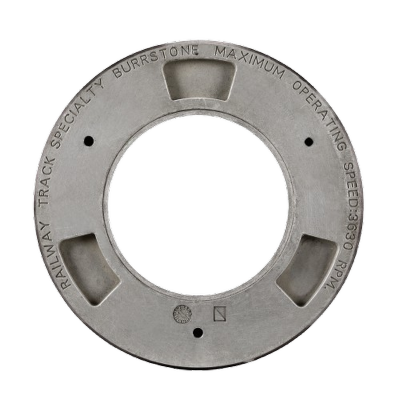

Are you looking for a reliable manufacturer of railway grinding and track maintenance equipment?
We can quickly provide customers with market analysis, technical support and customized services.
Safe Tracks Proven by China
- Name
- Phone
- *Title
- *Content