What is a Speno rail grinding machine?
What is a Speno rail grinding machine?
A Speno rail grinding machine is track and point re-profiling equipment built by Speno International SA, the Swiss manufacturer founded in 1960 and headquartered in Meyrin, near Geneva. Speno's activities are three: grinding and re-profiling of track and points, measuring rail surface faults and profiles, and detecting internal rail flaws by ultrasound. Two things make Speno unusual among grinding OEMs: it builds its own grinding stones through a dedicated subsidiary, and it sells both the machines and a contract grinding service run with its own fleets and crews. For operators running Speno-class vehicles, the practical question is therefore not only which machine to use, but where the grinding stone comes from — and that is where an independent supplier such as Molaton sits.
What a Speno machine is, and what it is not
Speno has developed its own equipment from the start rather than rebadging other builders' trains. The company's machines cover open track, tramways, metros and regional mixed networks, plus specialised work on bridges and switches, and its fleet is recognisable by its bright yellow livery. Two dates describe the engineering trajectory: in 1980 Speno introduced the first road-rail grinding machines for urban railways, and in 1985 the first inspection train able to detect rail flaws in real time at normal line speed, which removed the need to slow or stop traffic while inspecting.
Where it is not a full substitute is scale and scope. A Speno grinding machine is a re-profiling asset: it restores the transverse profile and removes fatigue metal from the running surface. It does not clean ballast, it does not correct geometry beyond the profile it puts into the head, and it does not replace tamping. Those belong to different machines and a different budget line. The manufacturing footprint is tightly held: two wholly owned Italian plants carry the work — one building the grinding trains and one producing the grinding stones used across the range — with quality systems certified to ISO 9001 since 1995 and ISO 14001 since 2007. Its presence is broad rather than local: machines operate on five continents, and in Japan a dedicated subsidiary established in 1987 supports them, where 47 Speno-built grinding machines are in service.
The consumable: which wheel a Speno-class vehicle takes
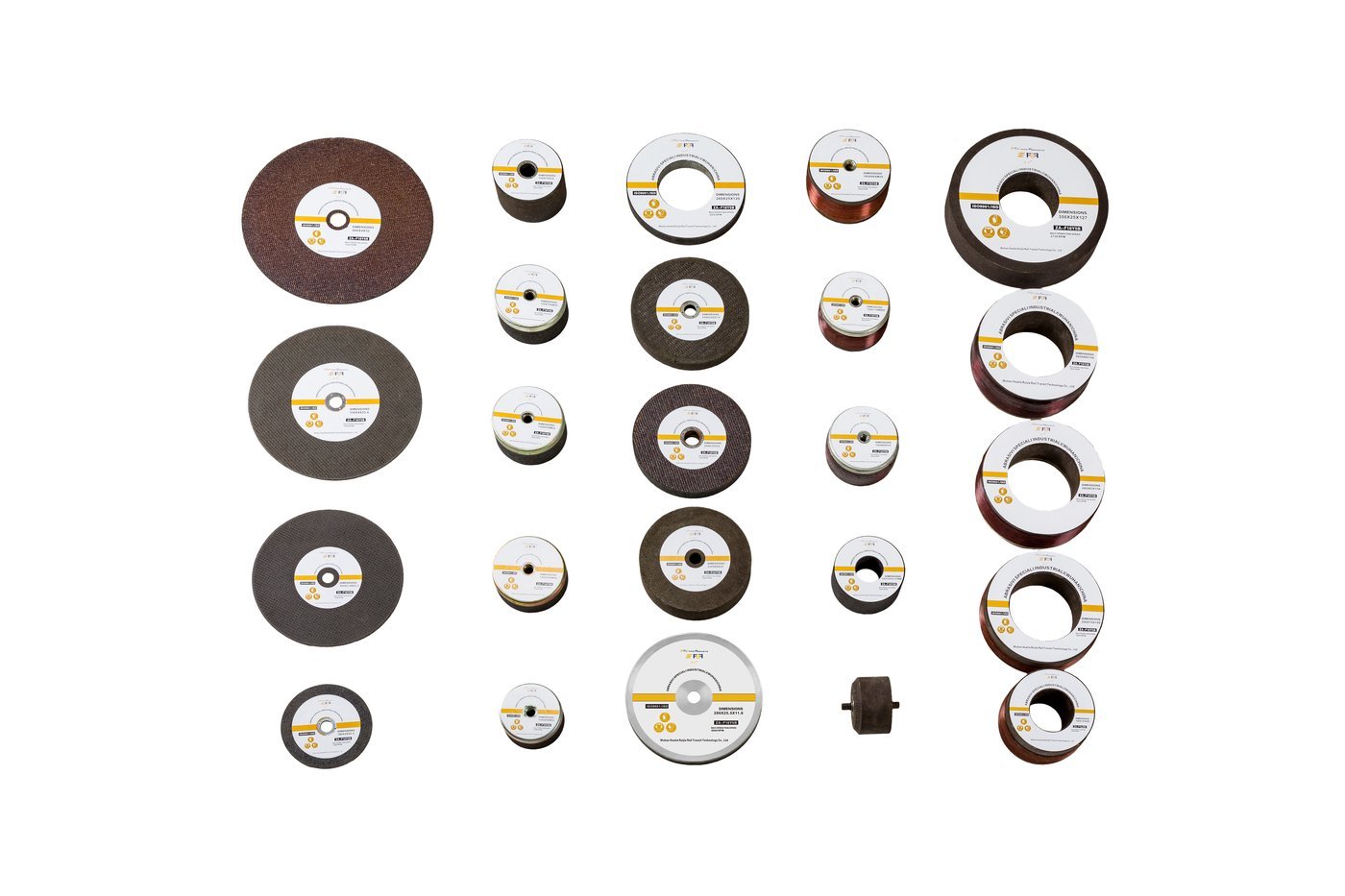
Because the machine builder also makes stones, the only way an independent wheel earns its place is by matching the grinding head exactly. In the Molaton range two families cover Speno-class grinding vehicles:
| Vehicle class | Wheel specification (OD × thickness × bore) | Construction | Grit | Max speed | Working speed |
|---|---|---|---|---|---|
| GMC16A class | 350 × 60 × 127, 350 × 50 × 127, 350 × 35 × 127, 350 × 25 × 127 mm | Aluminium base body with zirconia and fibreglass winding | 16 | 50 m/s | 2730 rpm |
| GMC96B class | 180 × 105 × 90 mm | Aluminium base body with zirconia and fibreglass winding | 16 | 50 m/s | 6000 rpm |
Fitting is a drawing problem before it is a price problem. The wheel must carry the right diameter, thickness and bore, the right base body and mounting method — grinding-car wheels take M10 mounting holes with an effective thread engagement of at least 17 mm — a balance grade inside tolerance (G1 at 30 g or better, G3 at 34 g or better to GB/T 2492), a maximum working speed of 50 m/s per GB 2494, and dimensional tolerances within ±2.0 mm on diameter, ±1.5 mm on thickness, 0.4 mm parallelism and 0.5 mm concentricity under JB/T 7992 and JB/T 11431. A stone half a millimetre out of thickness does not fail on a bench test; it fails as uneven cutting and vibration on the rail.
Case and data — Speno-class vehicles on measured wheels
The evidence for independent supply on these vehicles is a set of half-train comparisons, where the two sides of the same machine run different stones under identical conditions:
| Comparison | Conditions | Result |
|---|---|---|
| GMC-16 class half-train test (Jingha line) | 12 km/h at 13 kW, 5 passes, cumulative 37.5 km per pass | No breakage, correct dimensions, no blue burning; imported stone wear measured at 1.027× the domestic stone |
| DM01 half-train test (Wuhan–Guangzhou PDL, 2009) | 14 km/h at 15 kW, 60 pass-kilometres | Domestic stone 90 mm thick against 84 mm for the import; no blue burning, slightly coarser surface texture |
| GMC-96X half-train test (Hengliu line, Liuzhou, 2022) | Overnight window of about 2 hours, 18.72 pass-kilometres ground | Molaton stones consumed 20–30 mm per stone against 43.5–59 mm for the imported comparison — about twice the wear resistance |
Independent testing sets the same pattern. Under the Q/CR 1-2014 wheel specification for grinding trains, wheels must deliver at least 100 pass-kilometres of wear life, hold Ra ≤10 μm, run at 50 m/s and meet G1/G3 balance limits. RailwayCare's wheels have been tested by the China Academy of Railway Sciences with wear 1.4–2.6× better than specification, and by the national abrasives research institute with a G1b 260 × 90 × 153 wheel holding 4775 rpm for 30 seconds in the safety-speed test and surviving to 6354 rpm in the burst test with an imbalance of 21 g. RailwayCare has produced rail grinding wheels since 2004 as the first dedicated manufacturer in China, drafted the industry standard JB/T 11431, and holds ISO 9001, ISO 45001 and CRCC certification.
Related questions you may also ask
Who are the leading rail grinding machine manufacturers? Which rail grinding wheel fits Loram rail grinders? What are the types of track grinding machines?Match a stone to your Speno-class grinding head
Send the machine class, the wheel drawing or the dimensions you replace, the working speed and power you run at, and a rail condition sample. We will confirm the Molaton equivalent and set up a two-sided trial on your own vehicle, so the decision is made on your track and not on a data sheet.
Get a Speno Wheel QuoteThe wheel range for these vehicles is listed under rail grinder wheels for Speno and the general range under railway grinding wheels; the machines are compared under railway grinders. For the wider supply picture see the global rail grinding machine manufacturer directory and domestic versus imported wheels on five performance indicators.
Are you looking for a reliable manufacturer of railway grinding and track maintenance equipment?
We can quickly provide customers with market analysis, technical support and customized services.
Safe Tracks Proven by China
- Name
- Phone
- *Title
- *Content