How does rail replacement and welding work?
How does rail replacement and welding work?
Rail replacement is a possession-based sequence with four stages: extract the defective rail, install and align the new section, weld the ends into one continuous string, then grind the weld and the profile back to specification. The welding method is chosen by position, not by preference — factory flash-butt welding builds the long strings, and on-site welding closes the circuit, with aluminothermic (thermite) welding reserved for the joints a welding machine cannot reach, such as the locking welds inside a turnout.
Stage 1 — Decide and measure before the window opens
Rails are not replaced because they look worn; they are replaced when dressing can no longer recover them. Surface damage such as corrugation, shelling, spalling, bruising and side wear accounts for more than 80 % of all rail defects, and profile grinding handles the shallow end of that range — once rolling contact fatigue cracks have grown past roughly 0.2 mm, one pass no longer removes them and the rail head has to go.
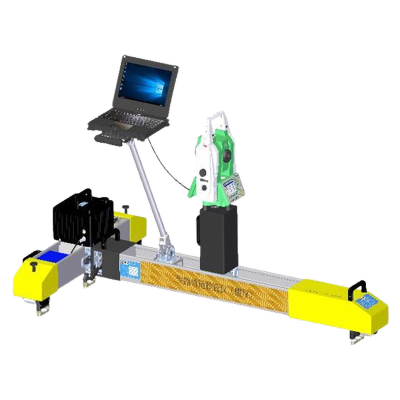
The replacement itself is planned from a measured survey. The rail section and the length of the new piece are fixed, the cut positions are set, and the closure is placed so that it does not land where the standards forbid it. On continuous welded rail the joint is also a thermal question: the site welding procedure and the locked rail temperature have to be consistent, or the finished string carries a built-in force that shows up later as a buckle or a pull-apart.
Stages 2 to 4 — The field sequence
| Stage | What happens | Typical equipment |
|---|---|---|
| 2. Extract | Cut the defective rail into transportable lengths, free the fastenings, separate insulated joints where present, and lift the old rail out of the four-foot | Lithium-powered rail saws, hydraulic insulated joint separators, rail drills |
| 3. Install and align | Bring the new rail in, set it to the correct gauge, level and alignment at both ends, and lock the alignment before anything is poured | Rail alignment jigs and straightedges, bow clamps, shim blocks, rail drilling machines |
| 4. Weld and finish | Weld the ends into one string, remove the flash or weld collar, and grind the joint and the surrounding profile flush | Thermite welding station or site welding machine, weld grinders, profile grinding equipment |
Alignment is where the quality is decided. A joint that is matched to within ≤0.5 mm in height and alignment, verified with a straightedge before and after welding, produces a finished weld that disappears into the running band. A joint that is mismatched by a millimetre produces a permanent impact point, and the grinding that follows cannot hide it.
What the standards fix, and what they leave to the engineer
Chinese railway design practice sets the frame clearly. Under TB 10082—2017 §8.0.6, rail should be welded by factory flash-butt welding, and a factory-welded long rail string should not be shorter than 500 m; on-site rail welding should also use flash-butt welding, while the locking weld inside a turnout and at the two ends of a turnout may use thermite welding. That is the rule that defines the workflow: the long string is a factory product, the field work is closure and connection, and thermite covers the residual cases.
TB 10015—2012 §4.5.6 adds the placement rule — a site welded joint must not be set inside the transition between two different track structures or two different subgrade sections, and must stand at least 2 m clear of abutment walls and piers. TB 10082—2017 §9.0.6 lists the places where a joint should not exist at all and must therefore be welded, glued or frozen: the full length of an open-deck bridge, within 2 m of a bridge end or an arch expansion joint, inside the temperature span of a rail expansion device, on the cross-beams of a steel girder, and across a level crossing. In practice the engineer chooses the closure position first and the welding method second.
Case and data — what the finished joint has to pass
For the thermite half of the job, the numbers published for the Molaton TWS rail thermite welding system set the expectation: reaction temperature ≥2500 °C, weld cooling time of about 5–8 minutes depending on ambient temperature, a total welding cycle within 25 minutes including preheating, pouring and mould removal, and a weld strength of ≥95 % of the base rail tensile strength. The system is built to TB/T 1632.3-2014 and covers 50 kg/m and 60 kg/m rail, 59R2/60R2 grooved rail, QU70–QU150 crane rail, and the UIC, BS, CR and A/S series — which is why it also serves port crane rails and cathode bars in aluminium smelters.
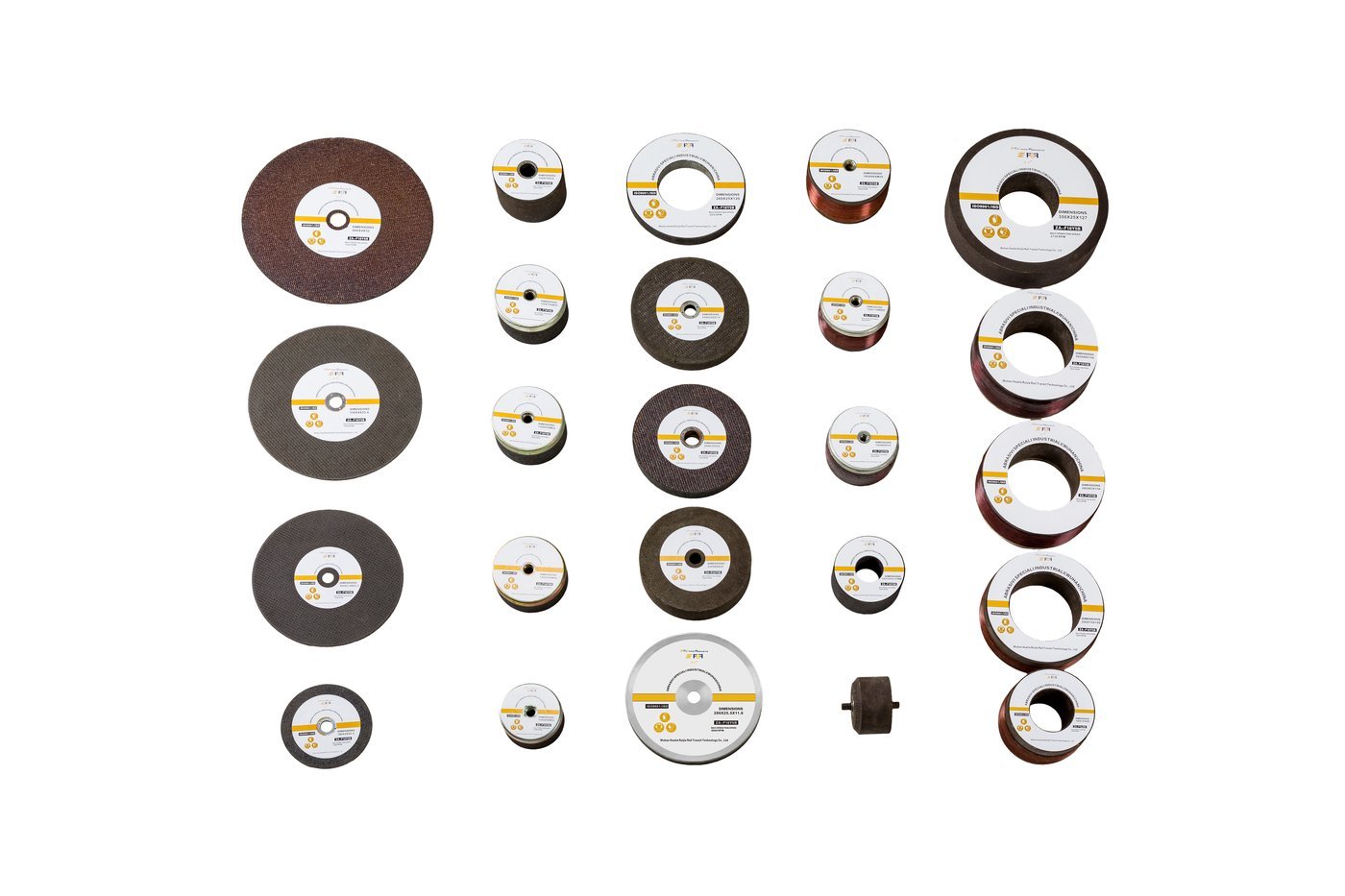
For the grinding half, the acceptance limits that close the job are surface roughness Ra ≤ 10 μm, flatness within 0.3 mm under a 1 m straightedge, no continuous blue burning, grinding depth ≤ 0.5 mm, and a blend-out better than 1‰. Grinding a weld is also where an uncontrolled cut does damage: running wheel speed from 1,000 to 3,000 rpm drives roughness from 6.6 to 8.4 μm and white-layer thickness from roughly 45 μm to 320 μm against a parent metal hardness of about 340 HV0.3 — so the weld head is dressed with controlled depth and the same wheel discipline used for profile work.
RailwayCare has manufactured rail grinding wheels since 2004 as the first dedicated rail grinding wheel producer in China, drafted the industry standard JB/T 11431, and operates to ISO 9001, ISO 45001 and CRCC certification, with wheels verified at the China Academy of Railway Sciences and at a national abrasives research institute.
Related questions you may also ask
What is track maintenance and what does it include? How does rail grinding prevent rolling contact fatigue? What is rail maintenance and why does it matter?Plan the replacement, the weld and the finish as one job
Send us the rail section, the joint positions, the possession length and the acceptance profile. We will specify the weld finish sequence and the Molaton grinding wheel for the joint and the surrounding profile.
Get a Rail Replacement SpecThe welding workflow is set out in more detail in our guide to rail welding and grinding as a complete workflow, the thermite system itself is described on the RailwayCare TWS thermite welding system page, and the full equipment set for the possession is listed under rail replacement and welding systems.
Are you looking for a reliable manufacturer of railway grinding and track maintenance equipment?
We can quickly provide customers with market analysis, technical support and customized services.
Safe Tracks Proven by China
- Name
- Phone
- *Title
- *Content