How Wide Are Railroad Tracks? Standard Gauge and Track Width Explained
The short answer is 1,435 mm — 4 feet 8½ inches — measured between the inner faces of the two rails. That is standard gauge, and about six out of every ten kilometres of railway in the world is built to it. The longer answer is more useful. A railroad is not one width everywhere. Roughly a quarter of the world runs wider, another sixth runs narrower, and — this is the part most articles skip — the 1,435 mm figure itself is not measured at the same height above the rail head in every country. That means two tracks both described as standard gauge can read slightly differently on the same instrument. This guide gives the numbers, the full gauge map, and the practical consequences for anyone who specifies track, rolling stock or maintenance equipment across more than one network. A standard gauge railroad track is 1,435 mm (4 ft 8½ in) wide, measured as the minimum distance between the two gauge faces — the inner, working edges of the rail heads. Three things about that definition are worth pinning down before the numbers go any further. It is measured to the working face, not the centreline. The rail head is a curved profile. Quoting the distance between rail centres, or between outer faces, gives a different number that is not the gauge. It is a minimum, not an average. Where the gauge faces are worn unevenly along a section, the smallest value governs. This is why a gauge reading can be within tolerance at the start of a curve and out at the end without anything having moved. It is a distance inside a height window, not at a single point. Because both the rail head and the wheel flange are curved, the point where the flange actually contacts the rail sits below the running surface. Each railway administration therefore defines the height at which the gauge is measured — and the heights differ. That last point is the one that catches people out, so it gets its own section below. Measured 14 mm below the rail top and measured 16 mm below the rail top, a worn rail will not give the same gauge. The gauge face leans, the head wears into a new shape, and the horizontal distance between the two faces changes with height. Different administrations have historically fixed different heights for the measurement plane. ISO 23054-1:2022 settles this in the sensible way: it defines gauge as the smallest distance between lines perpendicular to the running surface intersecting each rail head within a range from 0 to a depth Zp below the running surface, and then states that Zp lies between 14 mm and 16 mm. The standard also notes the consequence explicitly — gauge limit values depend on the chosen Zp. Europe and Japan work to 14 mm; China and Japan also work to 16 mm depending on the system. What this means in practice is simple and easy to forget. If you are comparing gauge records from a European network and a Chinese network, you are not necessarily comparing the same geometric quantity. On new, unworn rail the difference is negligible because the head profile is still the design profile. On a side-worn rail in a tight curve, where the gauge face has leaned and flowed, a 2 mm difference in measurement height can be the difference between a pass and a fail against a ±2 mm tolerance band. The full method — where to place the tool, how mechanical and digital gauges differ in accuracy class, what to record alongside the reading — is set out in our guide to rail gauge and how track geometry is measured correctly. Railways sort into three families by width relative to 1,435 mm. The shares below are route-length shares, and they are quoted from published summaries rather than from a single survey — different compilations place standard gauge anywhere between roughly 57 per cent and 60 per cent of world route length, so treat the figures as indicative rather than exact. Broad gauge overall accounts for roughly 23–26 per cent of world route length and narrow gauge roughly 15–16 per cent, again depending on the compilation. The important structural fact is not the exact percentage but the concentration: standard gauge covers almost all of the highest-traffic networks, while the non-standard gauges are heavily represented in exactly the places where railway is the only practical land transport — Russia's long hauls, India's dense network, southern Africa's mineral corridors, and mountain routes everywhere. 1,435 mm is the width most of the world settled on, and the story of how that happened is a story of habit rather than engineering: it traces back through George Stephenson's adoption of existing colliery and road wagon spacing, and was formalised in Britain by the Gauge Act of 1845. We tell that history in full in our article on why 60 per cent of the world's railways use 1435 mm gauge. For the purposes of this guide, three consequences matter. Standard gauge carries most of the world's high-speed dedicated lines. It carries most of the world's interoperability, because a standard-gauge vehicle can in principle run anywhere else standard gauge runs. And it carries most of the world's available maintenance equipment, because tooling and consumables designed for it have the largest market. Broad gauge buys stability and space. A wider track gives a wider wheelbase, which resists overturning on curves and tolerates a taller, wider vehicle body. That is why Spain's Iberian gauge and India's 1,676 mm network support generous loading gauges, and why Russia's 1,520 mm network carries the heavy axle loads and long hauls it does. The cost is isolation. Spain and Portugal run 1,668 mm against a continent of 1,435 mm; India runs 1,676 mm while most of the freight it wants to trade with the world moves on standard gauge. Both countries have spent decades and billions addressing that. Spain began building its high-speed AVE network to standard gauge from the Madrid–Seville line in 1992, so that new lines could eventually connect to the European high-speed network. The Iberian gauge network remains in service alongside it, and the interface is handled by gauge-changing installations that adjust suitable wheelsets while the train is moving — the Talgo variable-gauge system changes gauge in under 20 seconds at up to 16 km/h. Newer conversions take a hybrid route: on the Castellón–Valencia section of the Mediterranean Corridor, one track was converted to standard gauge for high-speed services while the parallel track became dual gauge so Iberian-gauge trains could keep running. India's Project Unigauge, launched in 1991–92, went the other way: rather than adopting the world standard, it converted the country's metre gauge and narrow gauge lines to the national broad gauge of 1,676 mm. By the early 2020s more than 90 per cent of routes had been converted, at a cost above US$10 billion, and narrow gauge survives mainly on heritage lines such as Darjeeling and Kalka–Shimla. Narrow gauge buys cheapness. A 1,067 mm line uses shorter sleepers, less ballast, narrower formation, and can turn through tighter curves — which is why it was chosen for mineral extraction in arid or mountainous terrain across southern Africa, for Queensland's and Western Australia's interior, for New Zealand, and for Japan's conventional network. The penalty is capability. Narrow gauge constrains vehicle width, which constrains payload, and it constrains stability at speed. Cape gauge lines typically work within speed limits around 80–100 km/h and axle loads that would be modest by heavy-haul standards, though there are exceptions — some metre-gauge lines in South Africa, Japan and Australia run as main lines and reach around 160 km/h at 16–18 tonne axle loads. Rail gauge is often treated as a single line item in a specification. Mechanically it drives a chain of consequences, and each of them shows up in procurement. Sleepers and fastenings scale with gauge. A standard-gauge sleeper is around 2.59 m long; broad gauge needs more; narrow gauge needs less. The sleeper is not a generic item — it is cut to the gauge it serves, and its bolt hole positions, shoulder spacing and fastening geometry follow from that. The components themselves are covered in our guide to what railroad tracks are made of. Formation and ballast width follow the sleeper. A wider gauge means a wider ballast shoulder and a wider formation, which changes earthworks volumes, drainage design and the space occupied at bridges and in tunnels. Loading gauge follows the track. The structure gauge has to clear the widest vehicle body the track can carry, and a wider track can carry a wider body. That interaction is why a broad-gauge network can offer more space per passenger seat and more cube per wagon, and why converting a line's gauge without rebuilding its structures is rarely possible. Curve performance changes. A wider track resists overturning better but needs larger-radius curves for the same speed, and it needs more curve widening to let a rigid wheelset negotiate a tight radius. Turnouts and crossings are gauge-specific. A turnout is laid out to the gauge of the line it sits in — the lead length, the crossing angle and the check rail dimensions all follow. That is why special trackwork is one of the least interchangeable items in a railway. Our guide to diamond crossings and frog maintenance sets out how those dimensions govern acceptance on crossings. Wheel-rail contact geometry changes with the gauge-wear interaction, and the rail section each network standardises on differs with it — the section and specification differences across networks are set out in our overview of global rail specifications. The rail head profile that works on a 1,435 mm line is not automatically right for 1,676 mm, because the contact position on the head differs. This is where gauge stops being a civil engineering number and becomes a maintenance number — the point covered in our analysis of rail wear measurement and when to grind or replace. A track on a curve is not built to exactly 1,435 mm. It is built wider, deliberately, by an amount that depends on the radius. The reason is geometric. A wheelset is effectively a rigid axle with two flanges. On straight track the wheelset can sit centrally between the rails with clearance on both sides. On a tight curve it cannot: the outer wheel has to travel further than the inner wheel, the wheelset tries to align itself with the curve, and the flanges are pushed toward the outside of the rails. If the track stayed at 1,435 mm, the wheelset would jam. Widening the gauge on the curve restores the clearance the wheelset needs to negotiate the radius without binding. The practical figures, in Chinese practice, are typically 1,440 mm and 1,450 mm of gauge on curves of decreasing radius, against the 1,435 mm of tangent track. The upper limit matters as much as the widening itself: the maximum gauge permitted anywhere, including curve widening, is generally capped at 1,456 mm, because past that point the flange has enough room to drop between the rails. Two consequences follow for anyone reading a gauge record. A gauge reading on a curve is not comparable with one on tangent track. It has to be compared against the widened value for that radius, not against 1,435 mm. Reading 1,448 mm on a tight curve may be correct; reading the same number on straight track is a defect. Curve widening has to be introduced gradually. It is applied through the transition, ramping in at a defined rate, so the wheelset is not asked to absorb a step change in clearance. If the ramp is too abrupt the gauge change rate itself becomes the defect, whatever the absolute value reads. This is also where gauge and grinding meet. A curve that is ground to the wrong profile can move the gauge face outboard or inboard along the measured depth, changing the gauge number without any sleeper having moved. That is one of the reasons a gauge check is worth reading next to a profile measurement rather than on its own — a point our guide to rail wear measurement treats in detail. Where two networks of different gauge meet, the through service stops being through. Either the freight is transshipped, or the bogies are exchanged, or the wheelsets change gauge on the move. All three cost money and time. The clearest live example is the China–Russia interface. Russia runs 1,520 mm, China runs 1,435 mm, and the crossings at Manzhouli and Zabaikalsk are the chokepoints on the New Eurasian Land Bridge. More than 90 per cent of freight between the two countries is transshipped or has its bogies exchanged there, and the delay is routinely costed at around US$1,000 per container. The corridor crosses seven countries and uses two gauges, so a container moving from China to western Europe is handled twice before it arrives. Australia is the textbook domestic case. By federation in 1901 the colonies had chosen different gauges — New South Wales and Victoria standard, Queensland and Western Australia 1,067 mm, South Australia a mixture — fragmenting more than 40,000 km of track. The Melbourne–Adelaide corridor needed gauge changes at the state border until the 1990s, when the One Nation programme standardised most interstate lines. Regional narrow-gauge networks remain. Britain ran the largest conversion in railway history, and it is worth knowing how fast it can be done when the will exists. The Great Western Railway had built to 2,134 mm broad gauge. Its conversion to standard gauge began in the 1860s and culminated over the weekend of May 1892, when 285 km of main line was converted in under 48 hours using around 5,000 workers — service suspended Friday evening, restored Monday morning. The three engineering answers to a break of gauge are dual or triple gauge track, permanent conversion, and variable-gauge rolling stock. Dual gauge — three or four rails sharing a trackbed — solves interoperability without touching the vehicles but costs more to build and maintain and concentrates stress in the shared rails. Conversion is the cleanest long-term answer and the most expensive, typically estimated well above the cost of building new track. Variable-gauge axles are the most elegant and the least universal, because every vehicle that needs to cross has to be built for it. For anyone buying track measuring instruments, maintenance machinery or grinding consumables, gauge stops being background information and becomes a specification input. Track gauges have a measuring range, and the range has to cover your gauge. A mechanical gauge built for standard gauge typically spans roughly 1,420–1,460 mm, which is ample for 1,435 mm plus curve widening and wear but quite useless on a 1,520 mm or 1,676 mm network. Digital gauges are built to wider spans, but the ranged instrument is still the thing you buy against the gauge you actually maintain. The accuracy class you can certify depends on the instrument, not the network. A digital gauge in the highest class is needed for the tightest acceptance bands on high-speed standard-gauge work; a mechanical gauge with a stated error of ±1 mm is adequate for lower-speed lines and cannot certify a band tighter than that error. Our rail inspection tools list the ranges and classes we supply, and the wider inspection scope behind them is set out in our rail inspection solution. Grinding wheels are gauge-specific only indirectly — but the indirect chain is real. Our rail grinding wheel range is specified by rail section and duty for exactly this reason. Gauge itself does not dictate a wheel. Rail section, axle load, curve radius and rail hardness do. But broad-gauge networks tend to run heavier axle loads and harder sections, so the wheel that suits a 1,520 mm heavy-haul network is a different specification from the one that suits a 1,435 mm mixed-traffic line. We set out how that changes the specification in our article on adapting rail grinding wheels for 1520 mm gauge, which works through the GOST 33174-2014 requirements. Spares commonality is a gauge decision made decades ago. A fleet built for 1,067 mm cannot be redeployed on 1,435 mm without new bogies or new wheelsets. That is why the gauge map still shapes procurement today: two networks with the same track standard but different gauge share almost nothing in rolling stock. "Standard gauge is 1,435 mm exactly, everywhere." The nominal figure is universal; the measurement plane is not. On worn rail the two can differ by a measurable amount. Compare like with like before drawing a conclusion from records from two administrations. "Wider is stronger." Broad gauge gives more stability at the same speed and more room in the loading gauge, but it also costs more per kilometre in earthworks, sleepers, ballast and structures. High-speed networks worldwide converged on standard gauge because it balances overturning resistance against infrastructure cost better than the alternatives — not because it is the widest. "Narrow gauge means slow and light." It means cheaper, which is not the same thing. Cape gauge and metre gauge lines in southern Africa, Japan and Australia operate as main lines at speeds and axle loads that would have been unthinkable to the engineers who chose them for cost reasons. "Gauge conversion is a track job." It is a systems job. Signalling that detects trains through track circuits and axle counters has to be recalibrated for the altered geometry, and the rolling stock fleet has to be modified or replaced. Those two items are usually what decides the programme duration. We supply the items that sit on the track rather than the track itself — you can read more about us and what we make: track gauges and inspection instruments with stated ranges and accuracy classes, rail grinding wheels specified against the rail section and duty of the network they serve, and the portable machines and consumables that go with them. Where a network runs a non-standard gauge, we specify against the section and loading rather than assuming a standard-gauge default, which is how our rail maintenance solution is built — that is the whole point of our light customisation programme. Our grinding wheels hold an EN 12413:2019 conformity certificate issued by UDEM (certificate M.2026.206.C147949), and we work across standard gauge, 1,520 mm broad gauge, metro and industrial networks, including rail grinding wheel supply for the 1,520 mm GOST systems. If you are specifying instruments or wheels for a network, tell us the gauge, the rail section (kg/m), the annual tonnage and the defect types you are dealing with. We will come back with the ranges, classes and wheel specification that fit, and we are glad to work through project cooperation where the scope runs beyond consumables. Contact us at simon.wang@railwaycare.com or +86 15072332788 with those four numbers and we can answer with a specification rather than a brochure. Standard gauge is 1,435 mm, which is 4 feet 8½ inches, measured between the inner working faces of the two rails. Broad gauge runs wider — 1,520 mm in Russia, 1,668 mm in Spain and Portugal, 1,676 mm in India — and narrow gauge runs narrower, most commonly 1,067 mm or 1,000 mm. No — it is measured a fixed distance below the top of the rail head, because that is where the wheel flange actually contacts the rail. The depth differs by administration: 16 mm in China, 14 mm in Germany and most European practice, 15 mm in France, 10 mm in the former Soviet Union. ISO 23054-1:2022 allows any depth between 14 mm and 16 mm, to be agreed between the parties. Because it was inherited rather than designed. George Stephenson used the spacing already in service on colliery and road wagons, which traces back through Roman road ruts to roughly 1.435 m. Britain formalised it in the Gauge Act of 1845, and the spread of British-built railways carried it worldwide. It is 4 feet 8½ inches because it was never a metric decision. It means more stability and more room inside the loading gauge, at the cost of more earthworks, longer sleepers, wider ballast sections and larger structures per kilometre. Standard gauge dominates because it balances those factors better for most traffic, not because wider is inherently superior — the world's dedicated high-speed lines almost all run on it. The through service stops. Freight is either transshipped or has its bogies exchanged, or the wheelsets change gauge on the move using a variable-gauge system. All three cost time and money; at the China–Russia crossings the delay is commonly costed around US$1,000 per container. Dual-gauge track, permanent conversion and variable-gauge rolling stock are the three engineering answers. Not because of the gauge itself, but because of what usually comes with it. Rail section, axle load, curve radius and rail hardness are what drive wheel specification — and broad-gauge heavy-haul networks tend to run heavier axle loads and harder rail sections. A 1,520 mm network running R65 and R75 rail needs a different wheel specification from a 1,435 mm mixed-traffic line, and the axle-load standard for the network usually sets the acceptance requirement.
The Direct Answer: How Wide Is a Railroad Track?
Where the 1,435 mm Is Actually Measured
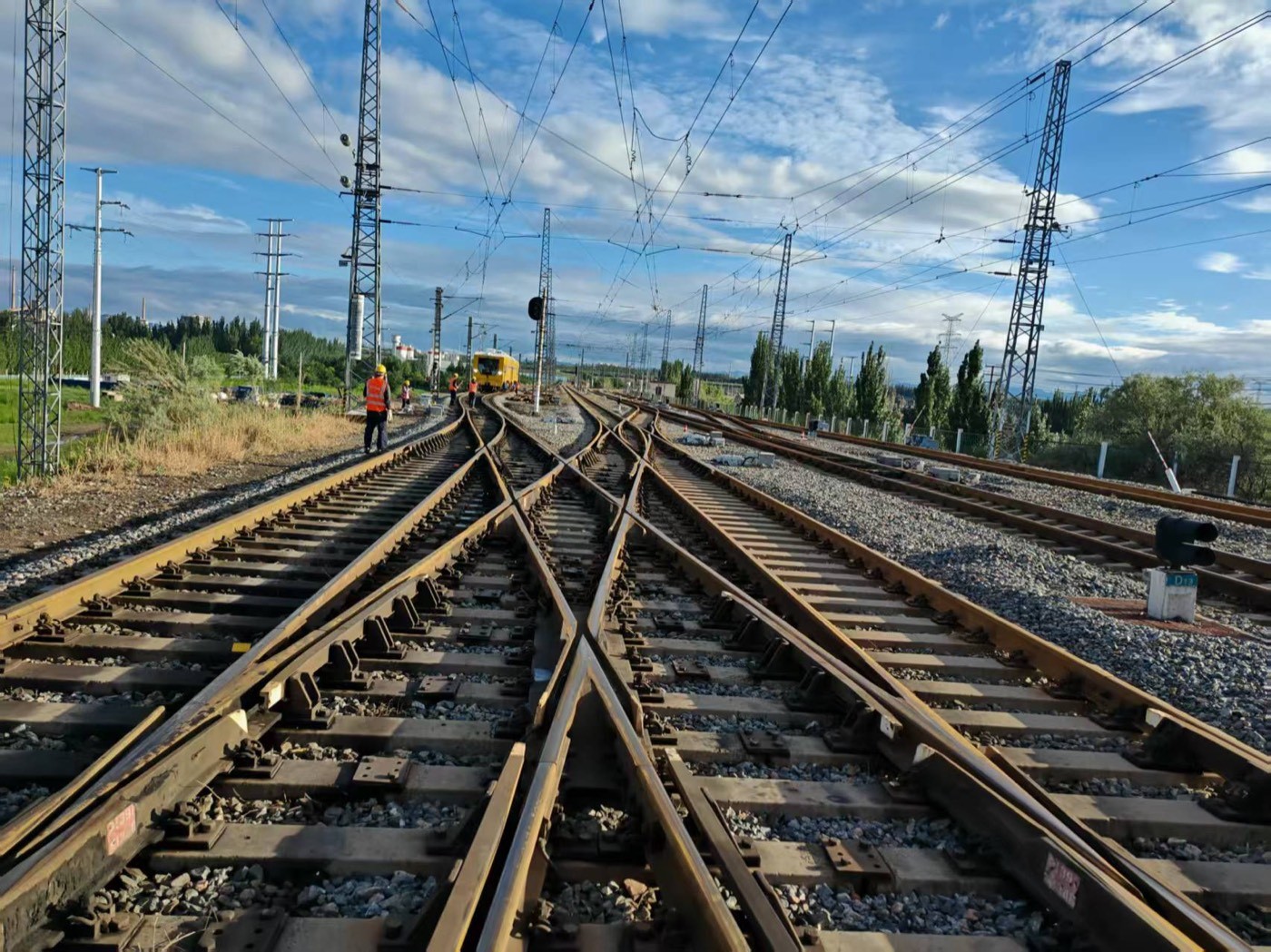
Standard or administration Height below rail top at which gauge is measured China 16 mm Germany (and most European practice) 14 mm France 15 mm Former Soviet Union 10 mm ISO 23054-1:2022 Any value of Zp between 14 mm and 16 mm, to be agreed between parties The World's Track Gauges, Side by Side
How Wide Are Railroad Tracks in Other Countries?
Family Gauge Approx. share of world route length Where it runs Standard 1,435 mm (4 ft 8½ in) about 57–60 % Europe, North America, China, most of the Middle East and North Africa, Japan's Shinkansen, Korea Broad 1,520 mm (5 ft) the largest broad-gauge share Russia, former Soviet states, Finland, Mongolia Broad 1,524 mm legacy alignment, largely superseded some former Soviet and Eastern European lines, converted to 1,520 mm from 1971 Broad 1,600 mm (5 ft 3 in) small Ireland, Victoria and South Australia in Australia, parts of Brazil Broad 1,668 mm (5 ft 5½ in) Iberian gauge Spain, Portugal Broad 1,676 mm (5 ft 6 in) Indian gauge, the second-largest single gauge in the world by route length India, Pakistan, Bangladesh, Sri Lanka, Argentina, Chile Narrow 1,067 mm (3 ft 6 in) Cape gauge, the dominant narrow gauge Southern Africa, Japan's conventional network, Queensland and Western Australia, New Zealand, Taiwan, China, parts of Indonesia and Africa Narrow 1,000 mm (3 ft 3⅜ in) metre gauge, about 15 % combined with Cape gauge Parts of Africa, Southeast Asia, South America, Switzerland, a section of the Kunming–Hekou route in China Narrow 762 mm / 610 mm about 0.5 % combined with other very narrow gauges Industrial, plantation, heritage and mountain lines Standard Gauge
Broad Gauge
Narrow Gauge
Why Gauge Is Not Just a Width
Why Curves Are Built Wider Than 1,435 mm
Break of Gauge: Where Two Widths Meet
What Gauge Means When You Specify Equipment
Common Misconceptions About Track Width
Working with RailwayCare on Gauge-Specific Track Tools and Consumables
FAQ
How wide are railroad tracks in feet and inches?
Is 1,435 mm measured at the top of the rail?
Why is standard gauge 1,435 mm and not a round number?
Does a wider track mean a better railway?
What happens where two different gauges meet?
Do different gauges need different grinding wheels?