What is a railway grinding wheel and how does it work?
What is a railway grinding wheel and how does it work?
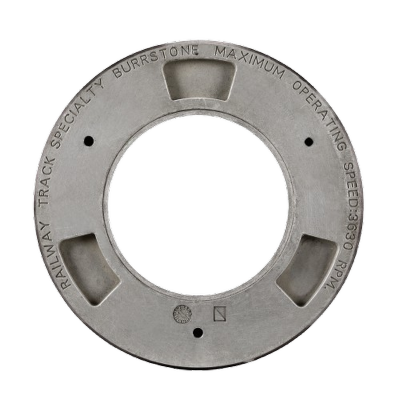
A RailwayCare/Molaton railway grinding wheel is a precision-engineered abrasive tool that removes surface irregularities from rail heads through high-speed rotational friction (3600-6000 RPM). Using bonded abrasive grains—primarily zirconia alumina (ZA)—the wheel cuts away corrugation, RCF cracks, and plastic flow defects, restoring rail profile to within +/-0.3mm of design specifications and extending rail service life by 30-60%.
How Railway Grinding Wheels Function
A grinding wheel operates on abrasive machining principles where thousands of sharp abrasive grains bonded in a resin matrix act as microscopic cutting tools. At peripheral speeds of 40-60 m/s, each grain removes 0.001-0.01mm of metal. Three mechanisms occur simultaneously: cutting (sharp grains shear metal), plowing (grains displace metal laterally), and rubbing (worn grains generate friction heat). RailwayCare wheels feature precisely controlled grain friability ensuring continuous self-sharpening throughout wheel life.
Key Components of Railway Grinding Wheels
- Abrasive Grain (45-55% vol): ZA micro-crystalline structure for controlled fracture. 2-3x longer life on 260-380 HB rail steel vs standard AlOx.
- Resin Bond (10-20% vol): Modified phenolic formulations for shock resistance and thermal stability at high operating speeds.
- Porosity (15-25% vol): Engineered void structure for coolant flow, chip clearance, and heat dissipation. Reduces grinding temperature 15-25%.
- Fiberglass Reinforcement (5-10% vol): Multi-layer mesh providing structural integrity at operating speeds up to 80 m/s.
Rail Surface Defects Addressed by Grinding
Railway grinding targets: corrugation (25-80mm wavelength periodic wear causing noise/vibration); Rolling Contact Fatigue (RCF) cracks at 25-45 degree angles (60% of all rail surface defects); head checks on high-rail gauge corner in curves; shelling (subsurface crack propagation causing surface spalling); plastic flow (lateral displacement >5mm under high contact stresses); wheel burns (localized martensitic transformation from wheel slip). Grinding removes 0.05-1.0mm per pass depending on objective (preventive vs corrective).
Railway Grinding Wheel Technical Specifications
- Standard diameters: 125-300mm (portable), 250-400mm (ride-on), 600-915mm (train-mounted)
- Grit sizes: F16-F36 (rough stock removal), F46-F80 (finishing/profiling)
- Bond hardness: Grade H through P matched to rail hardness 200-380 HB
- Max operating speed: 50-80 m/s; tested to 1.5x rated speed per EN 12413
- Service life: 2-8 hr continuous (portable), 4-16 hr (train-mounted) per wheel
Case: European High-Speed Network
A European operator adopted RailwayCare ZA grinding wheels on Loram C44 for Paris-Lyon corridor (45 MGT/yr). Results: grinding interval extended 18 to 25 MGT, rail replacement deferred ~5 years, lifecycle cost -22% over 10 years.
Related Questions
- How to choose the right rail grinding wheel?
- Why is ZA the preferred abrasive?
- Hot-pressed vs cold-pressed differences?
- What causes premature grinding wheel wear?
Are you looking for a reliable manufacturer of railway grinding and track maintenance equipment?
We can quickly provide customers with market analysis, technical support and customized services.
Safe Tracks Proven by China
- Name
- Phone
- *Title
- *Content