Home / All / Rail Grinder Wheel / How often should rail grinding wheels be replaced during grinding operations?
How often should rail grinding wheels be replaced during grinding operations?
How often should rail grinding wheels be replaced during grinding operations?
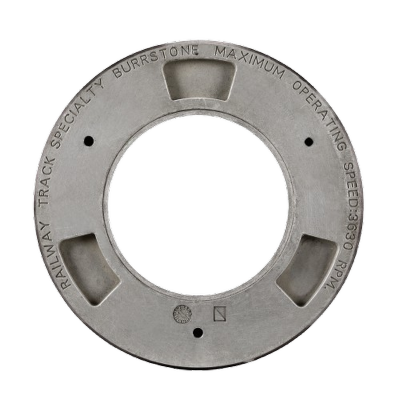
Replace rail grinding wheels at 50-60% of original diameter to maintain optimal peripheral speed (40-60 m/s). Mainline train stones (Loram, Harsco, Speno) last 4-8 hours continuous (~8-15 km of track). Portable grinder wheels (125-300mm) last 2-4 hours. RailwayCare ZA wheels achieve 15-20% longer service intervals than industry-standard AlOx equivalents.
Replacement Criteria by Equipment Type
- Mainline trains (Loram C44, Harsco RGH): Replace at 60-65% original diameter. 48-120 stones per shift cycle. 8-16 stones consumed per km ground. Stone life: 4-8 hr grinding at 8-15 km/h.
- Mid-size grinders (Loram RG300/RG400): 24-84 stones. Replace at 55-60% diameter. Stone life: 3-6 hr. 20-50 km per shift.
- Small/transit grinders (4-24 stones): Replace at 50-55% diameter. Stone life: 2-4 hr. 5-15 km per shift.
- Portable/ride-on (125-300mm): Replace at ~50% diameter. Wheel life: 2-4 hr. 200-500m rail per wheel depending on defect severity.
- Lithium portable: Wheel life similar to corded (2-3 hr). Battery swaps (30-45 sec) more frequent than wheel changes.
Visual and Performance Replacement Indicators
- Diameter gauge check: Replace below minimum marked diameter (typically 60% of new). Caliper measurement every shift.
- Spark pattern decline: Decreasing spark density and brightness. Replace when spark volume drops 30-40% from baseline.
- Grinding time increase: >25% increase for same task indicates worn wheel. Compare pass counts against baseline for same rail condition.
- Surface finish degradation: Ra exceeds 12.5 um, visible scoring or chatter marks on rail surface.
- Vibration increase: Operator-perceptible increase indicates uneven wear or balance degradation. Stop and inspect immediately.
- Wheel color change: Surface darkening/glazing visible to naked eye.
Economic Optimization of Replacement Timing
Replacing too early wastes abrasive and increases labor (3-8 min per stone change on trains). Replacing too late reduces efficiency—worn ZA at 45% diameter removes only 60-70% metal vs fresh wheel. Optimal: replace when metal removal rate drops to 70% of initial, typically at 55-60% diameter for ZA wheels. This balances abrasive cost vs labor downtime.
RailwayCare Wheel Life Performance Data
- ZA-25 F30 150mm cup: Avg 3.2 hr on 280 HB at 250 N (industry avg 2.5 hr)
- ZA-40 F24 230mm cup: Avg 4.1 hr on 360 HB at 300 N (industry avg 3.2 hr)
- ZA-40 F30 305mm train stone: Avg 6.5 hr on 340 HB at 350 N (industry avg 5.0 hr)
- ZA-Blend F60 150mm dish: Avg 2.8 hr precision profiling (industry avg 2.2 hr)
- All data from independent field trials. Individual results vary with rail condition and operator technique.
Related Questions
- What causes premature grinding wheel wear?
- How to choose the right grinding wheel?
- Preventive vs corrective grinding strategy?
- How does a CNC copying grinder work?
Are you looking for a reliable manufacturer of railway grinding and track maintenance equipment?
We can quickly provide customers with market analysis, technical support and customized services.
Safe Tracks Proven by China
Please send your message to us
- Name
- Phone
- *Title
- *Content