Switch Rail Fish-Scale Crack Elimination: Small Machine Grinding with Precision Railway Grinder Wheels
When fish-scale cracks appear on switch rails and movable point rails in high-speed turnouts, they are not just cosmetic defects — they are stress concentration points that can initiate rail fractures under cyclic wheel loading. Eliminating these defects requires a railway grinder wheel capable of controlled, low-heat material removal in the most geometrically constrained areas of the entire turnout. The Beijing Railway Bureau's documented three-step methodology provides a blueprint for effective small-machine intervention.
Understanding Fish-Scale Cracks: Why They Demand a Specialized Railway Grinder Wheel
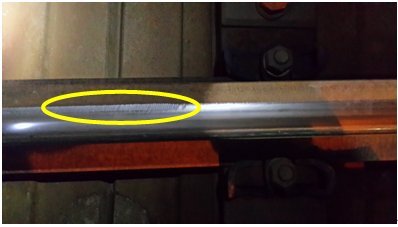
Fish-scale cracking on turnout components is a surface-initiated fatigue phenomenon caused by the combination of high contact stresses, lateral forces from steering transitions, and the hardened surface layer of heat-treated switch rail steel. Unlike open-line surface defects that can be addressed by large grinding vehicles at speed, turnout fish-scale cracking requires:
- Precision access: Only portable machines can reach the switch rail transition zones where these cracks concentrate.
- Low thermal input: Excessive heat during grinding can alter the pre-existing hardness profile of switch rail steel.
- Controlled depth removal: Removing too much material shortens service life; removing too little leaves crack roots intact.
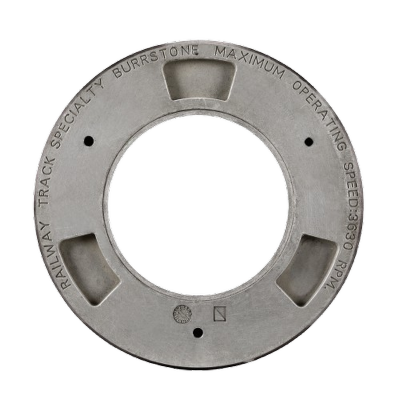
These requirements define the specification for the ideal railway grinder wheel used in this application: sharp cutting edges for efficient material removal at low pressure, self-sharpening abrasive behavior to maintain consistency through extended passes, and a bond system that erodes predictably without generating excessive frictional heat. Molaton's hot-pressed zirconia alumina wheels match all three criteria.
The Fish-Scale Treatment Philosophy: Grind Like a Train Wheel, Not Like a Cutting Tool
The Beijing Bureau's guiding principle for small-machine defect treatment is elegant in its simplicity: treat the grinding wheel as if it were a train wheel traversing the rail surface. This means the operator should visualize how an actual train wheel would make contact with the rail at each position along the switch rail or point rail, and then guide the portable machine's railway grinder wheel along that same contact path.
This philosophy ensures two critical outcomes:
Natural Profile Preservation
The ground surface follows the natural wear pattern of train wheels, maintaining optimal wheel-rail contact geometry after grinding.
No Over-Ground Zones
By simulating actual wheel paths, the operator avoids creating artificial high spots that would cause new stress concentrations.
Step 1 — Defining the Grinding Range for Switch Rail Fish-Scale Cracks
Before any railway grinder wheel touches the switch rail, the treatment range must be precisely defined. The Beijing Bureau's specification covers:
- Forward extent: From 4 sleepers before the front weld joint of the switch rail (toward the facing moveable point)
- Rearward extent: To 4 sleepers after the rear weld joint of the switch rail (toward the closure rail)
This range captures the full zone where fish-scale cracking typically develops — the area where the switch rail transitions from full contact with the stock rail to partial contact and back again under varying lateral load conditions.
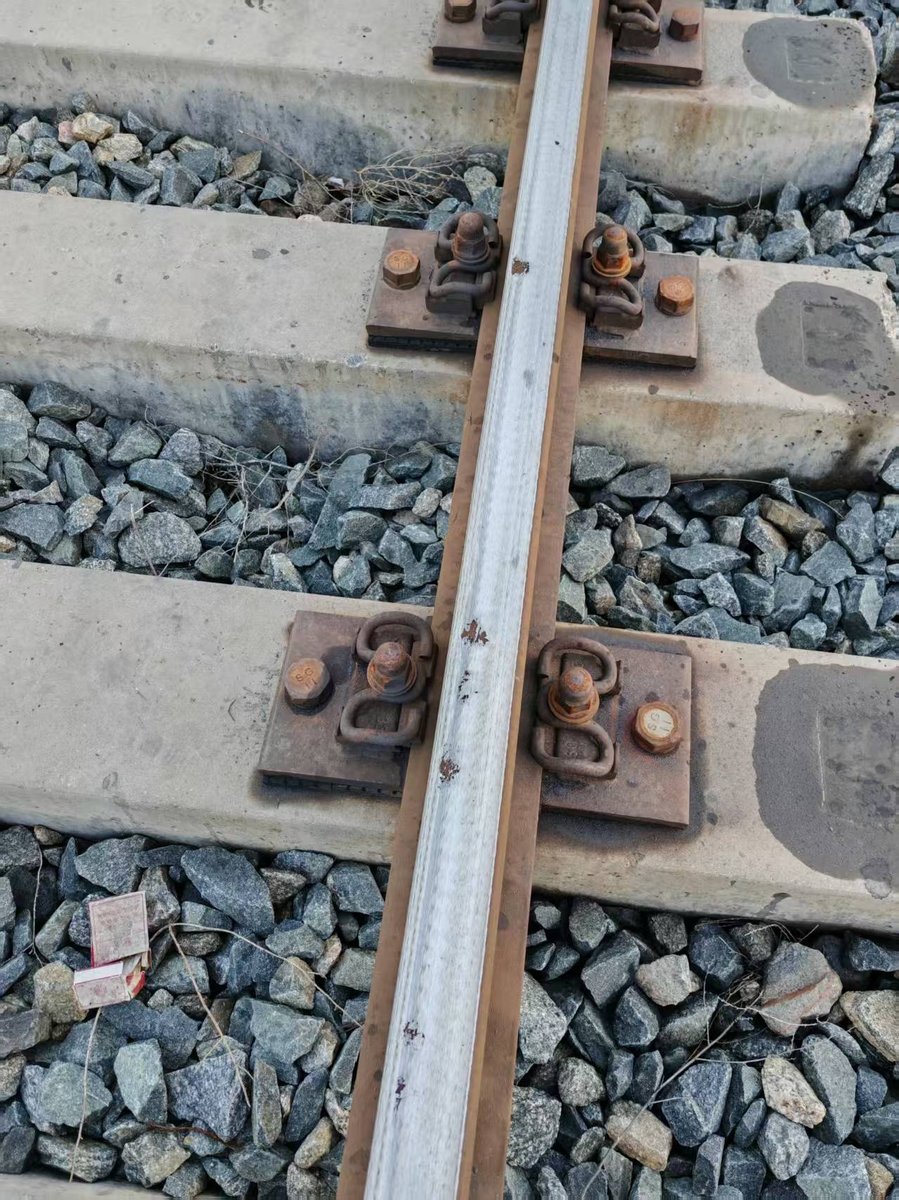
Defined grinding range for switch rail fish-scale crack treatment — every railway grinder wheel pass stays within this boundary.
Step 2 — Starting Position: Begin Where the Rail Feels the Load
The starting point for each grinding pass is not arbitrary — it begins at the load-bearing contact point between the switch rail and stock rail. This is the position where actual train wheels apply their maximum contact pressure. By starting here and grinding toward the gauge side (导向面), the operator follows the natural progression of wheel-rail contact.
Starting at the wrong position — for example, at the field side of the rail head — risks removing material from a zone that does not naturally experience heavy wheel contact, creating an artificial flat spot that will cause poor ride quality after trains resume operation.
Grinding starts at the load-bearing contact point and proceeds toward the gauge face — mimicking the path of a real train wheel.
Step 3 — The Uniform-Layer Method: Remove One Layer, Preserve the Profile
The most important rule of fish-scale grinding is this: do not change the existing rail profile shape — simply remove one uniform layer from the entire contact surface.
This means the railway grinder wheel should remove approximately the same depth of material across the full width of the contact band, rather than aggressively targeting individual crack locations. The rationale is straightforward:
- Fish-scale cracks are shallow: They typically extend only 0.1–0.3 mm below the rail surface. A uniform layer of 0.1–0.15 mm removal is sufficient to eliminate them completely.
- Profile integrity matters more than crack elimination: If the operator grinds deeply into individual cracks while leaving surrounding areas untouched, the resulting irregular profile creates new stress risers that may accelerate future crack formation.
- Uniform removal is faster: A single light pass across the full width takes less time than multiple targeted deep cuts, reducing total track possession time.
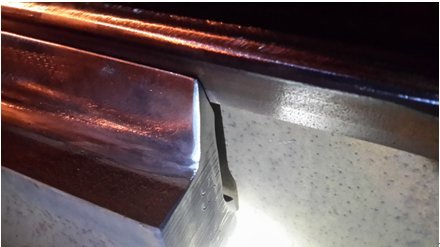
The uniform-layer method — one even pass removes all fish-scale damage while preserving the original profile geometry.
Movable Point Rail Fish-Scale Treatment: Same Method, Tighter Space
The movable point rail at the frog section presents the same fish-scale problem but in an even more constrained space. The Beijing Bureau applies the identical three-step methodology:
- Range: 4 sleepers before and 4 sleepers after each weld joint in the frog area
- Start position: Load-bearing contact point on the point rail, grinding toward gauge side
- Method: Uniform-layer removal without changing the combined point-rail/wing-rail profile
The key difference is spatial: the frog area has less room for maneuvering the portable machine, making it even more essential that the railway grinder wheel delivers clean, predictable cutting on the first pass. Molaton's zirconia alumina formulation excels here because its grains fracture microscopically under load, continuously exposing fresh sharp cutting edges that maintain consistent cut depth even when the operator cannot maintain perfectly steady hand pressure in tight spaces.
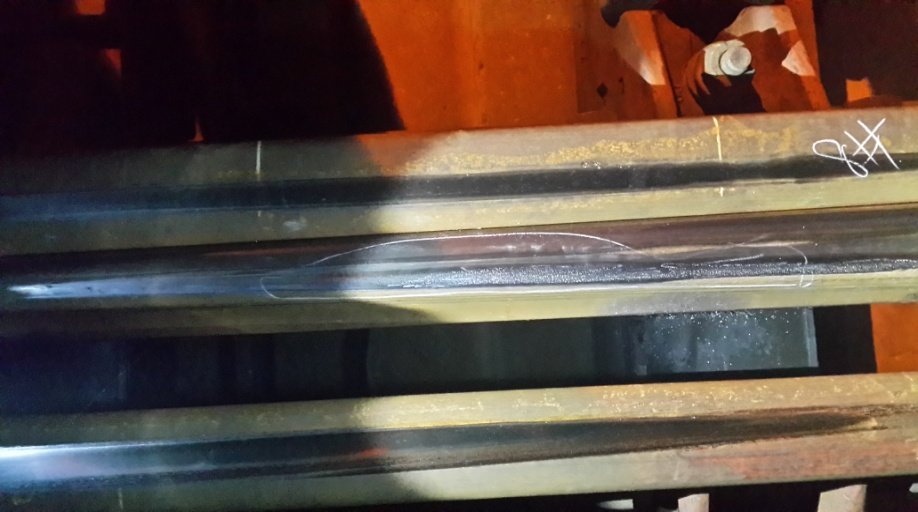
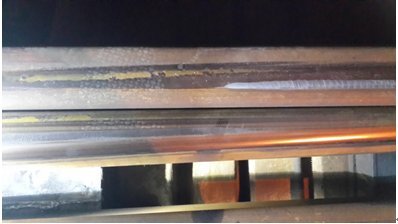
Movable point rail before (right) and during fish-scale treatment — the railway grinder wheel must work within extremely limited clearance.
Pre-Grinding Structural Adjustment: The Foundation of Successful Small-Machine Work
Before any small-machine grinding begins, the turnout structure itself must be brought into proper adjustment. Grinding a structurally misaligned turnout is like painting over rust — the underlying problem remains. The Beijing Bureau specifies:
Contact Gap Control
Switch/point rail tip-to-stock/wing rail gap <0.5 mm; other positions <1 mm. This ensures the railway grinder wheel grinds the true contact surface, not a gap-induced false surface.
Roller Adjustment
In closed-switch condition, switch rail bottom-to-roller plate gap <0.5 mm. Prevents vertical deflection during grinding that would cause uneven cut depth.
Reduction Value Check
Switch/point rail reduction value vs. design value deviation <1 mm. Ensures the correct contact geometry exists before grinding modifies the surface.
Geometry & Alignment
Track measurement vehicle survey before grinding. Straight track alignment first, then curved track including attached curve synchronization.
Small-Machine Equipment Selection: Matching Machine to Railway Grinder Wheel Capability
The Beijing Bureau uses two types of portable grinding machines for turnout defect treatment, each requiring different railway grinder wheel characteristics:
| Equipment Type | Wheel Travel Range | Angle Range | Primary Application |
|---|---|---|---|
| Vertical Rail Grinder | H: 385mm, V: 185mm | ±30° vertical tilt | Gauge corner, rollover edge |
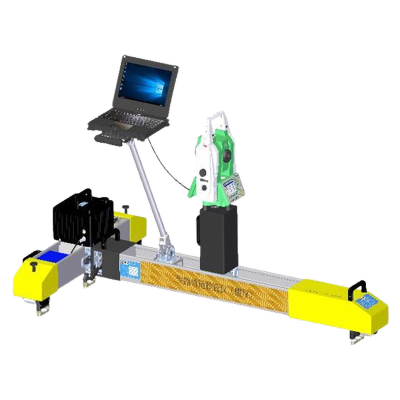
| Dedicated Turnout Grinder | H: 385mm, V: ~200mm | ±30° horizontal | All rail top surfaces & gauge corners |
Both machines are equipped with railway grinder wheel units that must deliver fine control at low feed pressure. Molaton supplies wheels specifically graded for portable-machine use, with grain size distributions optimized for the lower spindle speeds and hand-guided operation typical of this equipment category.
Quality Verification: Template Rulers and Deviation Standards After Treatment
After fish-scale grinding is complete, quality verification uses custom-fabricated template rulers matched to specific cross-section widths (typically 25mm, 35mm, and 40mm from rail centerline). The acceptance criteria:
- Within −25mm to +25mm from center: positive deviation ≤ 0.2 mm
- From 25mm to gauge corner edge: positive deviation ≤ 0.3 mm
- No visible fish-scale pattern remaining under 10× magnification
- Surface roughness Ra consistent with adjacent unground sections
Achieving these tolerances consistently requires a railway grinder wheel whose wear rate is predictable enough that operators can plan their pass count and depth per pass with confidence. Molaton's manufacturing quality control ensures batch-to-batch variation in wheel performance stays below 5%, giving operators the repeatability they need.
Why Molaton Is the Preferred Choice for Turnout Disease Treatment Applications
Turnout disease treatment is unforgiving. There is no room for error in confined spaces beside active high-speed lines. Molaton understands this because our customers — railway maintenance teams across Asia, Europe, and the Americas — have told us exactly what they need:
- Low-pressure cutting efficiency: Zirconia alumina grains stay sharp at the low downforce values that hand-held machines can deliver.
- Minimal thermal footprint: Hot-pressed porosity and optimized bond conductivity keep rail temperature rise below the threshold for metallurgical change.
- Consistent wear behavior: Every wheel performs like the last one, so operators do not need to relearn their technique for each new wheel.
- Full angle coverage: Our wheels cut cleanly across the full ±30° range required by both machine types.
Fish-Scale Cracks Don't Have to Be Recurring Problem
With the right railway grinder wheel and the Beijing Bureau-proven three-step method, you can eliminate fish-scale damage permanently. Contact Molaton for a free wheel matching consultation.
Consult Our Engineering Team →