Solutions for Rail Breakage
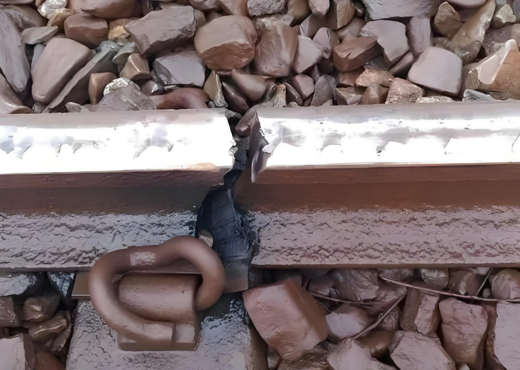
Rail Breakage Treatment
If a broken rail is discovered, the line should be immediately closed, and emergency, temporary, or permanent repairs should be carried out depending on the situation.
Emergency Repair
When the gap is no larger than 30mm, a clamp or bulge clamp can be placed at the gap. Emergency reinforcement should be carried out using a first-aid kit. Fasteners within a 50m radius before and after the gap should be tightened, and a dedicated person should be assigned to guard the area. Trains should be allowed to pass at a speed not exceeding 45 km/h, and the speed limit on adjacent tracks should not exceed 160 km/h.
After emergency treatment, marks should be made on the non-working sides of the railheads on both sides of the gap (marking intervals are generally 26m). The distance between the two marks and the gap value on the non-working side of the railhead should be accurately measured and recorded.
Temporary Repair
When a rail is severely damaged, the gap exceeds 30mm, or permanent repair cannot be performed immediately after emergency treatment, the damaged portion should be cut off. A rail of the same type, at least 6m long, should be inserted between the two cuts. Holes should be drilled at the rail ends, joint clamps installed, and tightened with 10.9 grade bolts. Fasteners within 50m before and after the short rail should be tightened, and trains should be allowed to pass at a speed not exceeding 160km/h.
Before temporary repairs, marks should be made on the non-working sides of the rail head on both sides of the gap (marking intervals are generally 26m). The distance between the two marks and the gap value on the non-working side of the rail head should be accurately measured and recorded.
Permanent Repair
For emergency or temporary repairs, in-situ welding or short rail insertion welding should be performed within the same track maintenance window on the same day. During welding, the locking rail temperature of the seamless track should be maintained constant. The working rail temperature should be 0°C to 20°C lower than the actual locking rail temperature. When short rail insertion welding is used, the short rail length must not be less than 20m.
Rail welding should be performed in accordance with the "Rail Welding" standard (TB/T1632) and meet the following requirements:
(1) Welding equipment with tensile and pressure holding functions should be used.
(2)The rail temperature during welding operations should not be lower than 5°C, and adverse weather conditions such as strong winds, rain, and snow should be avoided. If rail welding must be carried out in adverse weather, appropriate measures should be taken to ensure the ambient temperature is above 5°C. After the rail is pushed out, it should be covered with asbestos or other materials until the rail temperature drops below 300°C.
(3)After the rails are welded, the welds should be inspected for defects.
(4)After the welding operation is completed, the distance between the original marks should be measured, and the welding operation range should be calculated.
Upon discovery of broken switch point rails, stock rails, movable point rails, or wing rails, the track should be immediately closed and repairs carried out.
If an adhesive-bonded insulated joint is pulled apart, the fasteners on both ends of the track for 50m should be immediately tightened, the speed limit should not exceed 160km/h, and permanent repairs should be carried out promptly. If insulation fails, it should be replaced immediately during the same track maintenance window and permanent repairs should be performed.
Railway Care Solution
After reviewing the complete rail breakage repair process above, it's clear that efficient, robust, and rapid repair is the core requirement for rail breakage emergency repair. Ordinary tools and consumables often struggle to balance safety and efficiency.
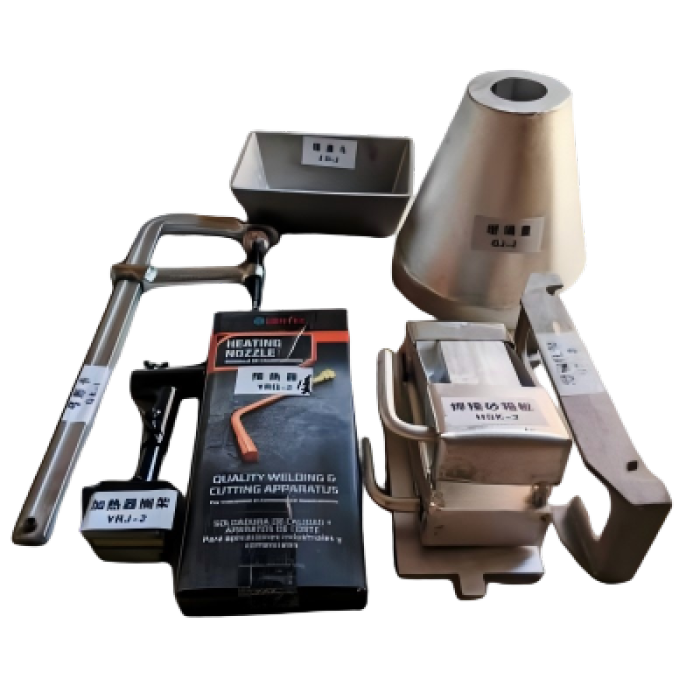
We professionally manufacture complete rail breakage repair equipment and related consumables, suitable for emergency repairs and routine maintenance of various rail systems. Our equipment saves time and effort, achieves satisfactory repair strength, and significantly reduces maintenance costs and safety risks.
For procurement, solution, and on-site technical consultation needs, please contactus:
We can provide product parameters, construction cases, and demonstration services. We welcome cooperation from all engineering and construction companies.